
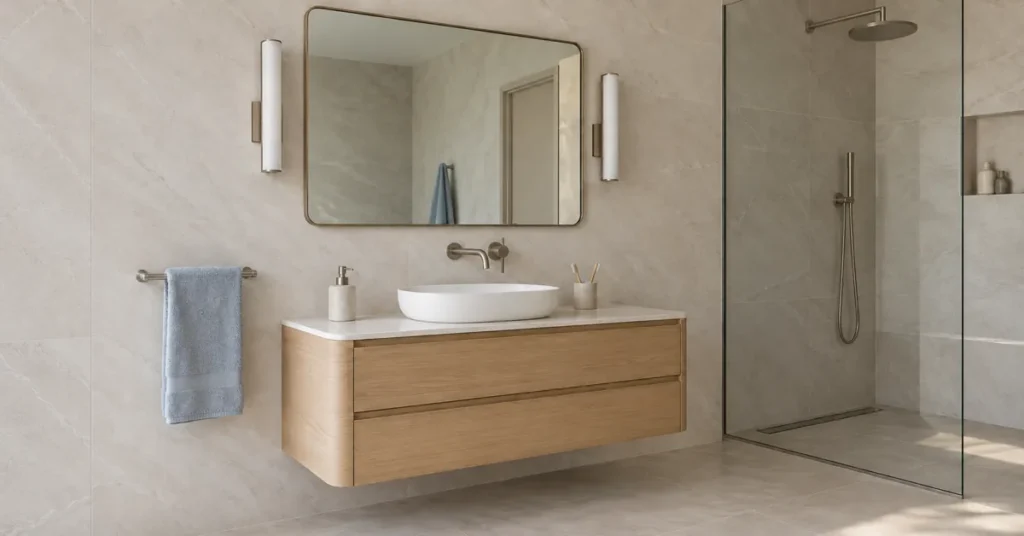
Picking a bathroom mirror that fits well is not just about style. If the proportions are off, the mirror can look too small for the vanity, crowd nearby lights or leave awkward gaps on the wall.
Start with the vanity width, then check the faucet, lighting, wall space and mirror shape. This guide explains how those measurements work together for single and double vanities.
Bathroom Mirror Size at a Glance
This table gives you a practical starting point for common vanity sizes. These are general planning guidelines, not fixed rules. Your faucet, lighting, wall width and mirror shape will affect the final choice.
| Vanity Width | Mirror Width Starting Point | What to Check |
| 24 in (61 cm) | Up to vanity width; allow for frames and fixtures | Compact space; check wall width and light position |
| 30 in (76 cm) | Up to vanity width; allow for frames and fixtures | Side sconces may require a narrower mirror |
| 36 in (91 cm) | Up to vanity width; allow for frames and fixtures | Frame thickness adds to visual width |
| 48 in (122 cm) | Up to vanity width; allow for frames and fixtures | One mirror or a mirror with side cabinets |
| 60 in (152 cm) | One wide mirror or two mirrors centred on the sinks | Double vanity; align mirrors over each sink |
| 72 in (183 cm) | One wide mirror or two mirrors centred on the sinks | Check weight, mounting and light clearance |
Should a Bathroom Mirror Be the Same Width as the Vanity?
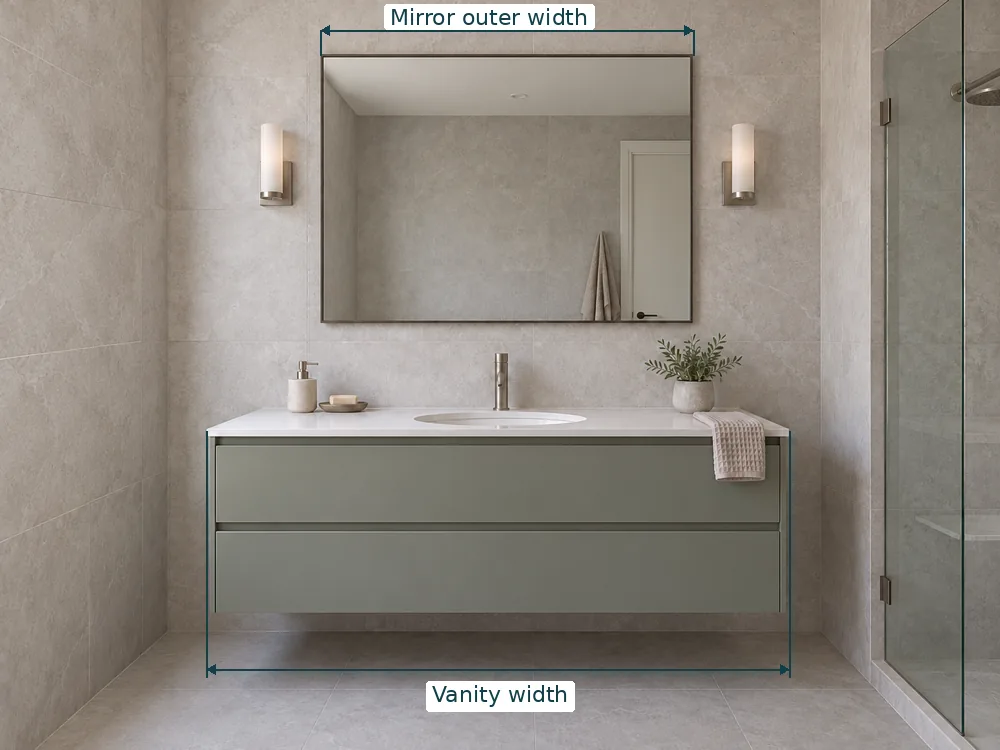
It can be. A mirror that matches the vanity width creates a clean, aligned look. However, a mirror slightly narrower than the vanity is also a common choice. It leaves a small visual margin on each side, which can make the arrangement feel more balanced.
Kohler recommends a mirror narrower than or equal to the vanity width as a starting point.
Going wider than the vanity is possible in some layouts, especially when the wall is wide and open. But it requires careful planning around lights, wall edges and adjacent cabinets. In most cases, treating the vanity width as a comfortable maximum keeps things proportional.
How Wide Should a Bathroom Mirror Be?
Start by measuring the vanity from edge to edge. That measurement is your upper boundary for mirror width in most situations.
Allow space for side sconces, shelves and cabinets. Check their actual dimensions and installation instructions before choosing the mirror width.
Frame thickness matters too. A mirror with a thick or ornate frame takes up more visual space than a frameless design at the same glass dimensions. If you are comparing options, check the total outer dimensions, not just the glass size.
Also check whether your sink is centred on the vanity. Off-centre sinks sometimes call for a mirror centred over the basin rather than over the full vanity width. If you are choosing the basin too, compare under-counter wash basin options before finalising the sink centreline and mirror position.
How Tall Should a Bathroom Mirror Be?
Height is more flexible than width. There is no single correct mirror height, because it depends on the people using the bathroom, the vanity height, the faucet and whatever light fixture sits above the mirror.
Check that everyone using the bathroom can see their face comfortably while standing normally. A taller mirror may accommodate different user heights better than simply mounting a small mirror higher.
Check the actual countertop height rather than assuming it is standard. Leave the clearance specified for your mirror and overhead light.
How Much Space Should Be Between the Vanity and Mirror?
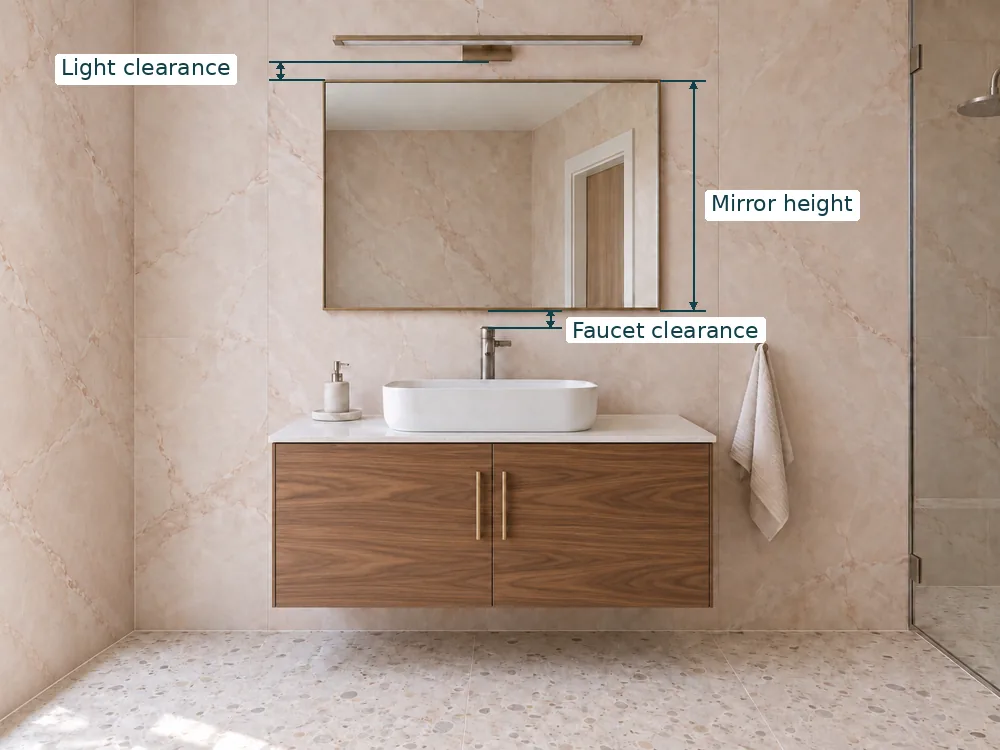
This depends on what you are measuring from. The countertop, the backsplash, the faucet and the mirror’s bottom edge are all different reference points, and sources use them inconsistently.
Measure from the highest part of the faucet and check the backsplash too. Kohler gives about 3 inches (7.6 cm) above the faucet and below overhead lights as a planning guide. Follow the instructions for your chosen mirror and fixtures; this is not a universal installation rule.
A tall backsplash may determine the lower edge instead. Check both obstructions rather than assuming that a gap measured from the countertop will clear the tap.
Bathroom Mirror Size for Common Vanity Widths
Mirror for a 24-Inch Vanity
A 24-inch (61 cm) vanity is common in powder rooms and compact bathrooms. A mirror up to 24 inches wide often works, but in tight spaces the available wall width and nearby fixtures may matter more than the vanity itself. A round mirror around 20 to 24 inches in diameter is a popular choice here, because it softens the look in a small room.
Mirror for a 30-Inch Vanity
A mirror between 24 and 30 inches (61 to 76 cm) wide suits most 30-inch vanities well. If you are adding side sconces, aim for the narrower end of that range to leave room for the lights.
Mirror for a 36-Inch Vanity
This is one of the most common single-vanity sizes. A mirror around 30 to 36 inches (76 to 91 cm) wide typically looks balanced. Going nearly full width gives a strong horizontal line; pulling back a few inches creates a softer proportion. Both approaches work depending on the frame and the rest of the wall.
Mirror for a 48-Inch Vanity
A 48-inch (122 cm) vanity can handle a substantial mirror. A single mirror of 36 to 48 inches (91 to 122 cm) is typical. At this width, check the mirror’s weight and make sure your wall can support the mounting.
Mirror for a 60- or 72-Inch Double Vanity
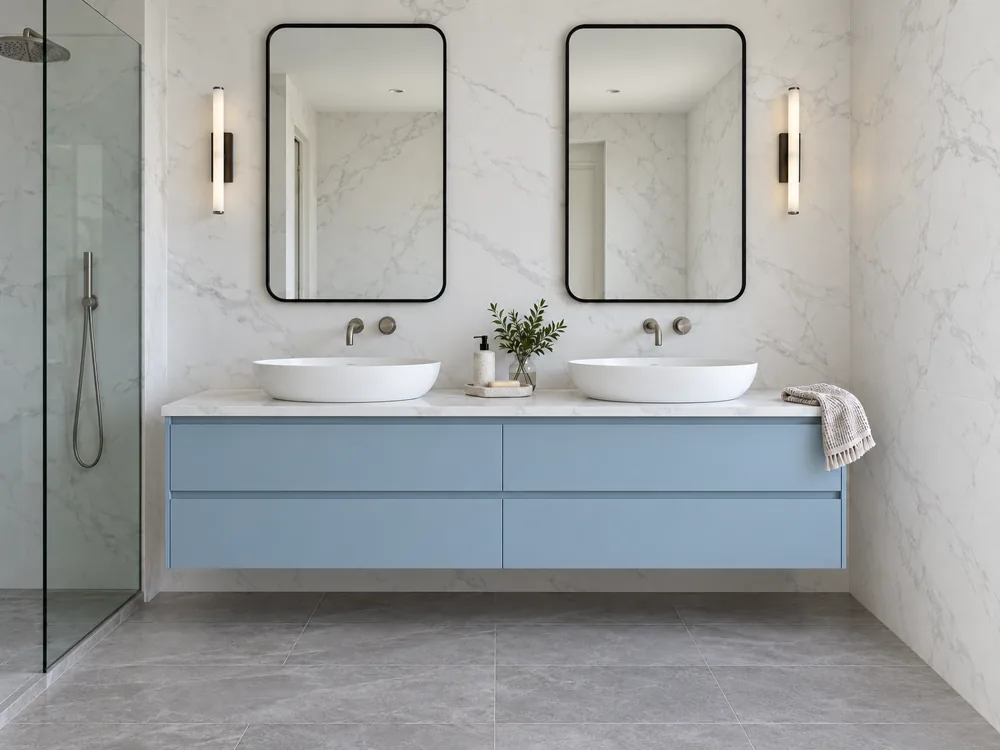
Double vanities offer two options: one large mirror spanning most of the vanity width, or two separate mirrors aligned over each sink. Both work well, and the choice comes down to your layout, lighting plan and preferred look. The next section covers this in more detail.
One Large Mirror or Two Mirrors for a Double Vanity?
One large mirror
A single wide mirror gives a continuous reflective surface that can make the wall feel more open. It creates a unified look and works especially well in contemporary bathrooms. The trade-offs are weight (large mirrors are heavier and harder to hang), and you will need to plan lighting carefully since side sconces are harder to place with a full-width mirror.
Two separate mirrors
Two mirrors, each centred over a sink, create clear symmetry and leave a gap in between for a sconce, shelf or simply open wall space. They are lighter individually and easier to replace. The main consideration is spacing: mirrors placed too far apart can look disconnected, while too close together can feel crowded. Align each mirror with its sink centreline and keep the gap consistent.
Neither option is universally better. Choose based on your lighting plan, wall proportions and how the vanity area is used.
Does Mirror Shape Change the Size You Should Choose?
Yes, because different shapes use their dimensions differently.
Round mirrors lose coverage toward the upper and lower edges compared with a rectangle of the same overall width and height. Check whether the mirror is wide enough at the height where you need to see your reflection.
Rectangular mirrors are the most efficient shape for maximising reflective area relative to their outer dimensions. They are a straightforward choice when coverage and proportion to the vanity are the priority.
A tall oval can provide more vertical coverage than a round mirror of the same width. Its curved sides provide less coverage near the top and bottom than a rectangle.
Arched mirrors add visual height and draw the eye upward, which can make the upper wall feel more open. The arch reduces reflective area near the top of the mirror compared to a rectangle of the same overall width and height.
What Size Mirror Works in a Small Bathroom?
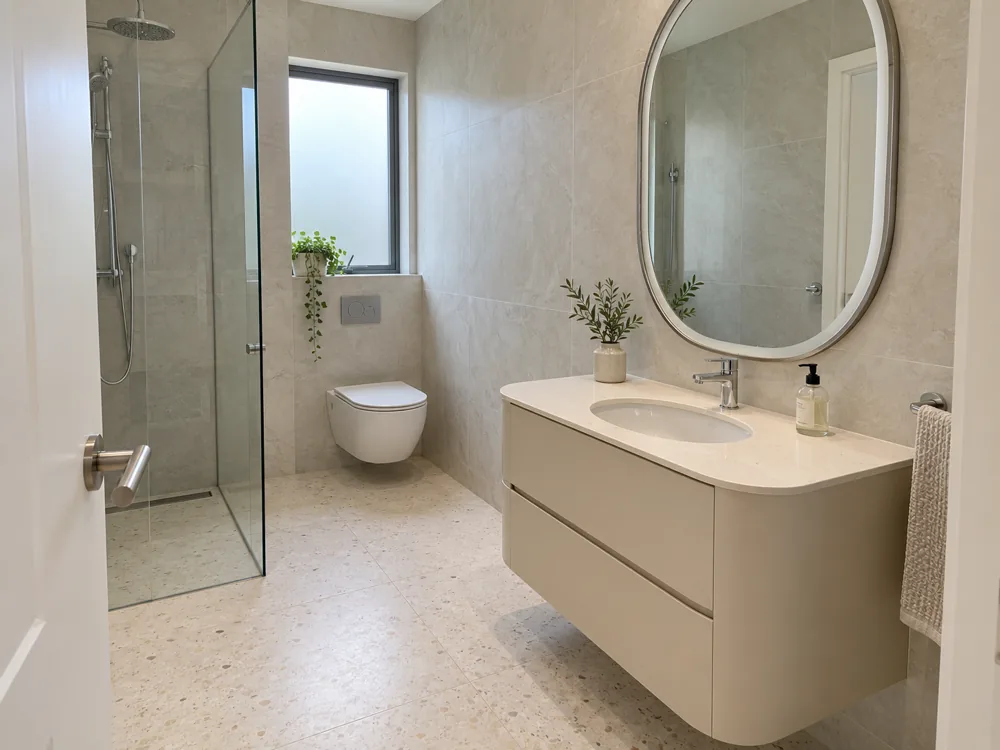
A small bathroom does not automatically mean a small mirror. A reasonably generous mirror can help reflect light around the room and make the wall feel less closed in. The vanity width and the available wall space still guide the decision.
Where space is tight, a frameless or slim-frame mirror tends to feel lighter and less dominant than a heavy framed option at the same size. Check for door swings, medicine cabinets and shelves that might conflict with the mirror edges. In very compact rooms, a tall, narrow mirror can be more practical than a wide one.
How Lighting Affects Bathroom Mirror Size
Side sconces need clear wall on either side of the mirror. If you plan to install sconces, the mirror needs to be narrow enough to leave room. A mirror that fills the full vanity width may not leave space for wall-mounted lights beside it.
An overhead light fixture above the mirror limits how tall the mirror can be. Leave enough clearance between the top edge of the mirror and the light so neither looks crowded. Check the light manufacturer’s spacing recommendation where available.
Integrated lighting may change the space needed for separate fittings. Our guide to mirrors with lights introduces the main styles. Check bathroom suitability, electrical requirements and installation instructions for the product you choose.
Bathroom Mirror Sizing Mistakes to Avoid
Buying before measuring. Check the vanity, wall, faucet and lighting before shopping.
Choosing by photo alone. Check the listed outer dimensions rather than judging scale from a styled photograph.
Ignoring faucet height. Check that the tap and backsplash do not obstruct the chosen mirror position.
Forgetting lighting clearance. Sconces and overhead lights need their own wall space. Plan both the mirror and the lighting together.
Choosing a frame that overwhelms the vanity. A thick or ornate frame can make a moderately sized mirror feel too large for a smaller vanity.
Following one percentage rule. Adjust proportions to your fixtures and available wall space.
Placing two mirrors too far apart or too close together. On a double vanity, align each mirror with its sink and keep the gap balanced.
Quick Bathroom Mirror Measuring Checklist
Before buying, measure:
- Vanity width (edge to edge)
- Wall width (from nearest obstruction on each side)
- Countertop and backsplash height
- Faucet height (to the tallest point)
- Available mirror height (from above the faucet to the light fixture or ceiling)
- Distance to overhead or side light fixtures
- Sink centreline(s)
- Nearby cabinets, shelves or towel bars
Then check the mirror’s:
- Overall dimensions (including frame)
- Weight and mounting method
- Fixing requirements for your wall type
- Manufacturer installation instructions
Frequently Asked Questions
Should a bathroom mirror be wider than the vanity?
In most cases, the vanity width works as a practical upper limit for mirror width. Going wider can work in some open layouts with plenty of wall space, but it requires careful planning around lighting and wall edges. Keeping the mirror at or slightly below vanity width is the safer starting point.
What size mirror should I use over a 36-inch vanity?
There is no single compulsory size. A mirror between about 30 and 36 inches (76 to 91 cm) wide is a common range. The right choice depends on your frame thickness, lighting arrangement and how much visual margin you prefer on each side.
How high should a bathroom mirror be?
Choose a height that gives the intended users a comfortable reflection and leaves the required space around the faucet, backsplash and lighting. There is no single mounting height for every bathroom.
Should a double vanity have one mirror or two?
Both options work well. One large mirror gives a continuous surface and a unified look. Two mirrors create symmetry and leave space between them for lighting or a shelf. Choose based on your lighting plan and the visual effect you prefer.
Does a round mirror need to be larger than a rectangular mirror?
Not necessarily. A circle has less area than a rectangle with the same overall width and height, but useful face-level coverage matters more than total area. Check the shape within your available wall width before choosing a larger size.


