
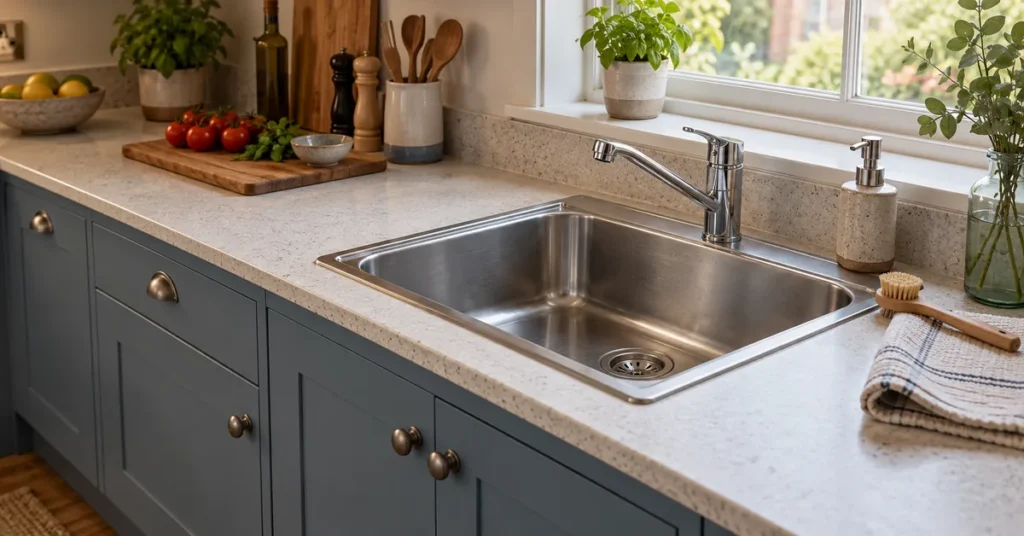
Sink listings often lead with a dimension such as 24, 30 or 33 inches. That number alone does not confirm cabinet fit, plumbing clearance or usable bowl space.
Use this guide to compare common sizes, measure your existing setup and shortlist a sink that suits your cookware and kitchen.
Kitchen Sink Sizes at a Glance
These common widths are starting points, not international standards. Check the exact model’s dimensions and minimum cabinet requirement.
| Sink Width | Metric Approx. | Typical Use | What to Check |
| 24–25 in | 61–63.5 cm | Small kitchens, secondary prep sinks, compact apartments | Cabinet interior width; single bowl usually more practical at this size |
| 27–30 in | 68.6–76.2 cm | Common mid-range choice for many household kitchens | Cabinet minimum width stated by manufacturer; countertop cutout dimensions |
| 33 in | 83.8 cm | Popular full-size option; suits single or double bowl configurations | Check model-specific minimum cabinet width, usable bowl dimensions and cutout. |
| 36 in+ | 91.4 cm+ | Large kitchens, frequent big-pot cooking, farmhouse/apron-front sinks | Cabinet and countertop must accommodate extra width; structural support for farmhouse styles |
What Do Kitchen Sink Measurements Actually Mean?
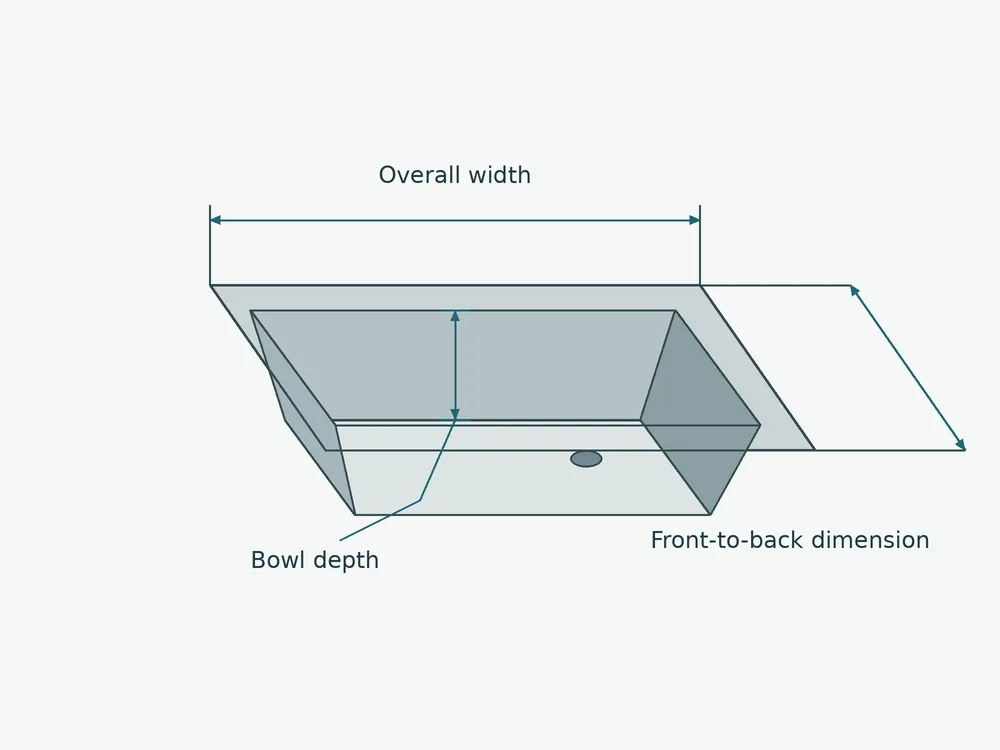
Sink listings use words like “length,” “width” and “depth” inconsistently. One brand’s “width” may be another brand’s “length.” Rather than trusting the product title alone, look for the manufacturer’s dimensional drawing, which labels every measurement clearly.
Side-to-Side Width
This is the measurement from the left edge of the sink to the right edge, including any rim or flange. It is the number most product titles advertise. A sink described as “33 inches” (83.8 cm) is usually about 33 inches across at its widest point, but confirm whether that includes the mounting lip.
Front-to-Back Dimension
Measured from the front rim (closest to you) to the back rim (against the wall). Most residential kitchen sinks fall somewhere around 18 to 22 inches (roughly 46 to 56 cm) front to back. This measurement affects how far the sink extends into your countertop and how much workspace remains behind or in front of the bowl.
If the sink sits below a window, also check tap clearance and where the window covering ends. Our curtain length guide includes shorter options for kitchen windows. Keep fabric clear of the tap and wet work area.
Bowl Depth
Depth is measured from the rim down to the bottom of the bowl inside the sink. Common bowl depths range from about 7 to 10 inches (18 to 25 cm). Deeper bowls hold more but take up under-sink storage space, while shallower bowls are easier to reach into.
How Cabinet Size Determines the Sink You Can Use
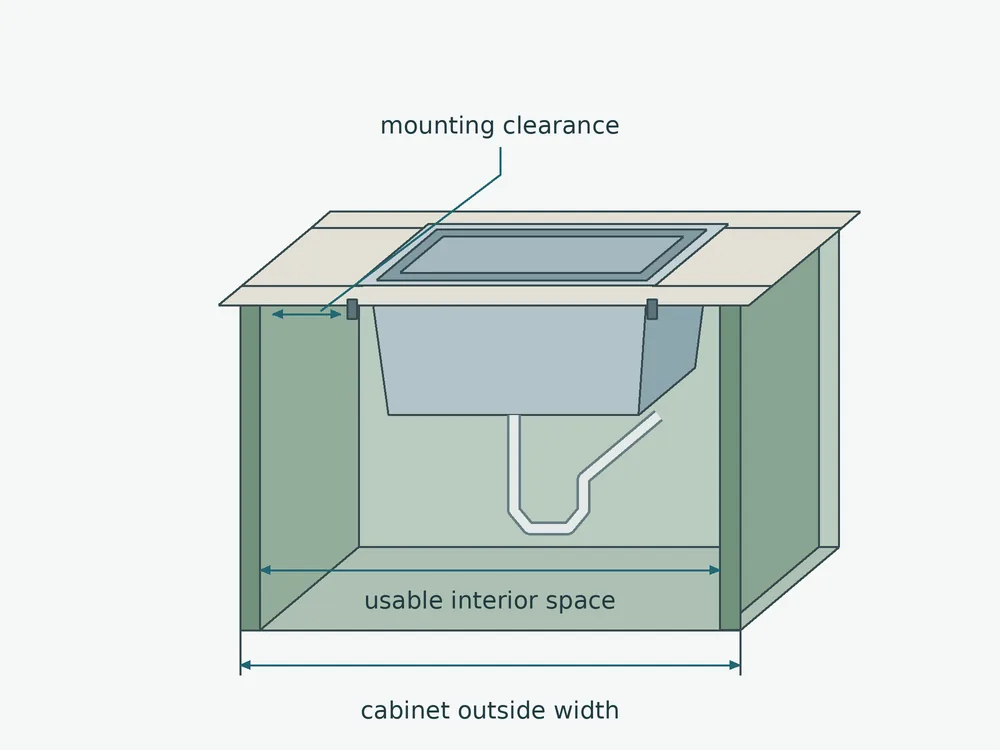
A 30-inch (76.2 cm) cabinet is measured externally. Side panels, the face frame, supports and mounting hardware can reduce usable space.
Do not subtract a fixed number from cabinet width to choose a sink. Cabinet construction and sink mounting details vary. Compare usable space with the model’s installation drawing.
Use the manufacturer’s stated minimum cabinet width. A model requiring a 33-inch cabinet should not be ordered for a 30-inch cabinet without explicit manufacturer approval.
Also check clearance for any garbage disposal, water filter or pull-out storage below. These items compete for the same space under the sink bowl.
How to Measure for a Kitchen Sink
Record the measurements below. Use consistent units and compare them with the replacement model’s specification.
For a replacement sink:
- Measure the current sink’s overall width (left edge to right edge).
- Measure the front-to-back dimension (front rim to back rim).
- Measure the inside bowl depth from the rim plane to the bowl floor near the drain, excluding the drain fitting.
- Check the existing cutout’s width, front-to-back size and corner shape. A drop-in rim hides its edges. Inspect from below if accessible, consult fabrication records, or ask a fitter to confirm it. Do not assume overall sink size equals cutout size.
- Open the cabinet and measure the interior width, depth and height. Note any plumbing pipes, bracing or hardware that restricts space.
- Record the mounting type. Changing between drop-in and undermount may require countertop changes; matching width alone does not establish compatibility.
Measure twice and compare the cutout shape, dimensions and mounting requirements before ordering.
Does Sink Type Change the Size You Need?
Drop-In (Top-Mount) Sink
A drop-in sink has a rim resting on the countertop around a smaller opening. The rim needs adequate supported overlap on every side. Check the supplied cutout template and mounting-clip clearance.
Undermount Sink
An undermount sink sits below the countertop. Check countertop suitability, mounting supports and the specified cutout or reveal. With this mounting style, countertop thickness also increases the reach from the worktop to the bowl floor.
Farmhouse (Apron-Front) Sink
A farmhouse sink has an exposed apron front. Check apron height, cabinet-front compatibility and the support requirements for the exact model. A specialist base cabinet or modification may be needed.
Single Bowl vs Double Bowl: Which Size Works Better?
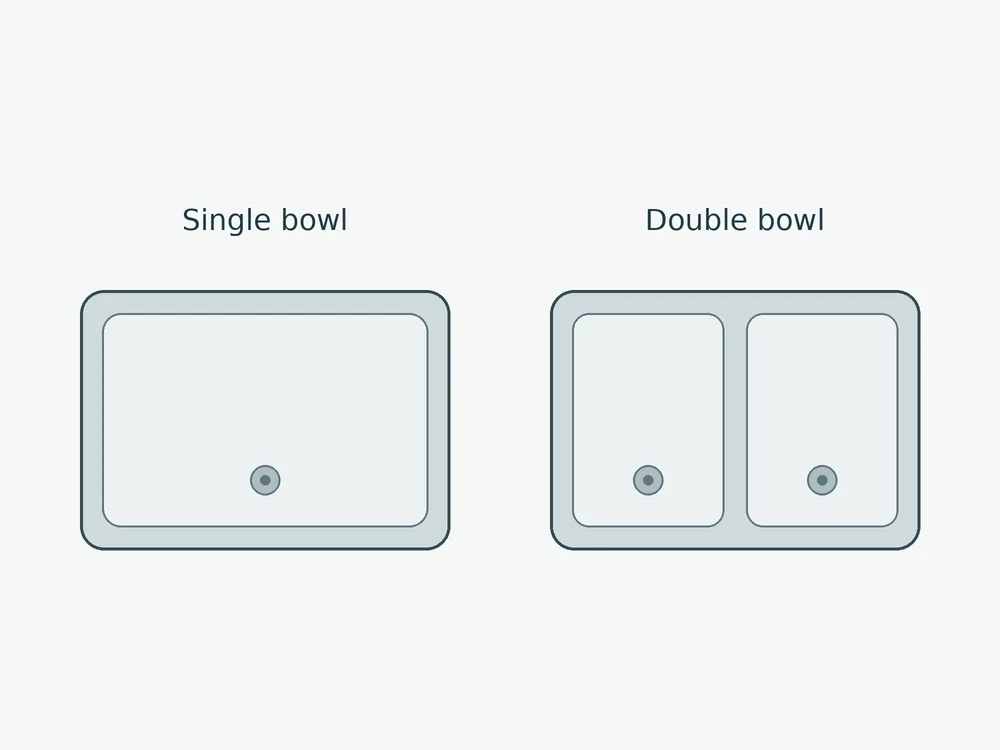
Neither is automatically better. The right choice depends on how you use your kitchen.
Before shortlisting, measure your largest frequently washed pot across its handles and check the length and width of a baking tray. Compare these with the internal bowl measurements, allowing room to turn and rinse the item. A sink can fit the cabinet while still being awkward for the cookware you use every day.
A single bowl offers uninterrupted washing space and can suit narrower installations. Compare its internal dimensions with your largest tray or pot; overall sink width does not describe the usable bowl.
A double bowl separates washing and rinsing tasks, but divides the available space. At a modest overall width, check that at least one bowl can hold your usual cookware comfortably.
Some sinks offer an unequal split, such as 60/40 or 70/30, giving a larger primary bowl while still providing a second compartment. If you are considering a double bowl, make sure the larger side can still hold your biggest cookware.
How Deep Should a Kitchen Sink Be?
Bowl depths commonly fall between 7 and 10 inches (about 18 to 25 cm), depending on the model.
Deeper bowls, around 9–10 inches (23–25 cm), offer more capacity and can help contain splashing. They take up more space below and may increase bending or reaching, depending on the user and countertop height.
Shallower bowls (7–8 in / 18–20 cm) are easier to reach into and leave more room underneath for a garbage disposal or cleaning supplies. They offer less capacity for soaking large items.
Before choosing, consider your countertop height, the size of your cookware, whether you have a garbage disposal and how much under-sink storage you need. A 10-inch-deep bowl is not automatically the best choice for every kitchen.
What Size Sink Works for a Small Kitchen?
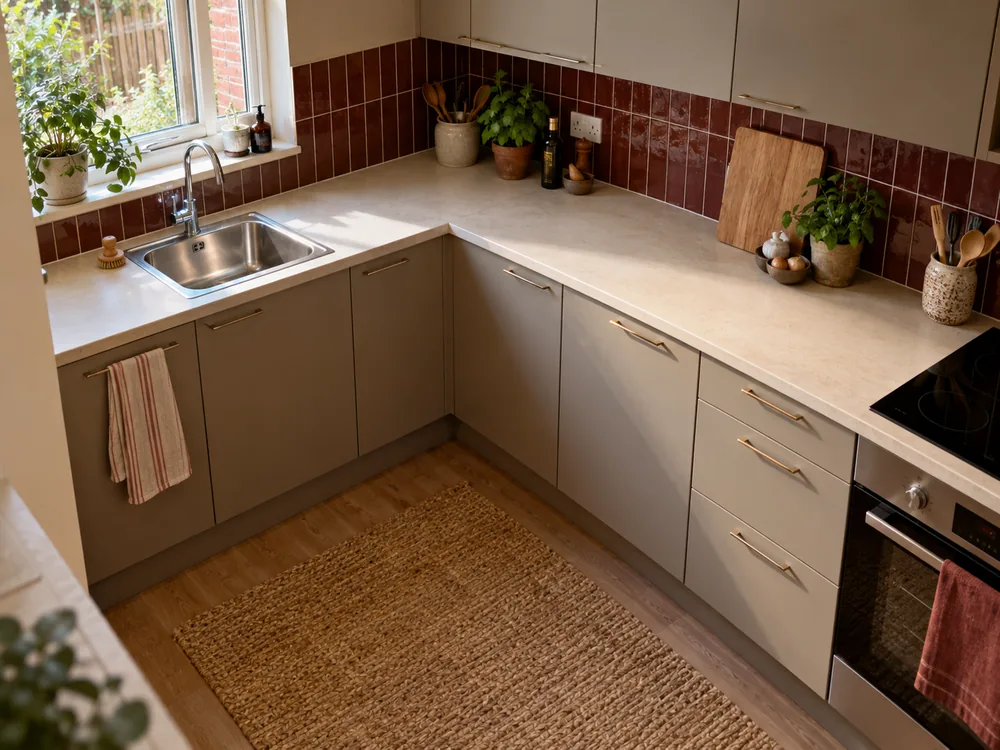
In a compact kitchen, preserve a useful preparation area rather than filling the available cabinet width with the largest possible sink.
A 24- or 25-inch (61–63.5 cm) single bowl may be worth shortlisting. Check the cabinet requirement, actual bowl dimensions and remaining counter space. A compact sink will not necessarily accommodate your largest cookware.
At a narrow width, a single bowl often provides more useful washing space than two small compartments. Check the internal dimensions against what you actually wash.
Allow for the dish rack and washing-up supplies as well as the sink. Our tips for keeping kitchen counters clear can help you protect the preparation space you have kept beside the bowl.
Choosing a Sink Size for Different Households
Household size alone does not determine sink size, but daily kitchen habits do. Here is a quick reference:
Compact kitchen: Shortlist smaller single bowls and preserve prep space. Check your largest cookware against the internal bowl dimensions.
Regular family kitchen: Compare 27–33 inch (68.6–83.8 cm) options if cabinet space permits. Washing habits matter more than headcount.
Large-pot cooking: Choose a bowl that accepts your largest pot or tray. Extra overall width helps only if it increases usable bowl space.
Heavy dishwasher use: A large sink is less critical. A mid-size single bowl for rinsing and occasional hand-washing may be enough.
Mostly hand-washing dishes: A wider sink with a double bowl or a large single bowl helps manage the workflow.
Kitchen Sink Size Mistakes to Avoid
Avoid these common mistakes:
- Buying by the product title without checking the full specification.
- Assuming a replacement will match an existing cutout or mounting type.
- Choosing extra depth without checking reach and clearance below.
- Dividing a narrow sink into bowls too small for your cookware.
- Ordering before comparing the installation drawing with your measurements.
Quick Decision Checklist Before You Buy
Before ordering your kitchen sink, confirm each of these:
☐ Cabinet nominal width and usable interior width
☐ Sink overall width, front-to-back dimension and bowl dimensions
☐ Bowl depth and whether it suits your comfort and under-sink space
☐ Manufacturer’s stated minimum cabinet width
☐ Countertop cutout size (and whether it matches your mounting type)
☐ Mounting type: drop-in, undermount or farmhouse
☐ Plumbing clearance and space for disposal or filtration
☐ Single bowl or double bowl based on your actual cooking and washing habits
☐ Comparison of your measurements with the manufacturer’s installation drawing
If a measurement or compatibility detail is unclear, confirm it with the manufacturer or a kitchen fitter before ordering.
Once your size is confirmed, you can explore style and construction options. If you are interested in handmade stainless-steel sinks and what makes them different from standard pressed models, our guide to handmade kitchen sinks covers what to look for.
Frequently Asked Questions
What is the standard kitchen sink size?
There is no single universal standard. Full-size residential kitchen sinks are most commonly around 30 to 33 inches (76.2 to 83.8 cm) wide, but sizes vary by manufacturer, region and model. Always check the manufacturer’s specification for exact dimensions.
What size kitchen sink fits a 30-inch cabinet?
There is no guaranteed sink width for a 30-inch (76.2 cm) cabinet. Choose a model whose stated minimum cabinet requirement is compatible, then verify the cutout and mounting clearances.
Is a 30-inch or 33-inch kitchen sink better?
Choose by cabinet compatibility, remaining counter space and internal bowl dimensions. A wider sink can offer more room, but a 33-inch label alone does not tell you the required cabinet size.
How deep should a kitchen sink be?
Common bowl depths range from 7 to 10 inches (18 to 25 cm). Deeper bowls suit large cookware; shallower bowls are easier to reach and leave more room under the sink. Your countertop height and under-sink storage needs should guide the choice.
How do I measure a kitchen sink for replacement?
Measure overall dimensions, internal bowl dimensions and depth, cabinet space and the countertop cutout. If the rim conceals the cutout, have it confirmed before ordering. Follow the measuring section above.
