
Carpet tiles have a perception problem. In most people’s minds, they belong in offices, classrooms, and commercial spaces — the hard-wearing, slightly dull, uniformly grey flooring of the workplace. The very idea of using carpet tiles in a living room seems like a compromise at best and a downright error at worst.
This perception is significantly out of date. The carpet tile market has changed considerably over the past decade. Domestic carpet options will be wider than people realize with regards to different designs, textures and colours in 2026. Besides, the functional benefits of carpet tiles for renters, pet owners, people with children or anyone who values flexibility are so strong that it is difficult not to be convinced. It is a matter of what you value the most that determines whether they will work well in a living room or not. This guide presents an unbiased view of both sides of the argument.
What Are Carpet Tiles?
Carpet tiles (also called modular carpet or carpet squares) essentially refer to carpet material cut into square or rectangular tiles, most commonly 50x50cm in size for the standard commercial specification, although domestic tiles are often available in a wider range of sizes including 30x30cm, 40x40cm, and 50x50cm. These tiles are installed on a floor one by one, either self-adhesively, with a special carpet tile adhesive, or with double-sided tape, instead of being stretched and secured at the edges as in the case of traditional broadloom carpet.
The key functional difference from traditional fitted carpet is individual tile replaceability. If a tile is stained, damaged, or heavily worn, it can be removed and replaced without any disturbance to other tiles. These single characteristic drives most of the practical case for carpet tiles in a home setting.
The Genuine Advantages of Carpet Tiles in a Living Room
- Individual tile replacement. A red wine spill on traditional carpet can mean replacing the entire carpet or living with a stain. Spilling the same amount of liquid on carpet tile would only require replacing one or two tiles, which is a small cost. In fact, households with children, pets, or a history of accidents may consider this as a huge practical
- DIY installation without specialist tools. Traditional broadloom carpet requires a professional fitter with stretching tools and a knee-kicker. Carpet tiles can be laid by most competent DIY enthusiasts with no specialist tools, cutting neatly with a sharp utility knife and a metal straight edge. A full living room can be tiled in a day.
- Easy adaptation to irregular room shapes. It is much easier to cut carpet tiles around doorframes, alcoves, hearths, fireplaces, and other obstacles because with loose carpet you have to do the cutting and fitting whereas with modular carpet tiles you can simply place the tiles without the wastage which is typical of large carpet
- Renter-friendly options. Carpet tiles installed with double-sided tape or peelable adhesive can be easily removed without damaging the base floor, which makes them an ideal choice for rental properties where permanent changes to the floor are not
- Pattern and design flexibility. Two or more carpet tile colours or textures can be combined to create checkerboard, herringbone, or striped patterns — creating a more interesting floor than any single-colour fitted carpet at the same price point.
- Subfloor access. Carpet tiles can be lifted and relaid to access subfloor pipes, cables, or underfloor heating connections without the destruction that lifting fitted carpet involves.
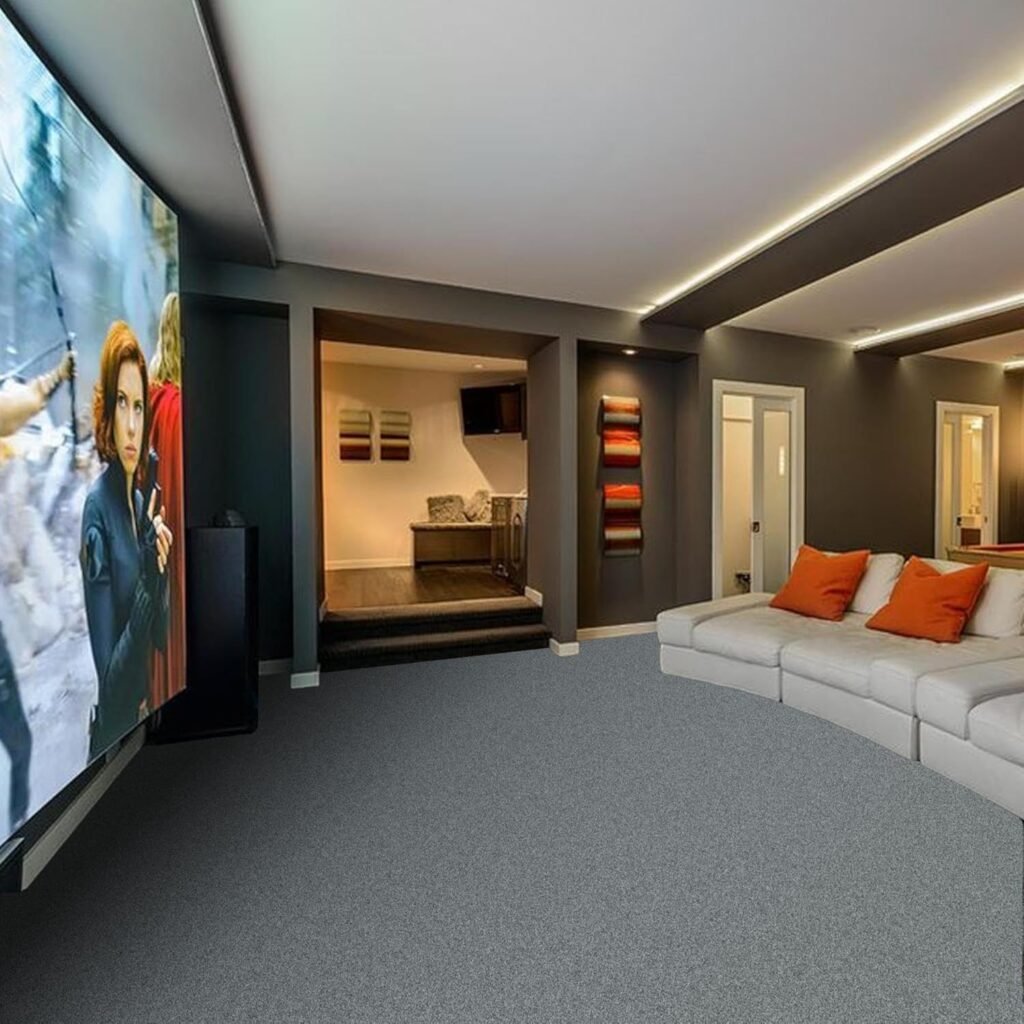
Self Adhesive Grey Carpet Tiles
The Honest Limitations
- Seams are visible. Even perfectly laid carpet tiles have visible seams between each tile. In most installations this is a minor aesthetic issue that disappears when furniture is in place and the room is in use, but in a room with raking light (sunlight at a low angle across the floor) or in a very minimally furnished space, the grid of seams can read as a commercial rather than residential quality.
- Pile direction variation. In looped or cut pile carpet tiles, slight variations in the direction each tile is laid can cause colour variation across the floor in certain light conditions. The standard professional solution is to lay all tiles with their pile in the same direction or to follow a consistent pattern of alternating pile direction — both of which minimize this effect.
- Weight and furniture indentation. Carpet tiles are not always as thick or as resilient as quality broadloom carpet. Heavy furniture placed on carpet tiles for extended periods can cause indentation that does not recover as well as in thicker fitted carpet. Using felt furniture pads reduces but does not eliminate this.
- Design premium for residential quality. The most commercially available carpet tiles are designed for heavy commercial use with a function-over-aesthetics approach. Genuinely attractive residential carpet tiles — in warm tones, interesting textures, or patternable colour ways — exist but typically at a higher price point than the commercial standard.
Carpet Tile Patterns — How to Make Them Look Designed
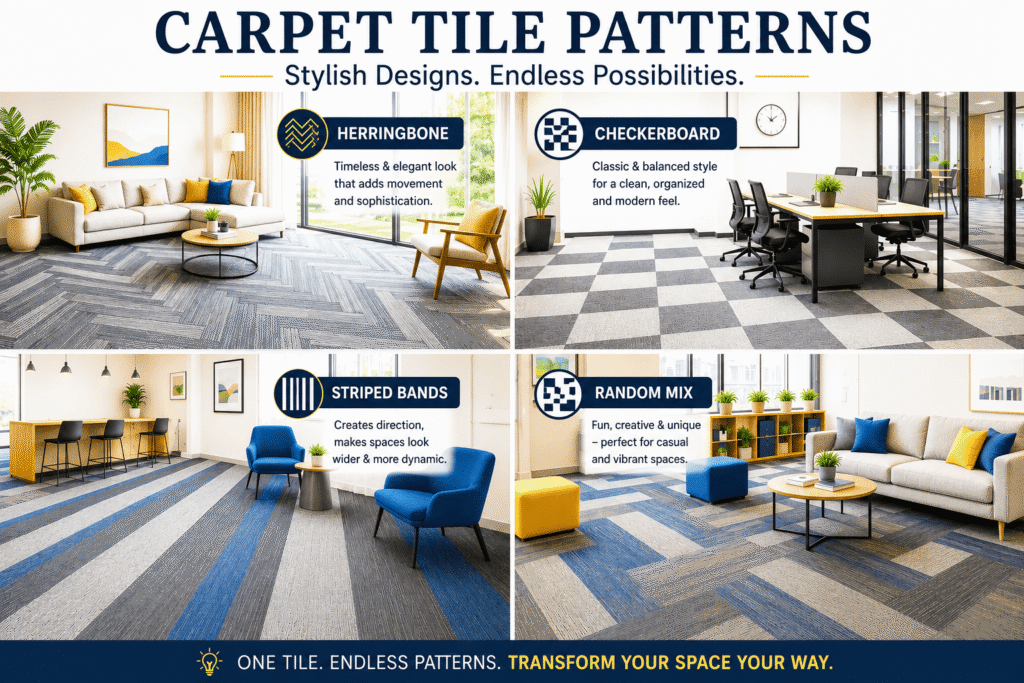
The most visually distinctive and most interior-design-aligned use of carpet tiles is pattern laying — combining two or more tile types in a deliberate geometric arrangement. The most effective patterns for a living room:
- Herringbone: Two complementary tones tiles laid in a herringbone (V-shaped) pattern, alternated the two colours. Produces an elegant directional pattern that seems more designed than any plain Works best with tones that are related but distinct — warm grey and warm beige, for example, or dark charcoal and medium grey.
- Checkerboard: Perhaps the easiest design is to alternate two different colored tiles in a straightforward grid. This will be most visually effective if the two colors have enough contrast to clearly see them as separate colors but are still close in tone so as not to appear very Classic checkerboard in black and off-white has a boldness that suits contemporary or retro-influenced living rooms.
- Striped bands: running tiles of a contrasting colour in stripes across the room — either with the stripe running parallel to the room’s length or at a diagonal — creates a directional floor that can visually widen or lengthen a room depending on stripe orientation.
- Random mix: using 3–4 closely related tones randomly laid creates a textured, variegated effect that disguises tile boundaries and looks more organic than any single-colour installation.
✦ PRO TIP: Before laying any carpet tile pattern in a living room, lay the full pattern out dry on the floor without any adhesive first. Step back and view it in the room’s light from all angles. Patterns that look balanced on paper can look very different in actual room conditions — a dry layout prevents the disappointment of a permanently laid pattern that does not work as intended.
Carpet Tiles vs Fitted Carpet — Direct Comparison
- Installation: carpet tiles — DIY-friendly, no specialist tools. Fitted carpet — professional installation usually required.
- Repair: carpet tiles — replace individual damaged tiles easily. Fitted carpet — difficult to repair without visible patching or full replacement.
- Underfloor access: carpet tiles — easily lifted and relaid. Fitted carpet — destructive to lift, difficult to refit.
- Appearance: fitted carpet — seamless, plush, residential quality. Carpet tiles — visible seams, slightly more commercial aesthetic in standard lay.
- Renter-friendly: carpet tiles with peel-off adhesive — yes. Fitted carpet — no.
- Cost (materials): carpet tiles — typically more expensive per square metre for residential quality. Fitted carpet — lower material cost at equivalent quality level.
- Cost (installation): carpet tiles — DIY saves fitting cost. Fitted carpet — professional fitting adds £3–6/m² to total cost.
Carpet Tiles vs Hard Flooring with a Rug
If your living room already has a hard floor (timber, LVT, laminate, tile), a large area rug laid over the hard floor can provide most of the warmth, comfort, and acoustic benefits of carpet but with more flexibility and a possibly higher-end aesthetic result. The rug can be changed seasonally, moved when needed, and removed entirely without any floor disruption.
One can argue that carpet tiles become a better choice over installing a hard floor in one or more of the following situations: when the condition of the hard floor below is so bad it needs completely covering rather than just warping, the budget is insufficient for a large quality rug, the home is with little children who spend a lot of time running around on the floor, or acoustic performance (carpet’s capacity to absorb sound) is a consideration.
How to Lay Carpet Tiles in a Living Room
- Step 1: Prepare the subfloor. Carpet tiles require a flat, clean, dry subfloor. Any high spots, loose boards, or damp must be addressed before laying. Sweep and vacuum thoroughly.
- Step 2: Find the centre of the room. Snap chalk lines from the midpoint of each pair of walls to find the room’s centre. This is your starting point — beginning from the centre ensures tiles are laid symmetrically.
- Step 3: Dry lay without adhesive. Starting from the centre, lay tiles outward toward all four walls without adhesive to check the pattern and ensure border tiles at the edges are at least half a tile width. Adjust the starting point if needed.
- Step 4: Fix the tiles. Apply double-sided carpet tape, peel-and-press adhesive tabs, or trowel-applied carpet adhesive according to the tile manufacturer’s recommendation. Press each tile firmly. Butt tiles tightly together.
- Step 5: Cut border tiles. Using a sharp utility knife and metal straight edge, cut tiles to fit at room edges, doorframes, and around obstacles. Multiple light scoring cuts produce cleaner edges than a single hard cut.
Final Thoughts
Carpet tiles are not the right choice for every living room, but the honest case for them in the right circumstances is stronger than their commercial reputation suggests. The individual replaceability, DIY installation, and renter-friendly installation options genuinely solve problems that traditional carpet cannot address.
For living rooms where flexibility, repairability, and renter-friendliness take precedence over seamless residential quality, a well-chosen carpet tile in a warm residential tone — or a considered two-tone herringbone pattern — is a completely valid and increasingly design-conscious flooring choice.
Frequently Asked Questions
Q: Are carpet tiles suitable for living rooms?
A: Yes, though with realistic expectations. The carpet tiles are a great option for the flooring being practical, versatile and also design-conscious that can fit very well living rooms in particular situations: such as rental flats where permanent alterations are not allowed, families with pets and children where replacing stains is the first concern, rooms with odd shapes or where the access to the subfloor is a need, and also whenever the DIY installation is preferred over a professional one. For those families who want to have the floor looking the most residential, without the seams being visible, a traditional fitted carpet or a good quality rug placed on the hard floor most often give a more elegant result.
Q: Can carpet tiles look good in a living room?
A: Yes — particularly when used creatively. A herringbone or checkerboard pattern in two complementary tones, or a neutral tile in a warm residential quality, can look genuinely attractive rather than commercial. The main thing is to opt for tiles that are marketed for residential use only (those with softer pile, warmer tones, and textures on a domestic scale) instead of standard commercial tiles, and to be careful when pattern laying and making pile directions consistent.
Q: How do I stop carpet tiles from moving in a living room?
A: The best technique is peel-and-press type adhesive or double-sided carpet tape sticking on the back of each tile, plus laying tiles one against the other during installation. Self-adhesive tiles are the easiest but their stick can wear off after a while in areas with heavy foot traffic or on certain types of subfloor. If you want a more lasting fitting in a living room, a specially made carpet tile adhesive spread on the subfloor will give you the best long-lasting grip.
Q: What is the best carpet tile colour for a living room?
A: Warm neutral colors like warm greys, warm beiges, oatmeal, taupe, and stone can be the best choice for a living room as they can be both the most versatile and the most flattering. Besides, they go nicely with basically any paint and furniture colors besides, they do not show dirt easily as extremely light or dark tiles do. Don’t go for the very cool greys (they look cold and a bit commercial in a home) or the extremely light cream or white tiles (they get dirty and marked very fast in a living room that has regular foot traffic).