Among the furnishing choices for a living room, choosing the right rug size is the top mistake made by many people. Most importantly, it can change the look and the feel of the room drastically. A rug of a wrong size can even ruin the beauty of a well-arranged room. A properly sized rug can unify the furniture, set the boundary of the area, and most importantly, create a vibe of a well-thought-out and complete room which the mere pieces of furniture, separately, can hardly do.
Fortunately, rug sizing is one of the things most people get wrong but it is actually just a few simple rules that anyone can learn. This article explains the main point, gives you concrete size suggestions for all the typical rooms and furniture arrangements, and even goes over the measuring technique so that you can purchase the right rug with certainty from the very first time.
The Core Rule: Furniture Should Touch the Rug
The single rule that resolves almost every rug sizing question is this: the front legs of every major piece of seating furniture in your arrangement should rest on the rug. This does not mean the entire piece of furniture needs to sit on the rug — just the front legs, with the back legs allowed to sit off the rug on the bare floor if necessary.
This rule exists because of how the eye reads spatial relationships. A rug that floats independently in the centre of a seating arrangement — touching no furniture at all — reads as a separate object placed in the room rather than as the foundation that defines and unifies the seating area. The moment furniture makes contact with the rug, the rug and the furniture group become visually integrated, and the room reads as considered and complete.
There are three recognised approaches to applying this rule, in order of how integrated and finished they appear:
- All four legs on the rug: each piece of seating furniture has its entire legs placed on the rug. This is the richest and most cohesive look and needs the biggest rug, but it can be done in most living rooms with the suitable
- Front legs only: the front legs of sofas and chairs rest on the rug while the back legs sit on the floor behind. This is the most common and most practical approach for moderate to small living rooms — it achieves the unifying effect with a smaller, more affordable rug.
- Floating with no contact (avoid): the rug sits entirely under the coffee table with no furniture touching it at all. This is the configuration to avoid — it creates the disconnected, undersized look that makes rooms feel smaller and less finished.
✦ PRO TIP: If you are choosing between two rug sizes and unsure which to pick, always choose the larger one. An undersized rug is one of the most visually damaging mistakes in living room design, while a slightly oversized rug — even one that runs close to the walls — rarely looks wrong. When in doubt, size up.
Rug Size Chart by Room Size
These size recommendations assume a standard living room layout with a sofa and one or two chairs arranged around a central coffee table, matching your rug to your furniture arrangement.
- Small living room (up to 3.5 x 4 metres / 11 x 13 feet): minimum rug size 160 x 230cm (5’3″ x 7’7″), ideally 170 x 240cm. This achieves the front-legs-on-rug standard for a compact two-seater sofa with one accent chair.
- Medium living room (4 x 5 metres / 13 x 16 feet): rug size 200 x 290cm (6’7″ x 9’6″), commonly sold as an 8×10 foot rug in the US market. This is the most popular rug size for standard living rooms and accommodates a three-seater sofa with two chairs comfortably.
- Large living room (5 x 6 metres / 16 x 20 feet or larger): rug size 275 x 365cm (9 x 12 feet) or larger. This size achieves the all-four-legs-on-rug standard even for a generously sized sectional or a sofa plus two armchairs.
- Open-plan living and dining combined: for open-plan spaces, the rug in the living room should fit the living area only (using the above method of determining a rug size based on the size of the seating arrangement) rather than the total floor area combined. A separate, smaller rug under the dining table marks that zone independently.
Rug Size by Sofa Configuration
Two-seater sofa only
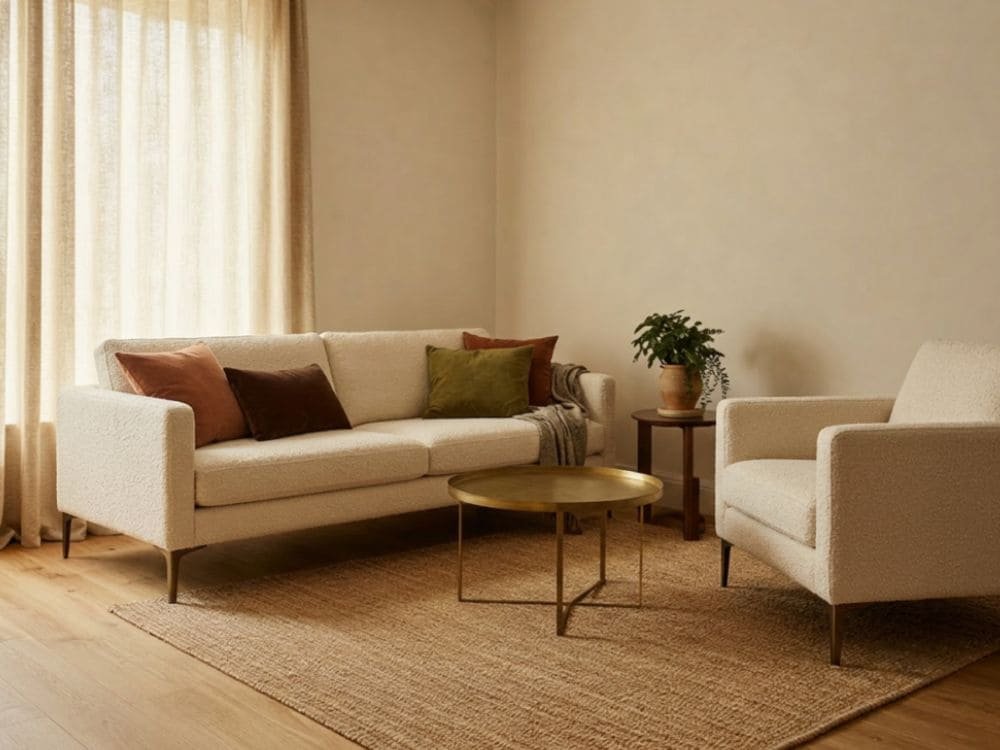
For one two-seater or a loveseat sofa only without any other seating, a rug around 160 x 230cm top size is the minimum that will have the sofa’s front legs on it. If a coffee table and a single accent chair come with the sofa, then the same size is usually the one that works well as long as the chair is placed close enough to the sofa ensemble.
Three-seater sofa with one or two chairs
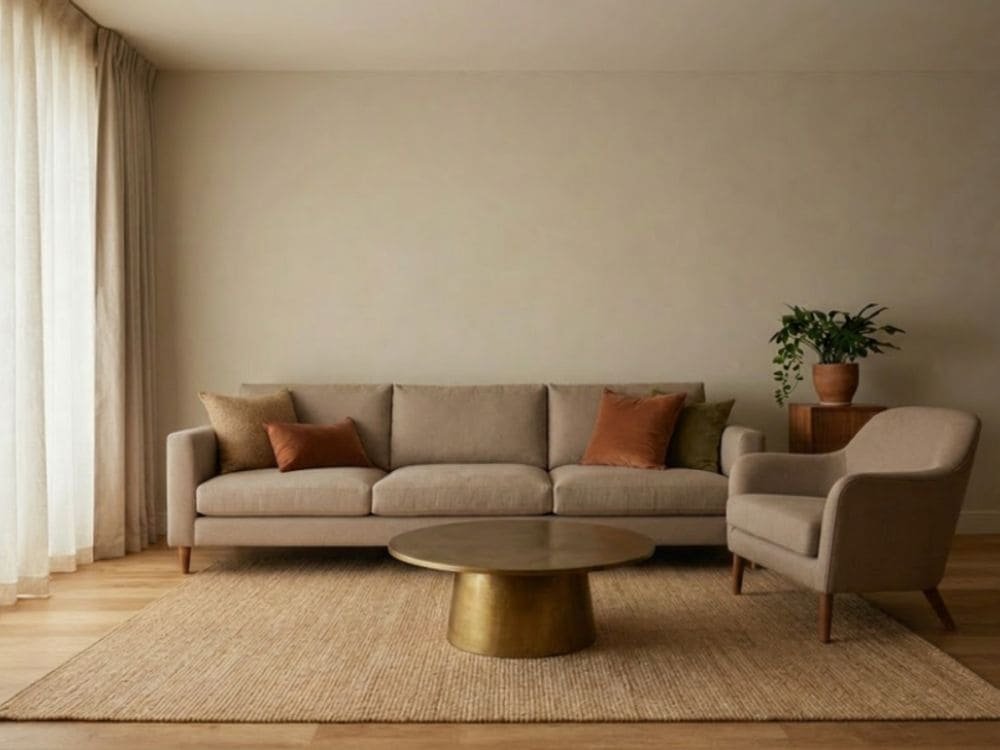
The typical living room setup easily fits a rug in the dimensions of 200 x 290cm (which is about 8×10 feet). It will be big enough to allow the main sofa to rest its front legs on the rug while comfortably covering the front legs of one or two accent chairs that are placed at right angles to the sofa.
L-shaped or sectional sofa
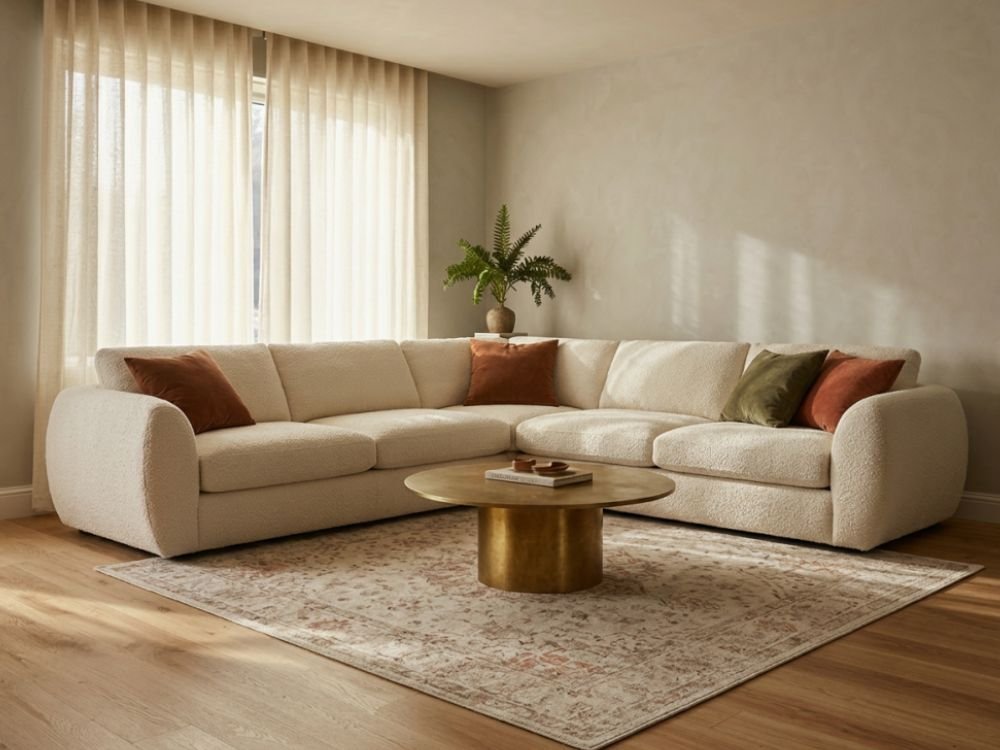
Sectional sofas require the largest rugs because of their combined footprint. A rug of at least 275 x 365cm (9×12 feet) is typically needed to achieve front-legs contact across the full width and depth of an L-shaped sectional. For very large sectionals, custom or extra-large rugs (10×14 feet or larger) may be required.
The most important measurement of a sectional is the overall total footprint width and depth of the seating area, along with the chaise or extended part. Take measurements of this footprint prior to deciding a rug size, because sectional sizes differ drastically from one model to another.
Two facing sofas or a conversation grouping
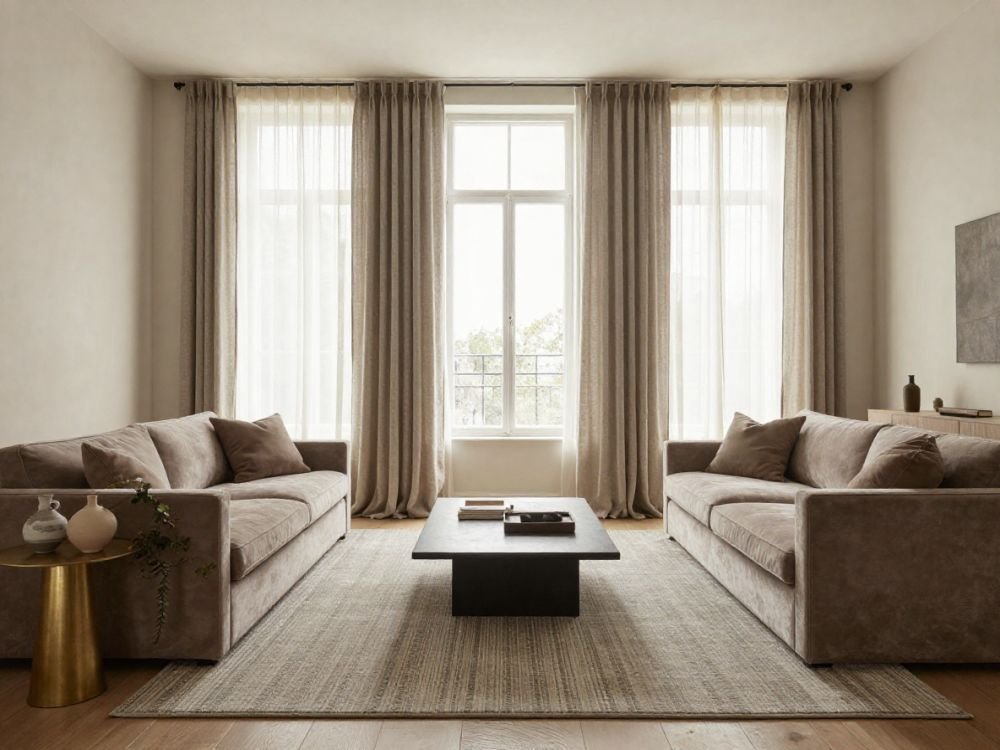
For a facing arrangement of two sofas or a sofa facing two chairs, the rug needs to extend under both sides of the seating arrangement, including the central coffee table. This typically requires 230 x 330cm or larger, depending on the total length of the facing arrangement.
How to Measure Your Room for a Rug
One of the biggest mistakes people make when buying rugs is just estimating the size rather than taking a proper measurement, and accurate measuring can help avoid this. Follow this process before ordering any rug:
- Step 1: Decide on your furniture arrangement first (or measure your existing arrangement if furniture is already placed). The rug size depends entirely on the furniture footprint, not on the room’s total dimensions.
- Step 2: Measure the total width of your seating arrangement — from the outer edge of the furthest piece on one side to the outer edge of the furthest piece on the other side.
- Step 3: Measure the total depth — from the front edge of the coffee table (or the front line where rug coverage should begin) to a point behind the sofa where the rug should end, typically allowing the rug to extend slightly behind the sofa’s front legs.
- Step 4: Add the standard buffer — for the front-legs-on-rug approach, the rug should extend at least 15 to 20cm beyond the outer edge of each piece of furniture on every side.
- Step 5: Use painter’s tape or string to mark out the proposed rug dimensions directly on your floor. Live with this marked area for a day or two before ordering — it is the single most reliable way to confirm a size will work before committing to the purchase.
Rug Shape — Matching Shape to Room and Furniture
Rectangular Rugs
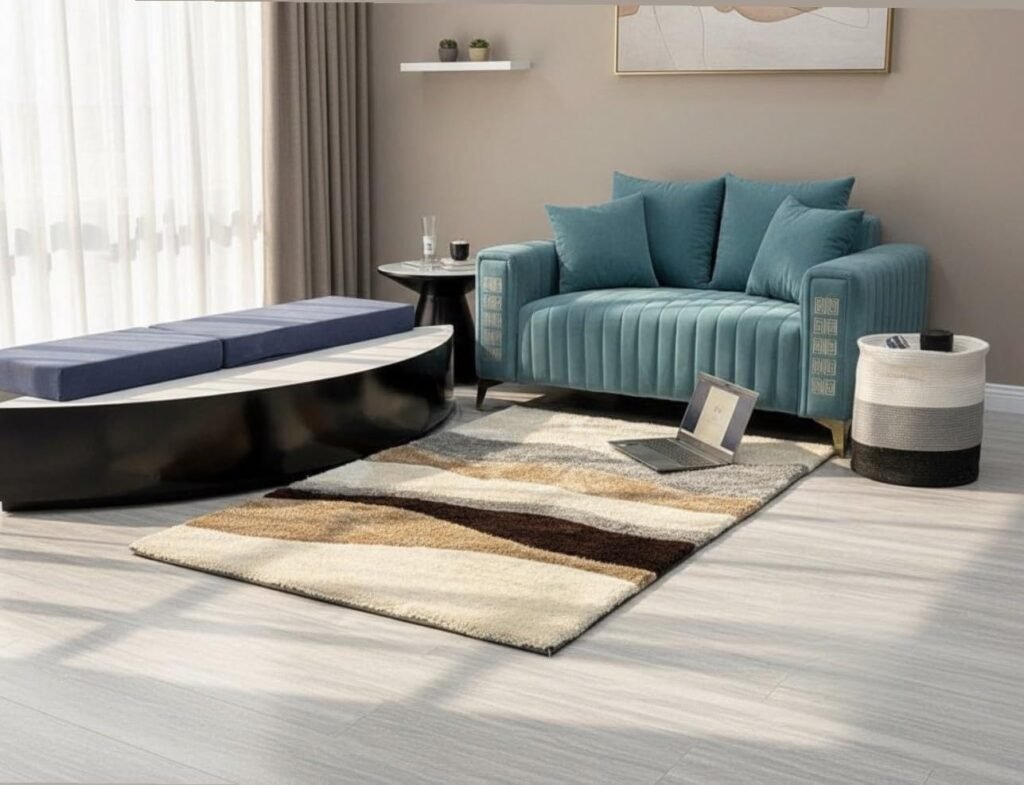
Rectangle Rugs For Living Room
Rectangular rugs are by far the most versatile and common shapes, able to fit almost all kinds of living room layouts. In fact, they can complement the rectangular and L-shaped furniture arrangements very well, besides having a natural alignment with the usual dimensions of a living room.
Round Rugs
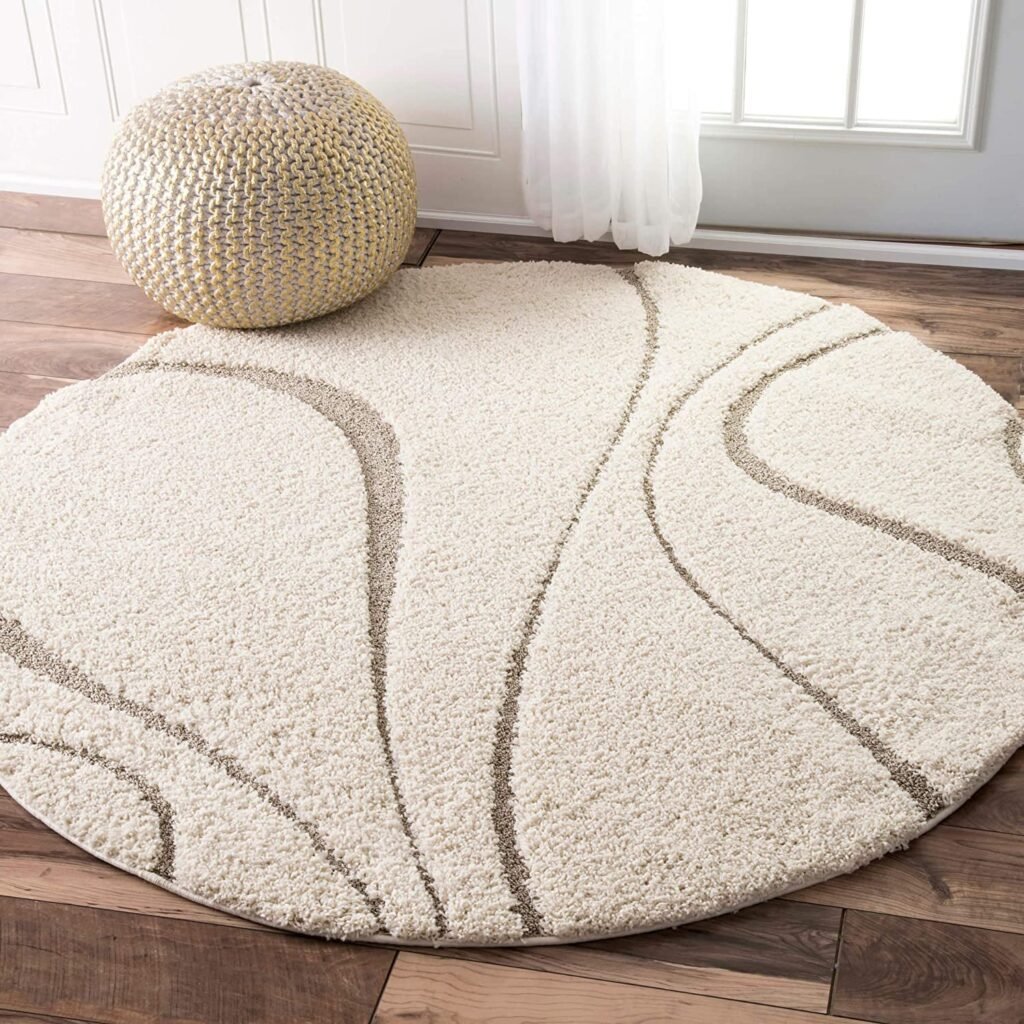
Round rugs work well in rooms with round or organic-shaped coffee tables, in conversation groupings arranged in a circular or near-circular pattern, and as a softening element in rooms with predominantly rectangular and angular furniture. A round rug under a round coffee table, surrounded by furniture, creates a particularly harmonious geometric relationship.
Square Rugs
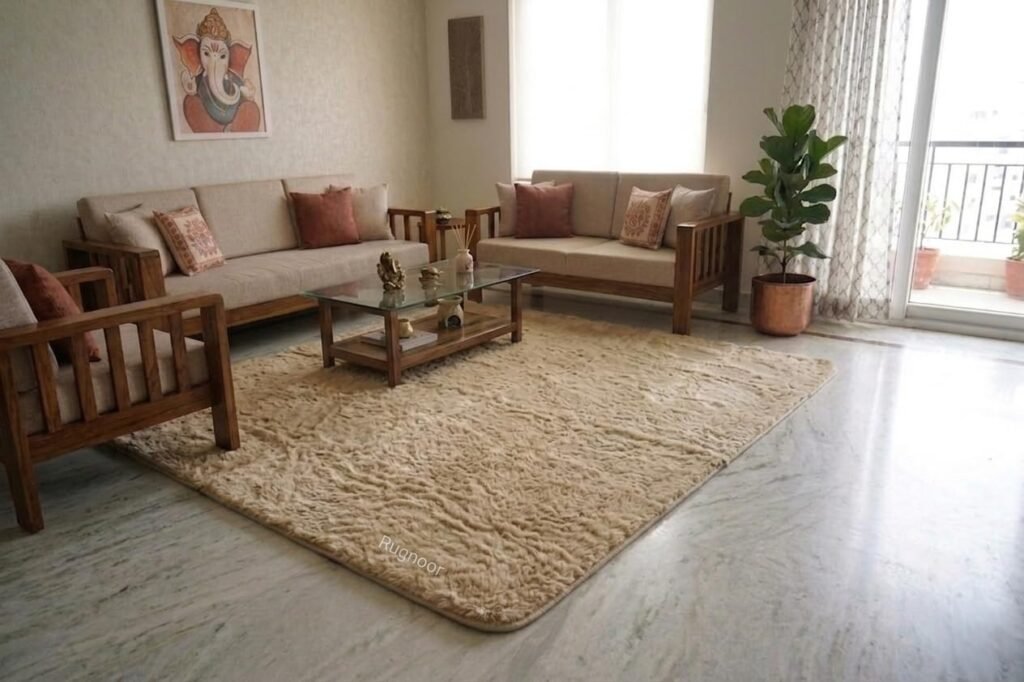
Square rugs suit square rooms and square furniture arrangements, though they are the least commonly available shape and often require seeking out specialist suppliers for larger sizes.
Rug Material — Matching Material to Room Use
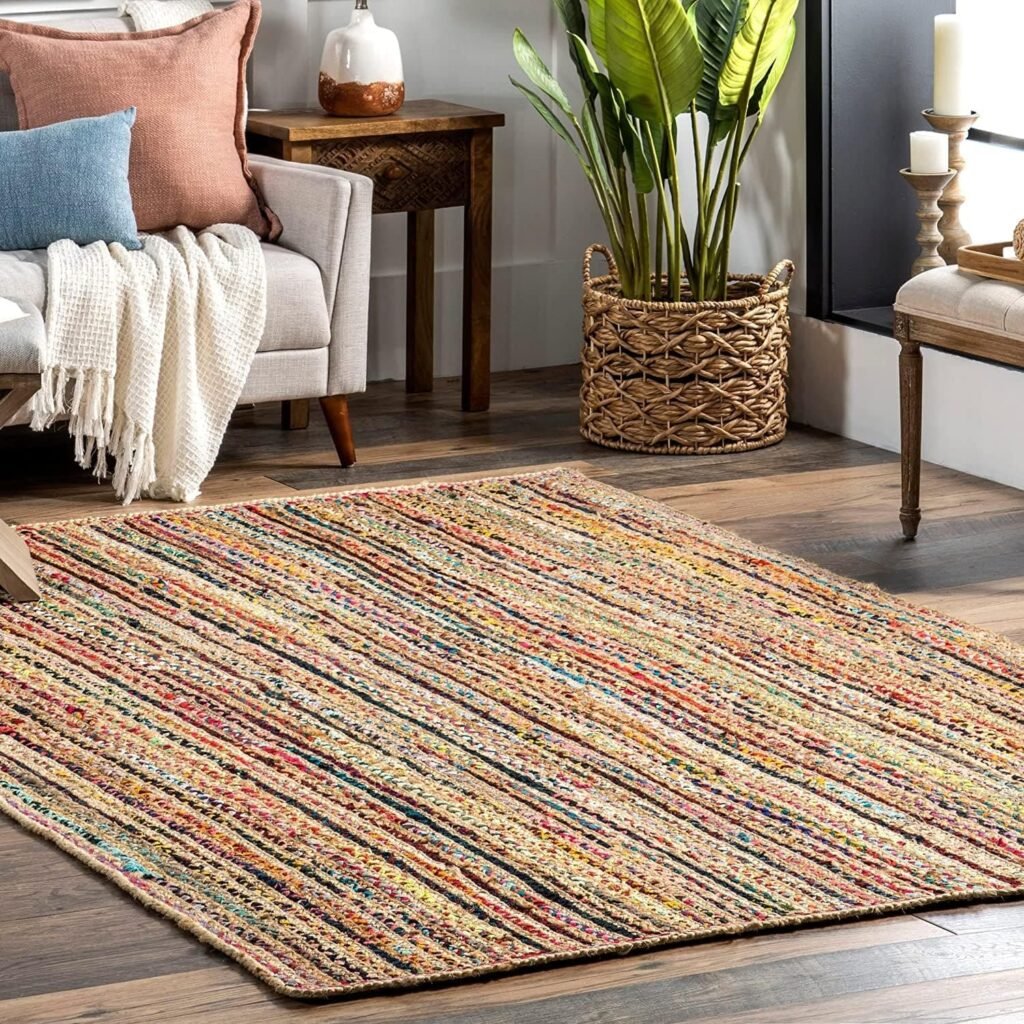
The material of the rug affects both its visual character and its practical performance, particularly important in living rooms which see heavy daily use.
- Wool: the most durable and most luxurious natural fibre option. Wool rugs feel warm to the touch, have a natural resistance to stains and develop a beautiful patina with years of use. In fact, a good wool rug is a perfect choice as a main living room rug in a home without small children or pets that are requiring frequent and heavy
- Jute and sisal: Natural plant fibers with their unique woven textures are perfect for use as the innermost rugs in layered arrangements or as the only rug in interiors decorated mainly with natural materials like jute rugs for the boho aesthetic (boho, farmhouse, coastal). Less soft underfoot than wool but highly durable and a strong visual texture.
- Cotton: lighter weight, more affordable, and machine washable in smaller sizes — making cotton rugs practical for households with children or pets, though less durable over the long term than wool.
- Synthetic (polypropylene, polyester): the most affordable and most stain-resistant option, widely used for outdoor or high-traffic indoor rugs. Visual quality has improved significantly and good synthetic rugs can be difficult to distinguish from natural fibre at a glance.
Layering Rugs — A Designer Technique for Any Budget
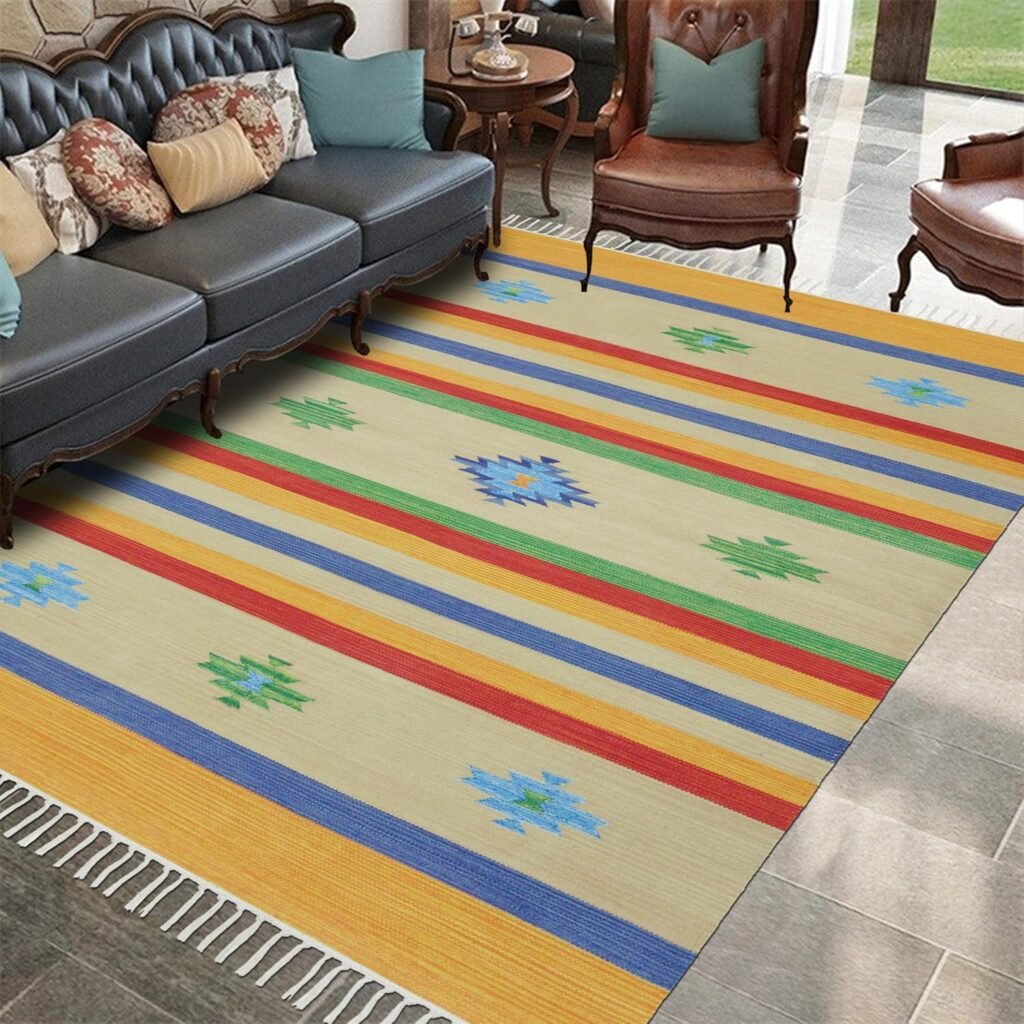
Kilim Style Accent Rug Living Room
Layering a smaller, more decorative rug over a larger, more neutral base rug is a technique used extensively by interior designers and is one of the most effective ways to add texture, introduce pattern, and define a seating area with more visual interest than a single rug alone provides.
The typical layering approach uses a large jute, sisal, or plain wool rug as the base — sized according to the furniture arrangement rules above — with a smaller, more patterned rug (kilim, Persian-style, block print, or geometric) layered on top, usually positioned slightly off-centre or at a gentle angle for a more organic, collected look.
Layering has a practical financial benefit as well as an aesthetic one: a smaller patterned rug is significantly less expensive than a large rug of the same quality and pattern complexity, making the layered approach an effective way to introduce a higher-end decorative rug into the room without the cost of sizing it to cover the full furniture arrangement.
- Base rug size: follow the standard sizing rules above based on your furniture arrangement
- Top rug size: typically 60-70% of the base rug’s dimensions, positioned to leave an even or slightly irregular border of the base rug visible around its edges
Common Rug Sizing Mistakes
- Buying a rug sized to the room rather than the furniture. The room’s total floor area is irrelevant to rug sizing — what matters is the furniture arrangement’s footprint. A small rug in a large room and a large rug in a small room can both be correct, depending on the furniture configuration.
- Centring the rug on the room rather than the seating area. The rug placement should be based on the furniture arrangement instead of the architectural centre of the room. In case of rooms where the seating is off-centre (usually in irregular or open-plan rooms), the rug placement should follow the furniture and not the
- Choosing a rug that only fits under the coffee table. This is the single most common and most damaging sizing error. A rug must extend to touch the seating furniture, not just anchor the coffee table.
- Ignoring the walkway. While the rug should be generously sized, leave at least 30 to 45cm of bare floor between the rug’s edge and the wall on circulation routes, to avoid an overwhelming wall-to-wall rug appearance unless that specific look is intentionally desired.
- Choosing material without considering use. A delicate wool rug in a high-traffic family room with young children and pets, or a hard-to-clean light-coloured synthetic rug in any household, are both mismatches between material choice and practical use that lead to early replacement.
Final Thoughts
Rug sizing is one of those decisions where a small amount of correct knowledge produces a dramatically better outcome than guesswork. The core rule — furniture legs should touch the rug — resolves the vast majority of sizing questions, and the size chart in this guide provides a reliable starting point for almost any living room configuration.
It is a worthwhile investment to get the size right even if that means a bigger, more expensive rug than initially planned. An undersized rug is probably the most noticeable and often repeated error in home decorating, and it negates the impact of every other carefully selected element in the room. On the other hand, a properly sized rug can do what no other single piece of decor is able to: it gives a furniture arrangement a complete, intentional, and truly finished appearance.
Before ordering, always measure your specific furniture arrangement, mark out the proposed rug size with tape on your actual floor, and live with that marked area for a day before committing. This simple step prevents the vast majority of rug sizing regrets.
Frequently Asked Questions
Q: What is the standard rug size for a living room?
A: The most popular and flexible size for a living room rug is 8×10 feet (about 200×290 cm). It is perfect for a standard three-seater sofa with one or two accent chairs in a medium-sized living room. 5×7 feet (160 x 230 cm) is considered the standard minimum for smaller living rooms. Bigger living rooms with sectional sofas or large seating arrangements generally require 9×12 feet (275 x 365 cm) or even bigger sizes. The right size always depends on your exact furniture layout rather than one universal standard.
Q: Should all furniture legs be on the rug?
A: Not necessarily. The most important rule is that the front legs of all seating furniture rest on the rug — this is sufficient to create a unified, well-anchored look. Making sure that all four legs of every piece on the carpet are placed (thus necessitating a bigger carpet) is considered the most luxurious, fully integrated look and is the preferred method in big rooms or projects with large budgets. However, placing only the front legs is a totally acceptable and very common standard that will be fine with moderate and smaller living rooms.
Q: How much space should be between the rug and the wall?
A: Typically in living rooms when you leave 30 to 45cm (roughly 12 to 18 inches) of exposed floor around the rug’s perimeter, it results in a neat and deliberate appearance. This space allowance can be adjusted – in compact rooms, a smaller space of 20 to 25cm around the rug is permissible if a larger, more impactful rug is desired. On the other hand, in very spacious rooms, a large margin of 60cm might look nice too. What definitely has to be avoided is a lopsided or accidental margin where the rug is much closer to one wall than to the other one.
Q: What size rug do I need for a sectional sofa?
A: Most sectional sofas need a rug of at least 9×12 feet (275 x 365cm) to properly cover the front legs of the sectional all over its footprint, even including the chaise or any extension. First, measure the overall width and depth of your particular sectional before picking a rug size, as the dimensions of sectionals can differ quite a lot – for example, some smaller sectionals might be okay with an 8×10 foot rug, whereas larger modular sectionals could require a custom, even bigger size.
Q: Can a rug be too big for a living room?
A: It is rare for a rug to be genuinely too large for a living room, provided a reasonable margin (even as little as 15-20cm) is maintained between the rug edge and the walls. A wall-to-wall rug with no margin at all can look like a fitted carpet rather than an area rug, which is the only scenario commonly described as ‘too big.’ In almost every other case, a generously sized rug looks more intentional and more luxurious than an undersized one — when genuinely unsure which size to choose, the larger option is almost always the safer choice.
Q: Should the rug match the curtains or other textiles in the room?
A: The rug isn’t required to exactly match the curtains or other textiles, in fact, in most well-designed rooms it shouldn’t. The best method is to find a rug that enhances the whole colour scheme and tonal range of the room, rather than being an exact match to any one element. neutral rug (made of jute, wool in a natural tone, or having a subtle pattern) will coordinate easily with any curtain colour. If the rug is patterned or coloured, it should have a colour that is already found in the room’s cushions, curtains, or artwork so that it doesn’t appear as the introduction of an entirely new colour.