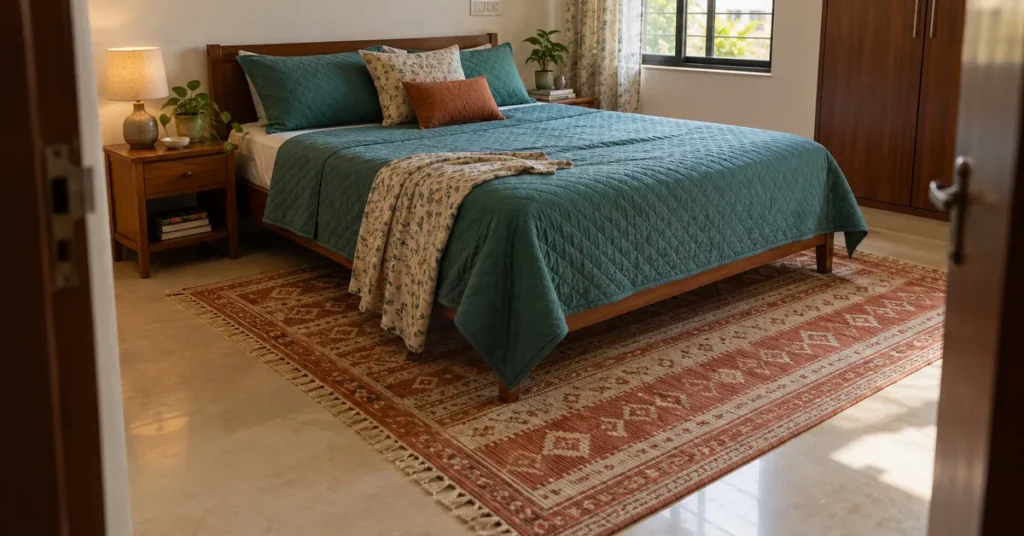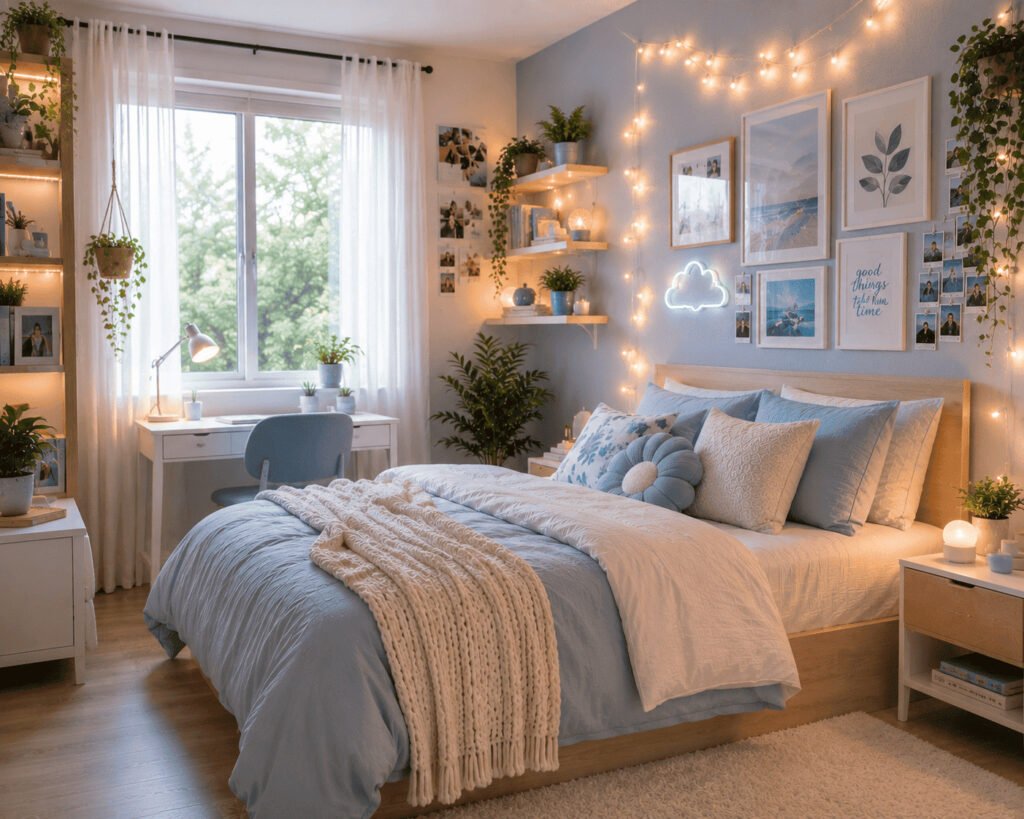
The master bedroom in an Indian home carries a significance beyond the merely functional. In Indian domestic culture, the master bedroom is a private sanctuary — a space where the aesthetic traditions of the family, the warmth of accumulated personal objects, and the colour vocabulary of Indian craft and textile heritage all come together in the room that is most intimately inhabited.
Designing a master bedroom in an Indian home is not just about following any generic Western style of bedroom design. In fact there are certain practical considerations which the thermal dynamics of Indian climates – how to tackle heat in summer, keep warm in winter – getting the two combination colour scheme right such as opting for richer warmer colour palettes as per the cultural preference, Indian woodworking traditions which offer a distinctive furniture vocabulary as well as the extraordinary textile heritage – block print cotton, hand embroidery, hand-woven fabrics – all of these make India the most valuable contributor to the global design vocabulary.
This guide covers every element of master bedroom design for Indian homes in 2026: colour, wall treatment, furniture, curtains, bedding, lighting, and accessories — with specific attention to the materials, colours, and craft traditions that make Indian bedroom design genuinely distinctive.
The Indian Master Bedroom Colour Palette
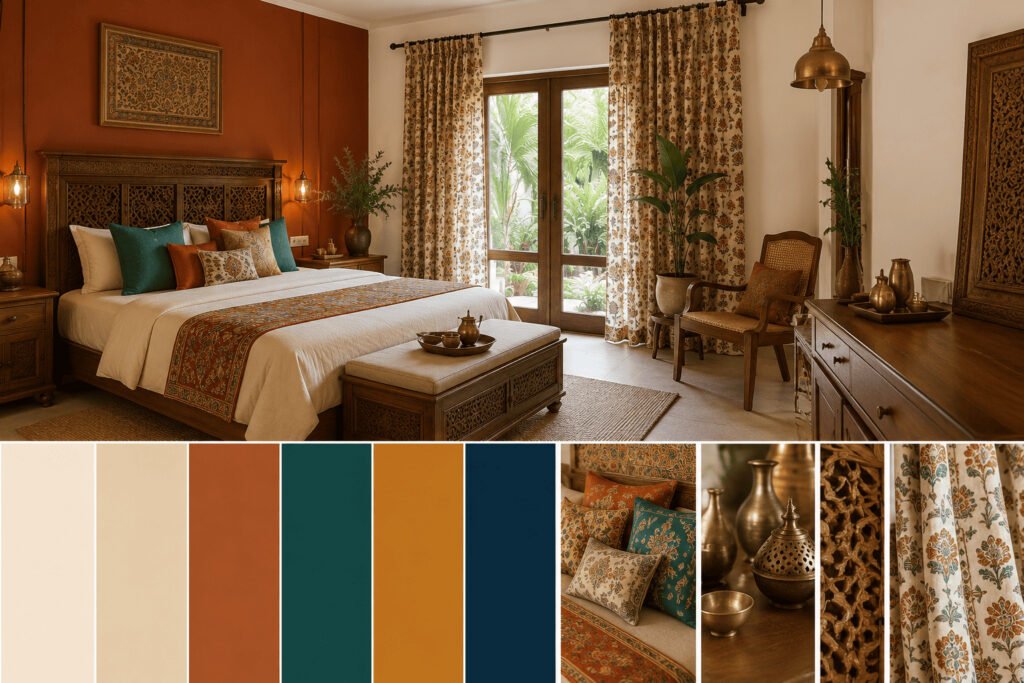
The Indian approach to colour in interiors is rooted in a rich heritage: the shades of ochres and terracottas seen in Rajasthani structures, the deep blues and refreshing whites used in hand-dyeing of Indian textiles, the greens of nature and golden hues of Mughal gardens, and the new colour schemes being developed by India’s flourishing interior design industry.
The best colour schemes for an Indian master bedroom in 2026 will be those that blend the rich heritage of Indian colours with the latest trends in a modern and chic look. Instead of being cool and minimal, they will be warm and grounded, beautiful and rich rather than neutral and fading away, but still sophisticated and not maximalist, warm earthy bedroom colours would also be good choice for master bedroom.
- Foundation colours: warm white or warm cream (walls and ceiling), warm wood in natural teak, sheesham, or mango wood tones
- Primary accent: One bold color could dominate the room through curtain fabric, cushion covers, or a completely decorated wall. Some of the most vibrant and intense colors typical for India are deep terracotta, rich teal, warm ochre, indigo and forest
- Secondary accent: a complementary warm tone — warm gold/brass metalwork, natural cotton white, warm caramel leather, or block print pattern in a related palette
- What to avoid: cool grey, blue-white, synthetic-looking surfaces — the Indian bedroom aesthetic rewards warmth and natural material quality
📌 NOTE: Typically, colours are perceived as warmer and more saturated under the intense natural light found in Indian climates (for instance, south-facing rooms in northern India or equatorial light in southern India) as compared to the soft, diffuse northern European light. What looks bold on a paint chip may appear balanced and warm on a full bedroom wall in Indian light conditions.
Wall Treatment — From Classic Two-Tone to Feature Walls
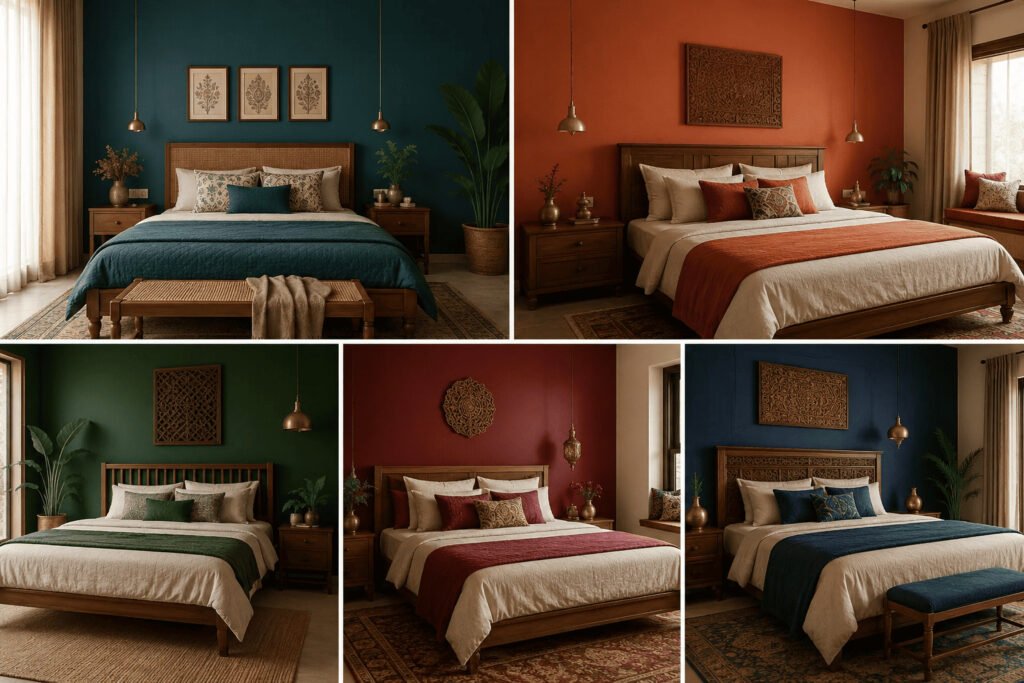
Indian interior design has a strong tradition of two-tone wall treatments — the lower portion of the wall in a deeper or richer colour, the upper portion in a lighter neutral. This technique, which has been part of Indian domestic design for generations (particularly in heritage properties), is being refined and updated in contemporary Indian homes with a more precise eye for proportion and colour.
The classic two-tone combinations or accent wall principles for Indian master bedrooms: deep terracotta lower with warm cream upper, rich teal lower with warm white upper, warm ochre lower with light stone upper. The dividing line typically sits at approximately 90 to 120cm — higher in rooms with higher ceilings, at the standard dado height in standard rooms.
Feature walls behind the bed — a single wall in a significantly richer colour than the other three — are increasingly popular in contemporary Indian master bedroom design, providing the dramatic colour statement of a two-tone wall with less commitment to the full-room effect.
- Best feature wall colours for Indian bedrooms: deep teal, rich terracotta, forest green, warm burgundy, deep indigo — all echo Indian colour traditions while reading as contemporary.
Curtains — The Heart of Indian Bedroom Design
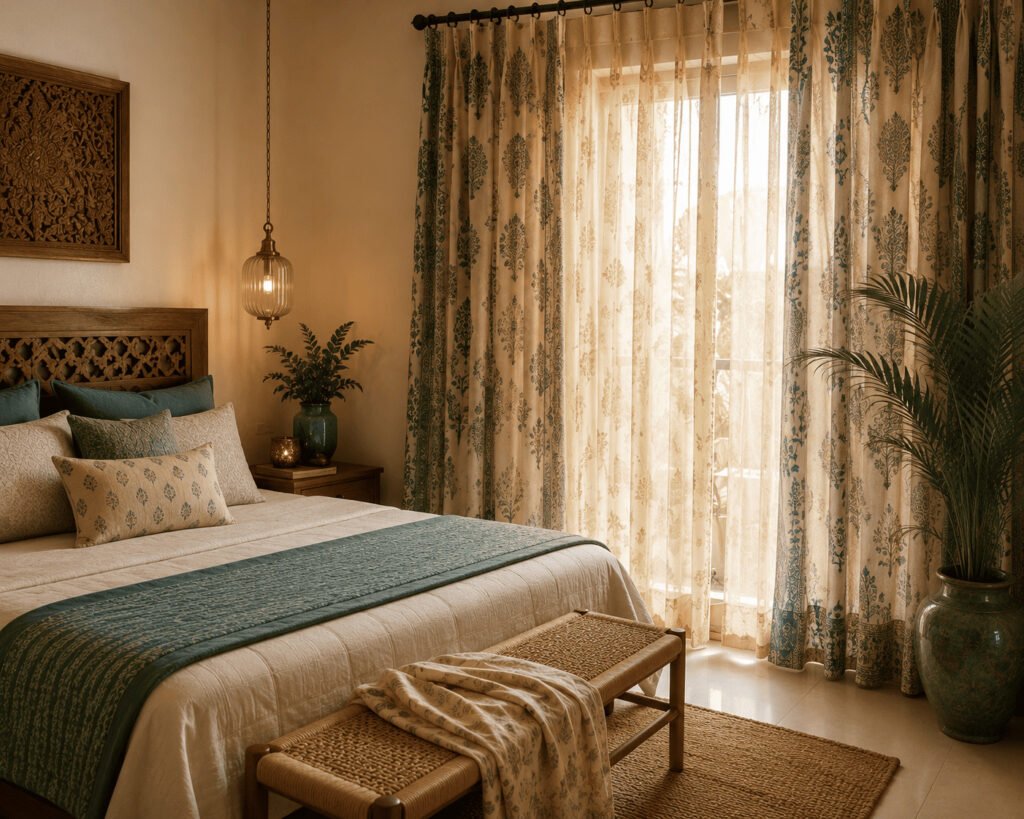
In no aspect of Indian interior design is the country’s advantage over Western generic alternatives more pronounced than in textiles and curtains. India is home to textile traditions — block printing, hand weaving, resist dyeing, hand embroidery — that have no equivalent in any other part of the world, and these traditions produce curtain fabrics of a character, beauty, and cultural depth that mass-manufactured alternatives cannot approach.
Block print cotton curtains — the definitive Indian bedroom choice
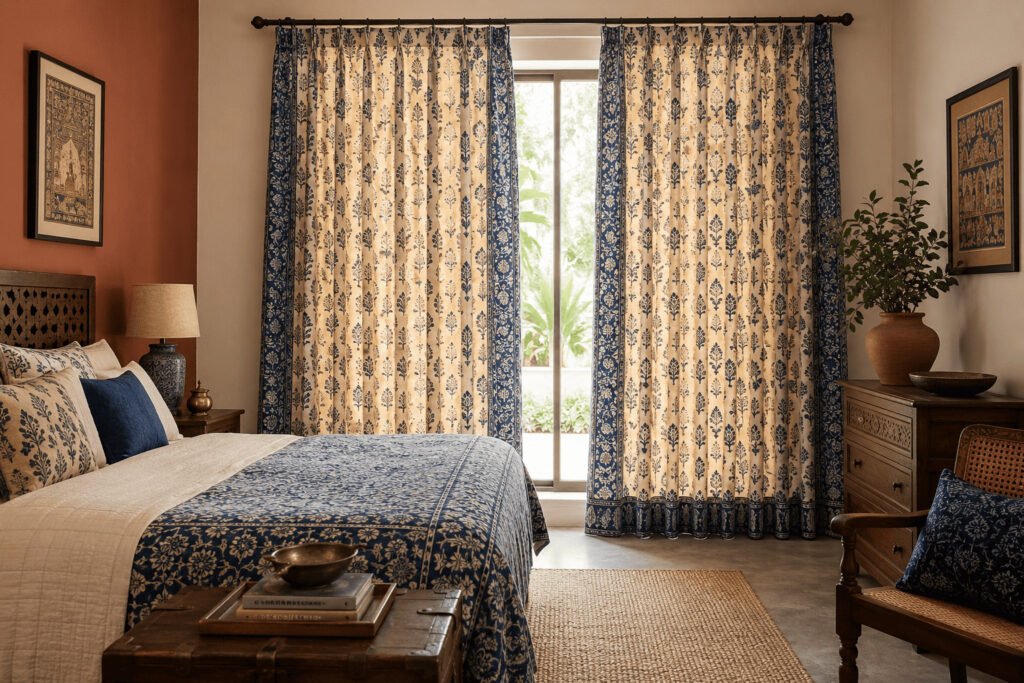
Block print cotton — hand-stamped using carved wooden blocks in designs that have been refined over centuries in craft centres like Jaipur, Bagru, and Sanganer — is the most culturally authentic and most visually distinctive curtain fabric available for an Indian home bedroom. The slight irregularity of hand-printing, the depth of natural indigo and vegetable dyes, and the story of craft and skill embedded in every metre of fabric give block print curtains a quality that no digital print on polyester can replicate.
For a master bedroom, floor-length block print curtains in indigo and cream, terracotta and natural cotton, or a botanical print on a warm neutral background come together to make a window treatment that is not only gorgeous but also distinctly showcases the heritage of Indian textiles.
Cotton curtains — practical, breathable, genuinely suited to Indian climate
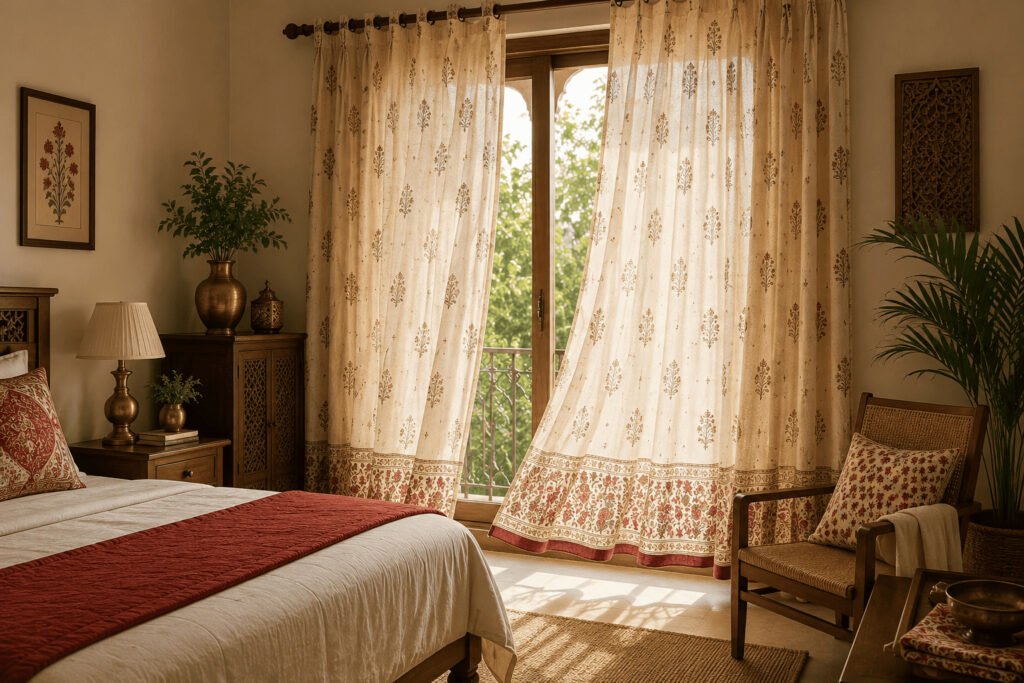
India’s climate makes fabric choice more practically consequential than in most Western contexts. Heavy synthetic fabrics — polyester velvet, thick polyester blackout — can feel hot and airless in rooms that are not air-conditioned, and many Indian homes prefer to manage room temperature through ventilation rather than AC in cooler months. That’s why it is important to understand why cotton curtains are better for Indian homes and climate.
Pure cotton curtains — medium-weight, well-woven, in natural or dyed colours — are ideally suited to Indian conditions. They breathe naturally, they wash well in the Indian context of frequent fabric laundering, and they carry colour beautifully in the rich dye traditions of Indian textile production.
Curtain hanging and length
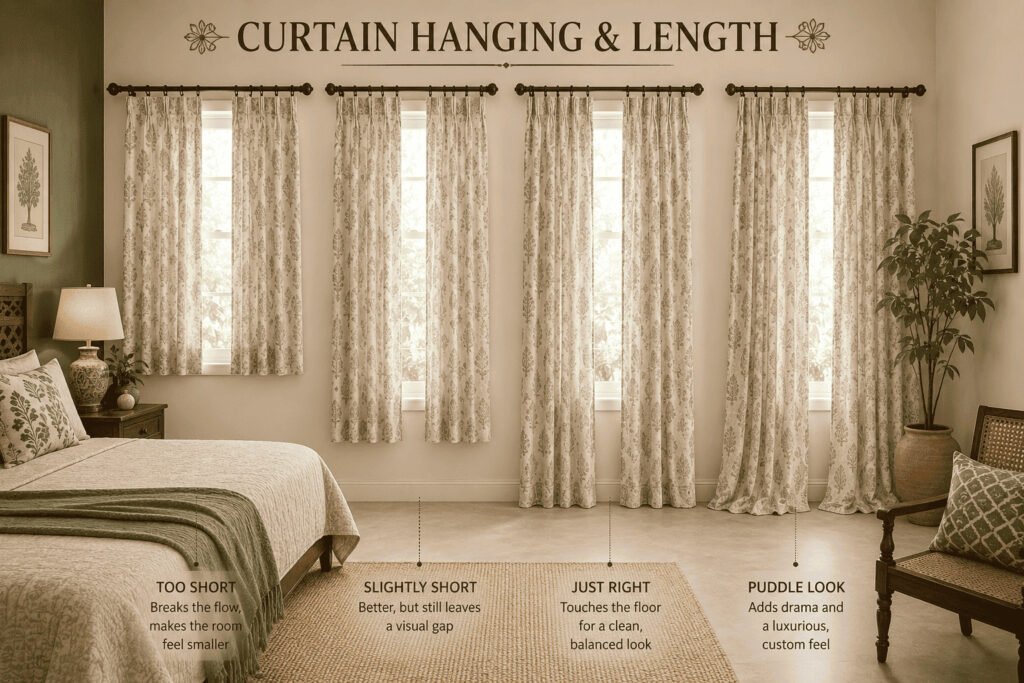
Floor-length curtains hung from as close to the ceiling as possible are the correct choice for Indian master bedrooms, for exactly the same reasons they work in any other bedroom: they make the room feel taller, the window feel more significant, and the overall space feel more designed. In many Indian apartments and newer homes where ceiling heights are 9 to 10 feet (270-300cm), the visual impact of ceiling-height curtains is particularly striking.
The Indian Platform Bed — Low, Grounded, and Beautiful
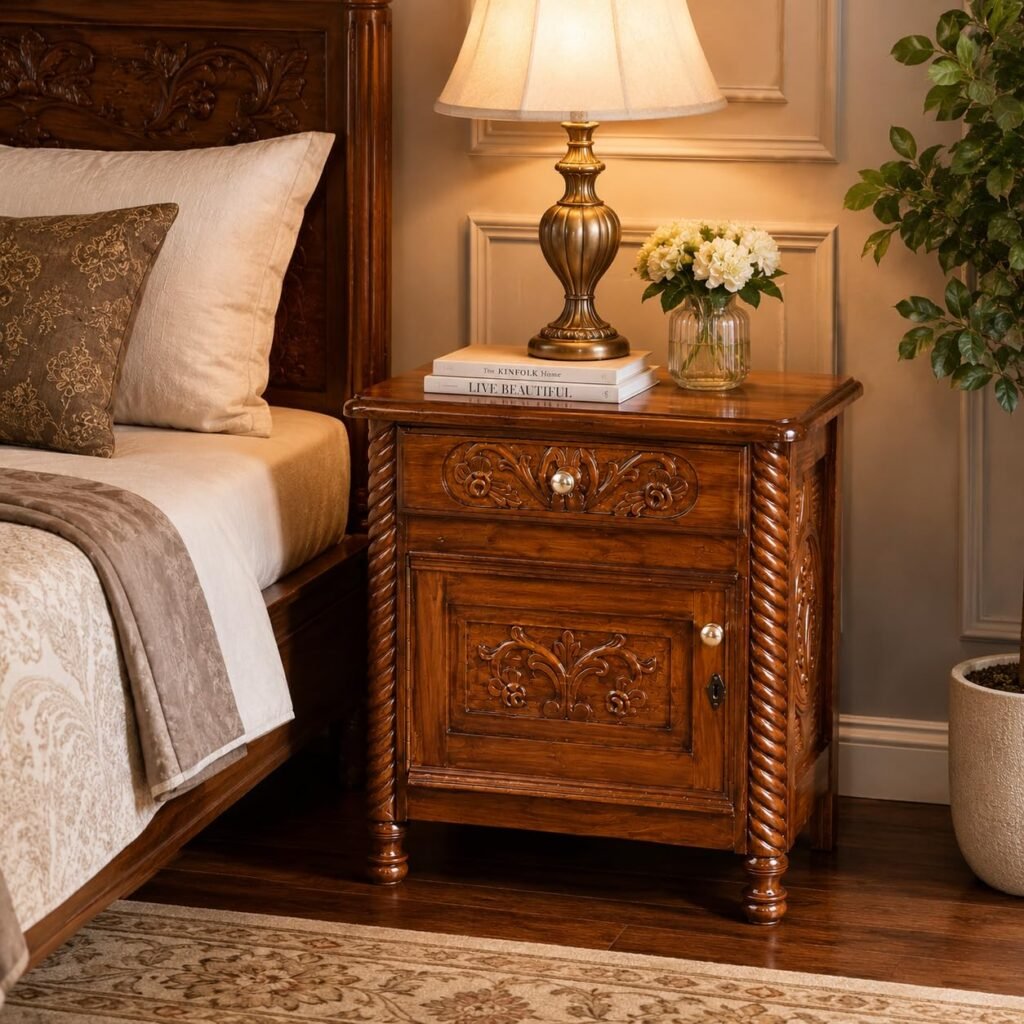
Wooden Carved Bedside Table Indian Sheesham
The platform bed — a low-profile bed frame close to the floor, often in solid carved or turned wood — is one of the most distinctively Indian furniture choices for a master bedroom. The preference for lower sleeping surfaces is both cultural (historically connected to mattresses on the floor in traditional Indian interiors) and climatic (lower temperatures nearer the floor in hot summer months).
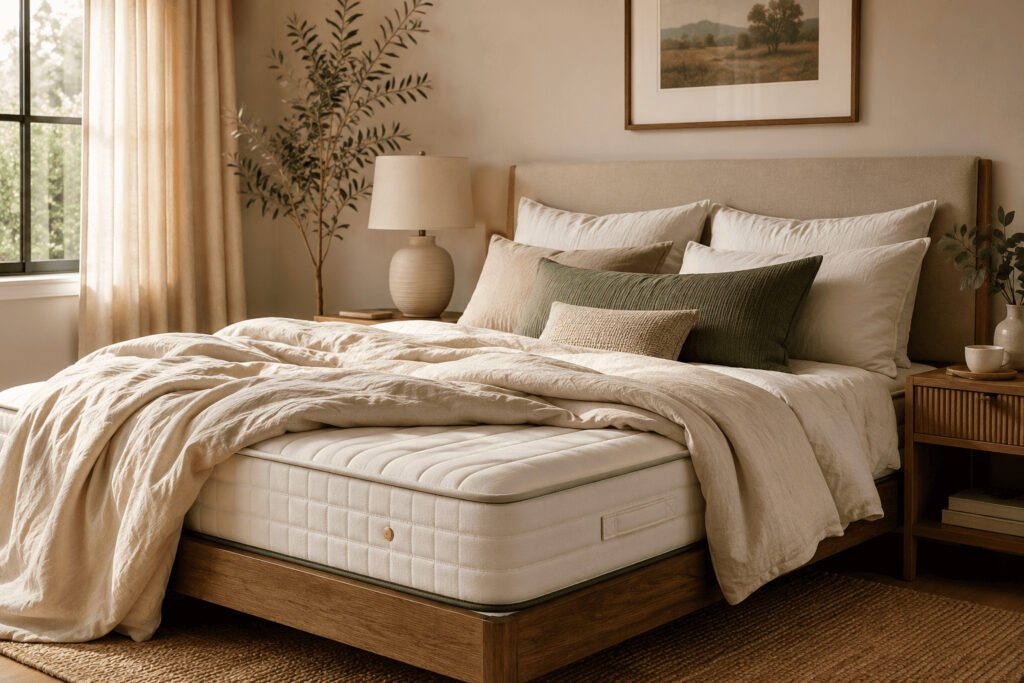
Contemporary Indian platform beds in sheesham wood (rosewood), teak, mango wood, or walnut — solid timber with visible grain, often with simple carved or turned detailing — combine traditional material values with clean contemporary forms. These are furniture pieces that improve with age and that connect the contemporary bedroom to the depth of Indian woodworking tradition, but choosing the right mattress for an Indian platform bed is a very important decision for master bedroom.
Bedding — Cotton and Block Print
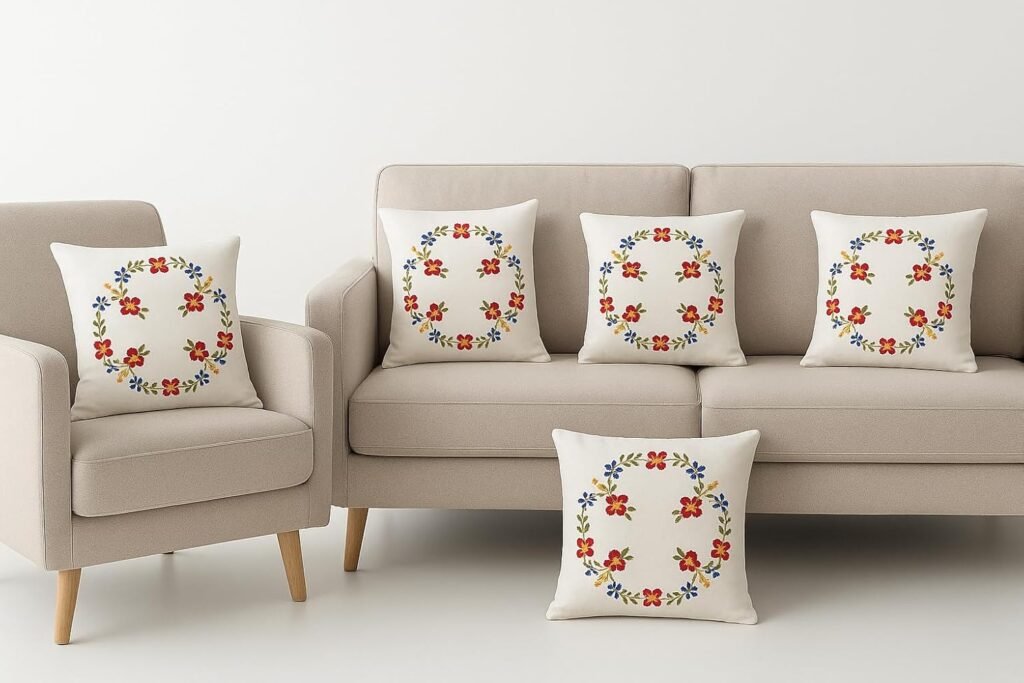
Embroidered Cushion Covers Cotton
Indian bedding traditions favour cotton overwhelmingly over synthetic alternatives, for the same climatic reasons that make cotton curtains the right fabric choice. The best Indian master bedroom bedding combines quality cotton in natural or lightly dyed tones (crisp white, warm cream, natural ecru) with the visual interest of block print or hand-embroidered decorative layers — a block print bedcover or embroidered cushion covers that carry the room’s craft character onto the bed itself. Even natural bedding materials — Indian and Japandi aesthetic share the same values.
The layered Indian bedding approach — a clean cotton duvet or bedsheet as the primary layer, with a decorative block print bedcover or woven cotton throw folded across the foot of the bed — is both practical (easy to adjust for temperature) and visually rich.
Lighting — Warm, Layered, and Beautifully Crafted
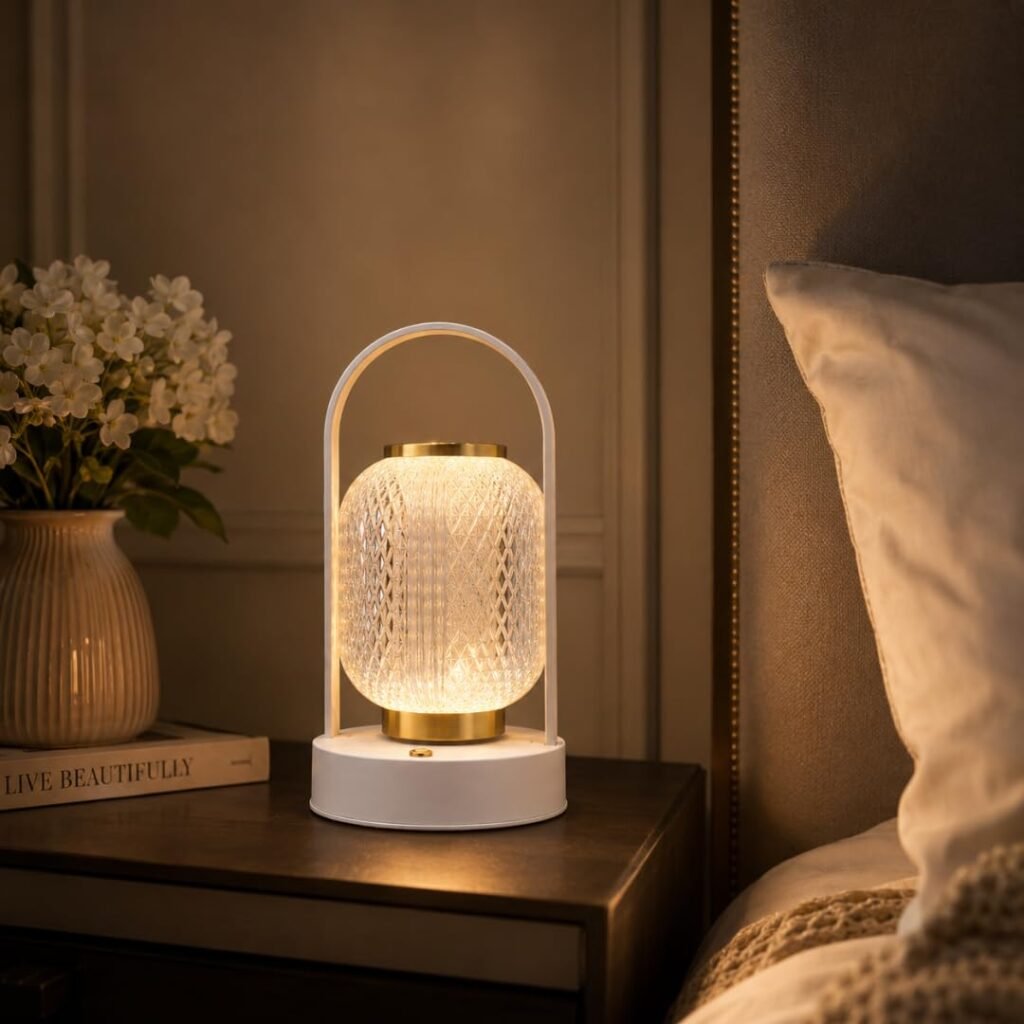
Bedside Lamp Warm Brass Touch Dimmer
One of the most unique ways in which Indian lighting traditions can set the bedroom mood involves the warm flickering light of brass diyas, the beautiful glow of lamp shades made from fabrics or paper, and the new generation blending of traditional handiwork with LED lighting. The perfect Indian master bedroom lighting would be a combination of meeting the functional needs of a bedroom (lighting for various activities, good lighting for reading) along with incorporating the rich tradition of using warm and soft lighting sources to create a cozy atmosphere.
The most effective Indian master bedroom lighting approach: a main ceiling light in warm white (turned off in the evening), two bedside lamps with warm light (2700K), and one or two brass or ceramic decorative lamps or diyas for accent lighting at lower levels. The evening atmosphere this creates — warm, rich, intimate — is one of the most beautiful domestic lighting environments available.
The Indian Bedroom Pooja Corner
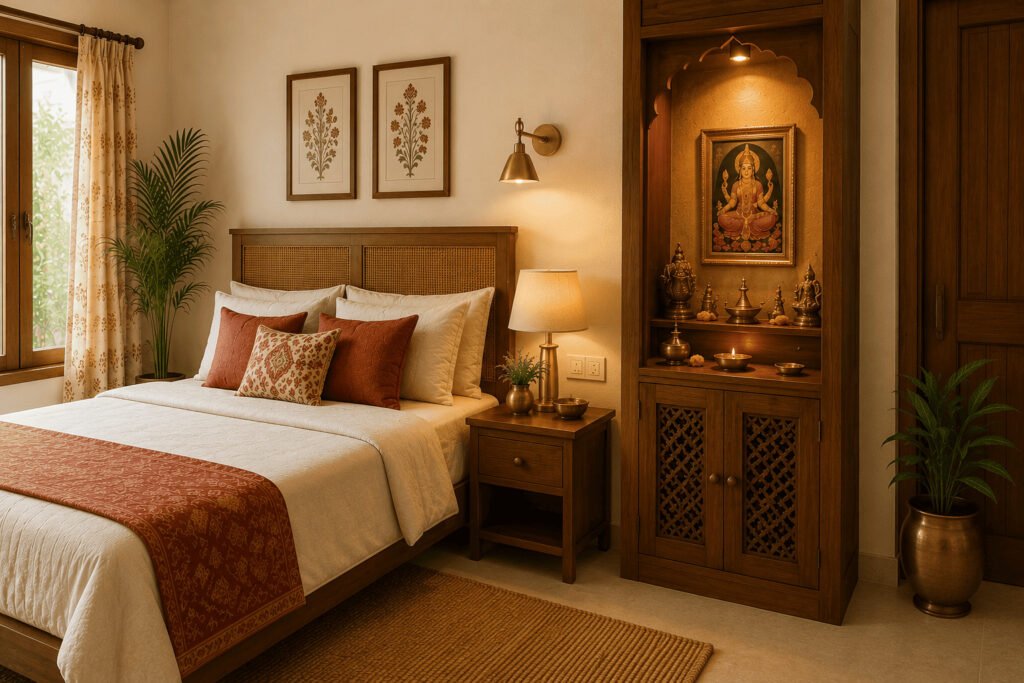
Many Indian master bedrooms include a small dedicated space for daily prayer — a pooja corner with a small shelf or alcove, a brass or copper diya, a small idol or image, and fresh flowers. This element, while entirely personal and variable in scale, is worth incorporating into the bedroom design from the beginning rather than retrofitting later.
A well-planned pooja corner – aligned with the Vastu principle of the north-east direction, equipped with a small dedicated shelf, warm devoted lighting, and clever storage for prayer materials – brings both spiritual and visual elements to the bedroom. A mere wall recess, or a tiny wooden shelf with a brass rail, would be sufficient.
- Vastu guidance: the north-east direction is traditionally preferred for prayer; avoid placing the pooja alcove directly above the sleeping area
- Design integration: use the same wood tone and colour palette as the rest of the bedroom so the pooja corner reads as an integrated element rather than an afterthought
- Lighting: a small warm LED spotlight or a battery-operated LED diya provides dedicated lighting without wiring complexity
Storage — The Indian Bedroom’s Practical Challenge
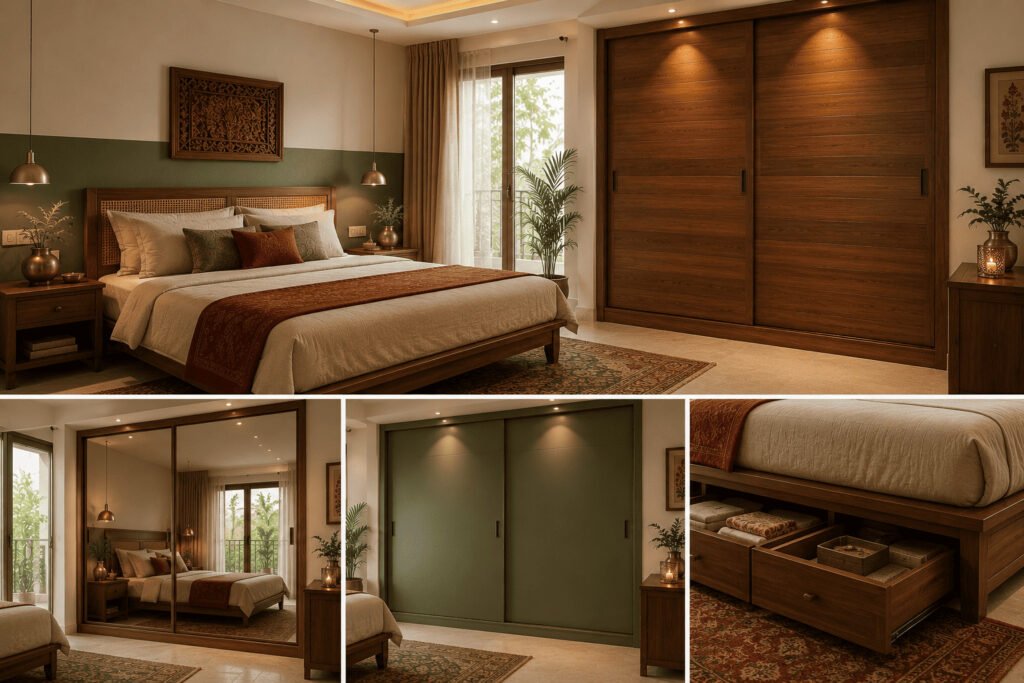
Indian households often have significant textile wealth — sarees, traditional clothing, embroidered linens — that requires generous wardrobe and storage space. The Indian master bedroom storage challenge is providing this capacity without the bedroom feeling overwhelmed by furniture, maximising storage without overwhelming the room.
The most effective approach: a full-height wardrobe occupying one complete wall, with sliding doors (to avoid the circulation space required by hinged doors in a compact room) in a finish that echoes the room’s wood tones or wall colour. Inside, the wardrobe should be specifically divided for Indian storage needs — hanging sections for longer garments, wide shelves for folded sarees, deep drawers for casual clothing, and a dedicated section for embroidered and special occasion items in dustproof cotton storage.
- Best sliding door finish for Indian master bedrooms: natural wood veneer (most harmonious), mirrored glass (adds depth, reflects light), or painted in the bedroom’s wall colour (recedes visually)
- Under-bed storage: the platform bed tradition creates natural under-bed storage — traditional wooden storage boxes or modern drawer units under the bed frame provide significant capacity without any additional floor footprint
The Verandah and Balcony Bedroom Connection
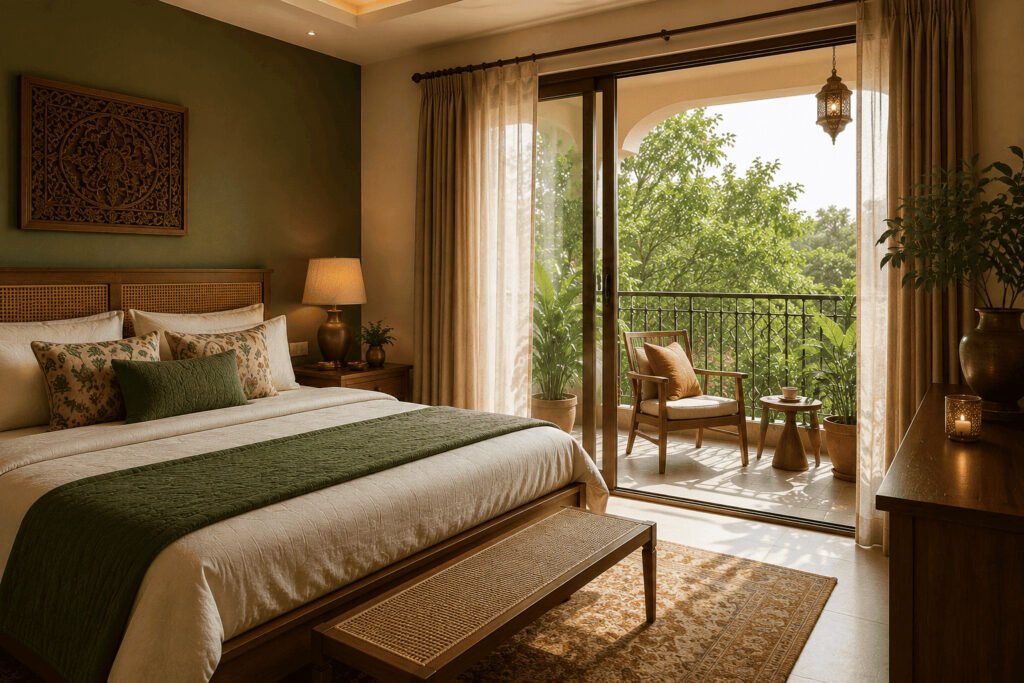
Many Indian homes — particularly in older residential buildings and newer apartments — have a balcony or small verandah accessible from the master bedroom. This indoor-outdoor connection is one of the most distinctive features of Indian domestic design and one worth addressing in the bedroom design.
When the master bedroom opens onto a balcony, the curtain treatment at the sliding or folding door becomes as important as the window treatment, curtain solutions for wide openings and balcony doors. Floor-length curtains at balcony doors — ideally in the same fabric as the window curtains — create a unified wall of fabric that can be drawn to separate interior from exterior or drawn open to create a seamless connection. Block print or cotton curtains at a balcony door, when drawn open and billowing slightly in the breeze, create one of the most beautiful domestic moments available in Indian design.
Plants and Nature in the Indian Bedroom
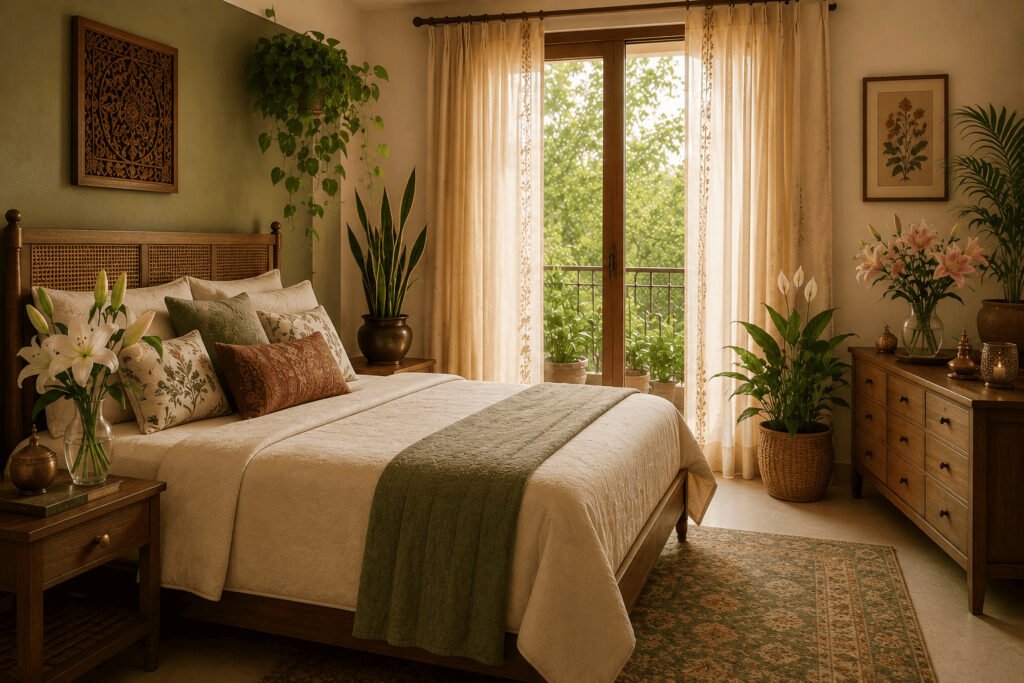
The Indian design tradition has a deep relationship with nature — in the garden motifs of block print fabric, in the botanical imagery of Mughal miniature painting, in the tradition of fresh flowers for daily offerings. Bringing living plants into the master bedroom honours this tradition while improving the room’s atmosphere and air quality.
The best indoor plants for Indian master bedrooms are those suited to the warmth and light conditions of Indian homes: money plants and pothos (extremely hardy, excellent air purifiers, grow prolifically in Indian conditions), snake plants (tolerant of inconsistent watering, very low maintenance), and peace lilies (flower reliably, prefer indirect light). Fresh flowers in a vase on the bedside table or dresser — changed regularly, chosen for fragrance as well as colour — add the dimension of scent that no manufactured room freshener can replicate.
Final Thoughts
The master bedroom of an Indian home, designed with attention to India’s extraordinary colour traditions, textile heritage, and craft vocabulary, can be one of the most beautiful domestic environments in the world. The warmth of good sheesham woodwork, the richness of block print cotton curtains in indigo or terracotta, the glow of warm lighting against walls in a deep earthy tone — these are design elements with a depth and character that no generic Western bedroom guide adequately addresses.
The approach outlined in this guide is not about recreating a ‘traditional Indian’ bedroom in an archaic sense — it is about drawing on the genuine strengths of Indian design tradition (colour confidence, textile richness, natural material quality, craft heritage) and combining them with contemporary proportion, thoughtful spatial planning, and the lighting and storage solutions that make a bedroom genuinely functional for modern life.
The curtains and textiles are the place to start. Choose block print cotton for the curtains, embroidered or hand-printed cushion covers for the bed, and quality cotton for the bedding — and the room’s character is established before a single wall is painted or a piece of furniture is moved.
Frequently Asked Questions
Q: What colour is best for a master bedroom in an Indian home?
A: Indian master bedrooms often suit the combination warm colours with strong earthy or jewel tone characters very well: deep terracotta, rich teal, warm ochre, forest green, or deep indigo are all well-established in Indian colour tradition and can look very attractive as feature wall or curtain colours. Warm cream and warm white are ideal for the remaining walls and ceiling. Indian natural light is typically warmer and stronger than northern European light, which means bolder colours can be used without the room feeling heavy — a terracotta that reads as intense in a UK bedroom will feel warmly enveloping in an Indian home.
Q: What curtains are best for an Indian master bedroom?
A: For an Indian master bedroom, cotton curtains with block prints are the most culturally meaningful and attractive option. The hand-printed design and pure cotton fabric together lead the bedroom to India’s wonderful tradition of crafts. Plain or slightly textured pure cotton curtains are best suited for the Indian climate as cotton is a breathable natural fabric which feels comfortable even without air conditioning. The two types of fabric should ideally be hung from the ceiling to the floor to get the best visual effect.
Q: What is Vastu Shastra and should I follow it in bedroom design?
A: Vastu Shastra, an age-old Indian architectural science, relates how the direction of a building and the arrangement of rooms impact natural energies and human health. A number of Indian households design their homes, more or less, according to the Vastu principles. Among the main Vastu instructions concerning the master bedroom are: placing the master bedroom mainly in the south-west part of the house, sleeping with the head of the bed towards the south or east, the main door not directly facing the bed, not placing mirrors on the wall that the bed faces, and having the pooja room in the north-east. Vastu guidance is personal and varies between families and practitioners — incorporate it according to your own family’s practice rather than following any single authoritative source.
Q: How do I make a small Indian master bedroom feel larger?
A: The same principles that make small bedrooms look spacious the world over are especially effective in Indian homes: floor to ceiling curtains that create the illusion of height, light warm wall colours (warm cream or warm white) with one feature wall in a deeper shade, a colloquial bed frame that minimizes visual bulk, mirrored sliding wardrobe doors that not only reflect light but also add the illusion of depth, and bare minimum floor furniture apart from the bed and necessary bedside pieces. In Indian flats with 9-10 foot ceilings, ceiling-height curtains can work wonders — the long, vertical lines of the curtains highlight the height of the room and even a small space can be made to feel quite ample.
Q: Which wood is best for Indian bedroom furniture?
A: Sheesham (Indian rosewood) is the most widely used and most valued Indian wood for bedroom furniture — it has a beautiful grain, takes polish well, and is extremely durable. Teak is of equal value and is even more resistant to humidity, therefore, it would be perfect for the coastal areas of India. Mango wood is a cheaper and attractive option with its lovely grain and warm golden-brown color, and it is also gaining popularity. These three types of wood perfectly match the warm and natural material vocabulary that a classy Indian master bedroom can have rather than the use of MDF or synthetic laminate alternatives.