
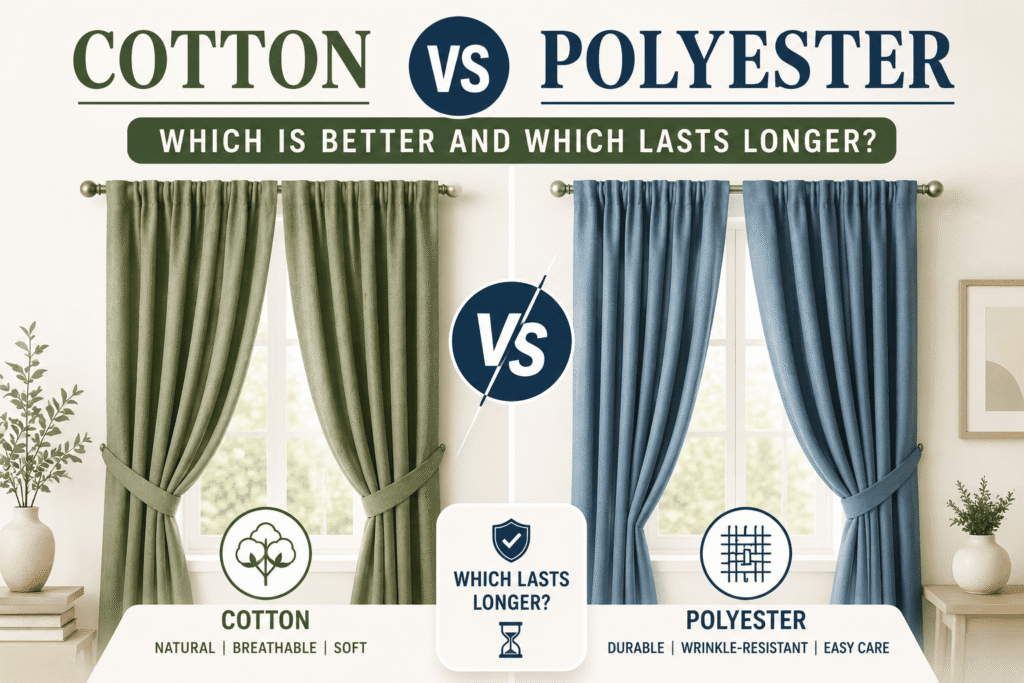
Eventually, each curtain buying trip leads to the same point: should one choose cotton or polyester? On the surface it seems like a simple question, but the right choice hinges on what factors matter most in a given household, room and budget. A person who gives top priority to natural fibers and durability will probably end up with a completely different result from the one whose main concern is convenience and cheap purchase price.
This guide gives you the honest, complete comparison. Not a marketing case for one fabric or the other – a genuine assessment of what each fabric is good at, what it is not good at, and which situations call for which choice. By the end you will know exactly which fabric is right for every window in your home.
Cotton Curtains — What They Are and Why They Matter
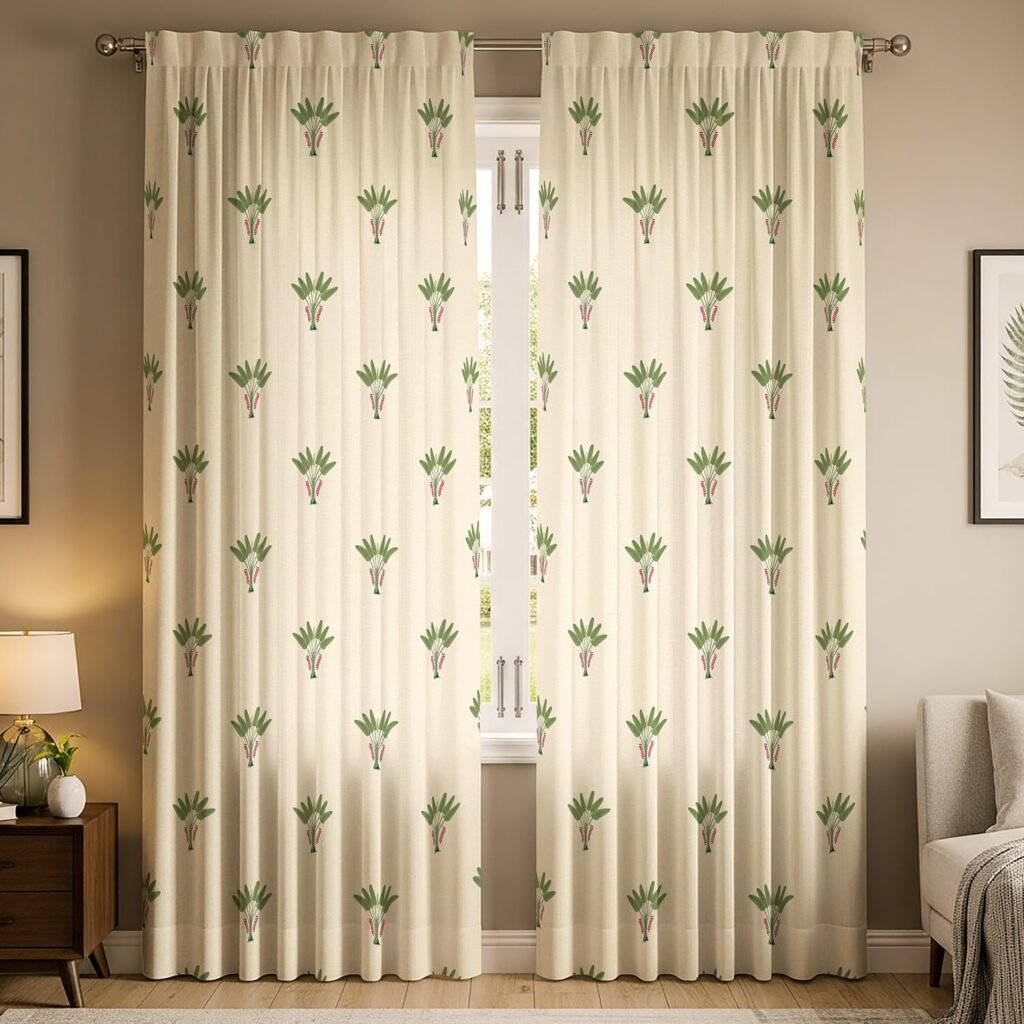
Cotton is a naturally-made plant fibre, which humans have been using for making textiles for thousands of years. The fabric of cotton curtains is derived by weaving the natural fibres of the cotton plant, resulting in a textile that is ventilated, decomposable, and truly pleasant to touch and to be around. The range of cotton curtain fabric starts from extremely delicate and thin that is fit for sheers and unlined panels and medium weight that is fit for lined curtains in most living rooms and bedrooms and finally heavy weight that is fit for interlined and thermally insulating curtains.
Cotton curtains have several qualities that make them genuinely different from synthetic alternatives — qualities that are immediately apparent in person but difficult to convey in an online product description. The texture of cotton has a natural irregularity that reads as warmth and authenticity. The way cotton fabric moves when a breeze passes through it is different from polyester — more natural, less plastic. The way light passes through unlined cotton has a warmth and golden quality that polyester cannot replicate.
The real advantages of cotton curtains
- They breathe. Cotton is a highly breathable fibre — it allows air to circulate, which means drawn cotton curtains in a warm room feel less stuffy than drawn polyester curtains in the same conditions.
- They improve with washing. Contrary to polyester that over time may become stiff, yellowed, or start pilling, good cotton fabric after multiple gentle washes will become softer and more pliable. Properly maintained cotton drapes at the fifth year stage would be more appealing than the day of their first
- They take dye naturally. The colours in cotton curtains have a depth and richness that synthetic dyes on polyester do not quite match. Cotton in a warm terracotta or a deep navy has a quality of colour that registers as genuine to anyone looking closely.
- They are eco-friendly and bio-degradable. Being a natural fiber, cotton will break down on its own after use. On the other hand, polyester is
- They drape naturally. The natural weight and flexibility of cotton result in a soft and natural drape that is more organic than polyester, especially when the panels are unlined or only lightly
- They age well. Cotton curtains in good fabric develop character with age — rather than degrading, they soften and settle into a quality that reads as established and considered.
The honest limitations of cotton curtains
- They wrinkle more. Cotton wrinkles more easily than polyester. This is especially noticeable right after the curtains have been washed but before they are re-hung and the fabric gently stretches downwards on its own
- They cost more. Quality cotton curtain fabric costs significantly more than comparable polyester. The price premium is typically 40–100% over polyester equivalents.
- They fade more readily in direct sunlight. Cotton dyes, particularly natural and plant-based dyes, are more susceptible to UV fading than the synthetic dyes used in polyester. In rooms with strong direct sunlight, this is a practical consideration.
- They shrink if washed hot. Cotton shrinks when washed above 30–40 degrees. Always wash cotton curtains at cold or 30 degrees to avoid size changes.
Polyester Curtains — The Honest Assessment
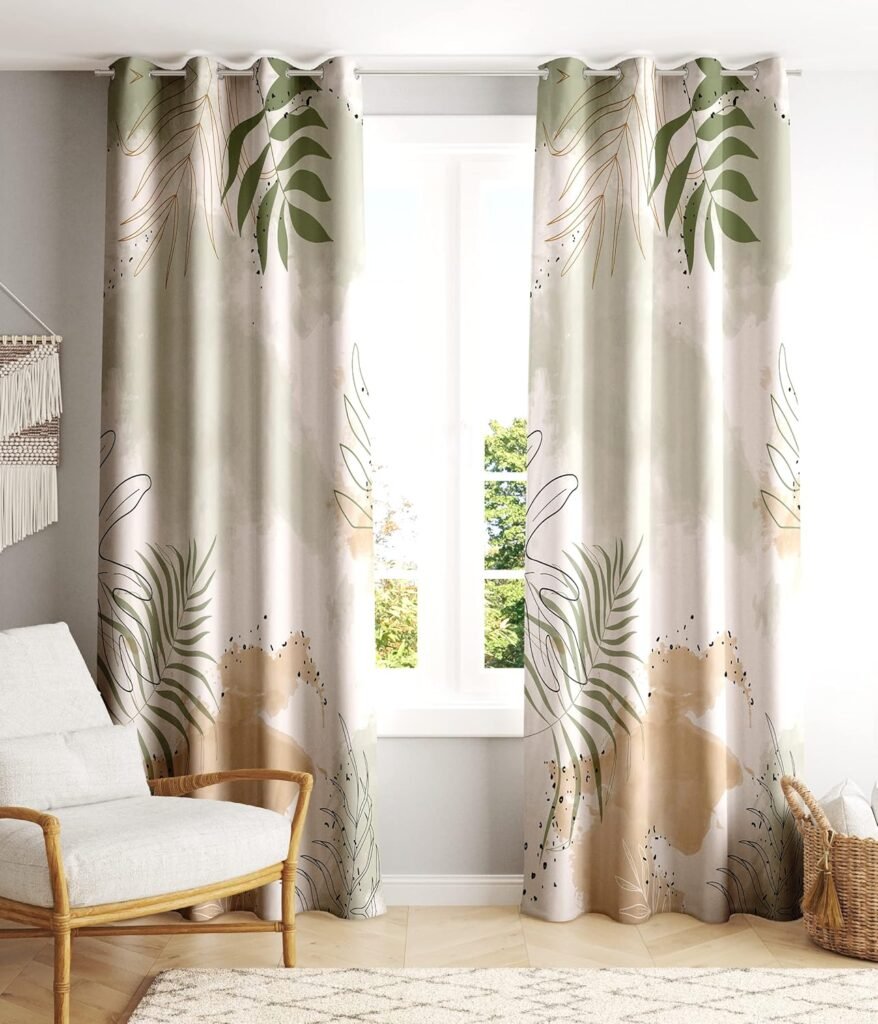
Polyester is a man-made fibre obtained from petroleum. Being cheap to make, non-shrinking, colour fast, easily accessible in a vast array of colours and styles plus easy to maintain are major reasons why it is the world’s most popular curtain fabric by volume. The vast majority of budget ready-made curtains you will find on the market are made from polyester or polyester blend.
It is important to be honest about polyester rather than dismissive. Polyester curtains in the right context, chosen for the right reasons, are a perfectly reasonable choice. The problem is not polyester itself — it is the tendency to choose polyester by default without considering whether a natural fabric would serve better.
The genuine advantages of polyester curtains
- They are significantly less expensive. For any given size and style of curtain, polyester will be 40–100% less expensive than cotton equivalent. For someone outfitting multiple rooms on a budget, this is a real and legitimate consideration.
- They resist shrinking. Polyester is dimensionally stable — it does not shrink when washed, even on a warm cycle. For anyone who worries about washing curtains at the wrong temperature, polyester is more forgiving.
- They are more resistant to UV fading. Modern polyester dyes are more resistant to UV fading than most natural dyes on cotton. In rooms with strong direct sunlight — south-facing rooms, conservatories — polyester curtains hold their colour longer than cotton.
- They are wrinkle-resistant. Polyester is a great wrinkle-resistant fabric compared to cotton. It is always a surprise, when after washing the curtains, they hang with fewer wrinkles and require less ironing to look
- They are easy to clean. The majority of polyester curtains can be washed thoroughly in the washing machine at 40 degrees or higher, and they dry rapidly and
- They are available in a huge range of styles and colours. The readymade curtain market is dominated by polyester, which means the widest range of colours, patterns, widths, and drops is available in polyester.
The honest limitations of polyester curtains
- They feel synthetic. One can sense the disparity in the touch of polyester as opposed to the feel of natural fibres. In a setting where you wish the fabrics to exude a sense of authenticity and closely resemble nature, polyester appears to be plastic rather than
- They are not breathable. Polyester lacks the ability to air naturally like cotton. When you close a polyester curtain in a warm room it will create a more suffocating, enclosed environment than if there are cotton curtains of the same
- They degrade rather than develop. Unlike cotton, which improves with age, polyester tends to degrade — pilling on the surface, yellowing slightly, losing some drape flexibility over years of washing and exposure.
- They are environmentally problematic. Polyester is a type of synthetic fiber that is not biodegradable. It does not break down after use and releases microplastic particles every time it is
- They can look less expensive. At close range, polyester curtains have a visual quality that reads as synthetic — a slight uniformity of sheen and texture that distinguishes them from natural fibres to anyone paying attention.
The Direct Comparison — Category by Category
Durability: who wins?
Both fabrics are durable in different ways. Polyester is more resistant to UV fading and more dimensionally stable (no shrinking). Cotton is more structurally resilient over very long periods — the fibres do not degrade in the same way polyester fibres do with repeated washing and UV exposure over 10+ years.
For rooms with direct sunlight: polyester wins on colour retention. For longevity over 10 years with good care: cotton wins on structural quality. For rooms with neither heavy sun nor a long-term plan: roughly equivalent.
Appearance: who wins?
Cotton wins clearly at close range and in daylight. All these aspects: texture, light absorption, and the elegance of the fall of the garment are far better in cotton. Polyester, going by a distance or a photo, may seem like it, but, here, most people can easily tell the difference of the two.
For rooms where the curtains are a focal point or where the quality of the fabric is part of the room’s character: cotton. For rooms where the curtains are functional background: either.
Ease of care: who wins?
Polyester wins on ease of care. More wash temperature flexibility, no shrinking risk, faster drying, less wrinkling. For households with young children, pets, or high curtain-washing frequency, polyester’s greater care tolerance is a genuinely significant practical advantage.
Cost: who wins?
Polyester wins on initial cost. For anyone on a tight budget, polyester curtains in the same size and style cost 40–100% less than cotton equivalents. This is a legitimate factor, particularly when outfitting multiple rooms.
However: when measured as cost per year over the likely lifespan of the curtains, cotton’s longer useful life and improvement with age means it can represent better long-term value than polyester that needs replacing at year 5 or 6.
Environmental impact: who wins?
Cotton usually comes out on top, especially if it’s organic or certified to a sustainable standard. Aside from being the renewable material, cotton is also biodegradable. Polyester is neither. For any household making environmental priorities in home purchases, cotton is the correct choice.
Which Fabric for Which Room?
Living room
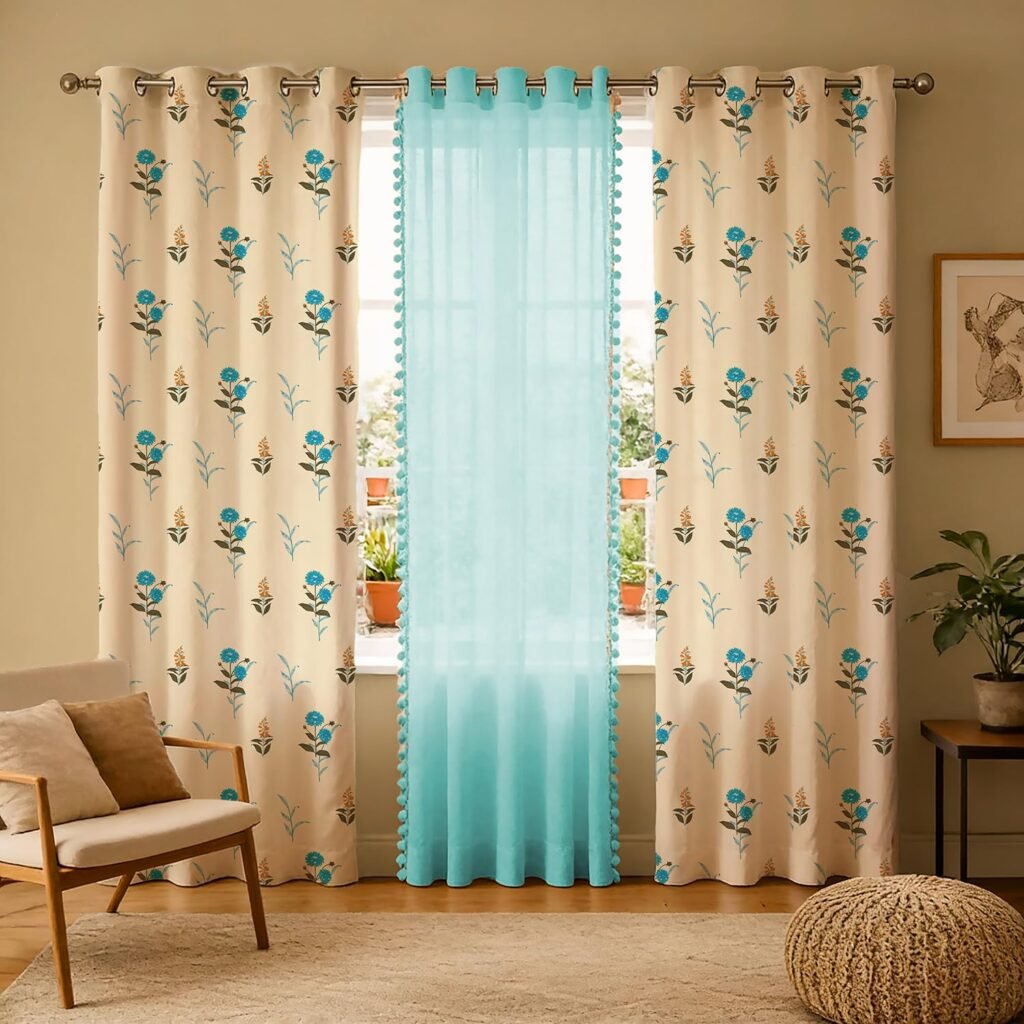
Cotton Curtains for Living Room
The living room is where you spend the most time looking at your curtains, and where fabric quality is most apparent. Cotton or linen are almost always the better choice for living room curtains — the natural texture and drape quality is worth the additional cost in a room that is seen and used daily. That’s why choosing the right curtain fabric for your living room is so important. The exception is a living room with very strong direct sunlight where UV fading is a significant concern — in that case, the colour retention advantage of polyester may tip the decision.
Bedroom
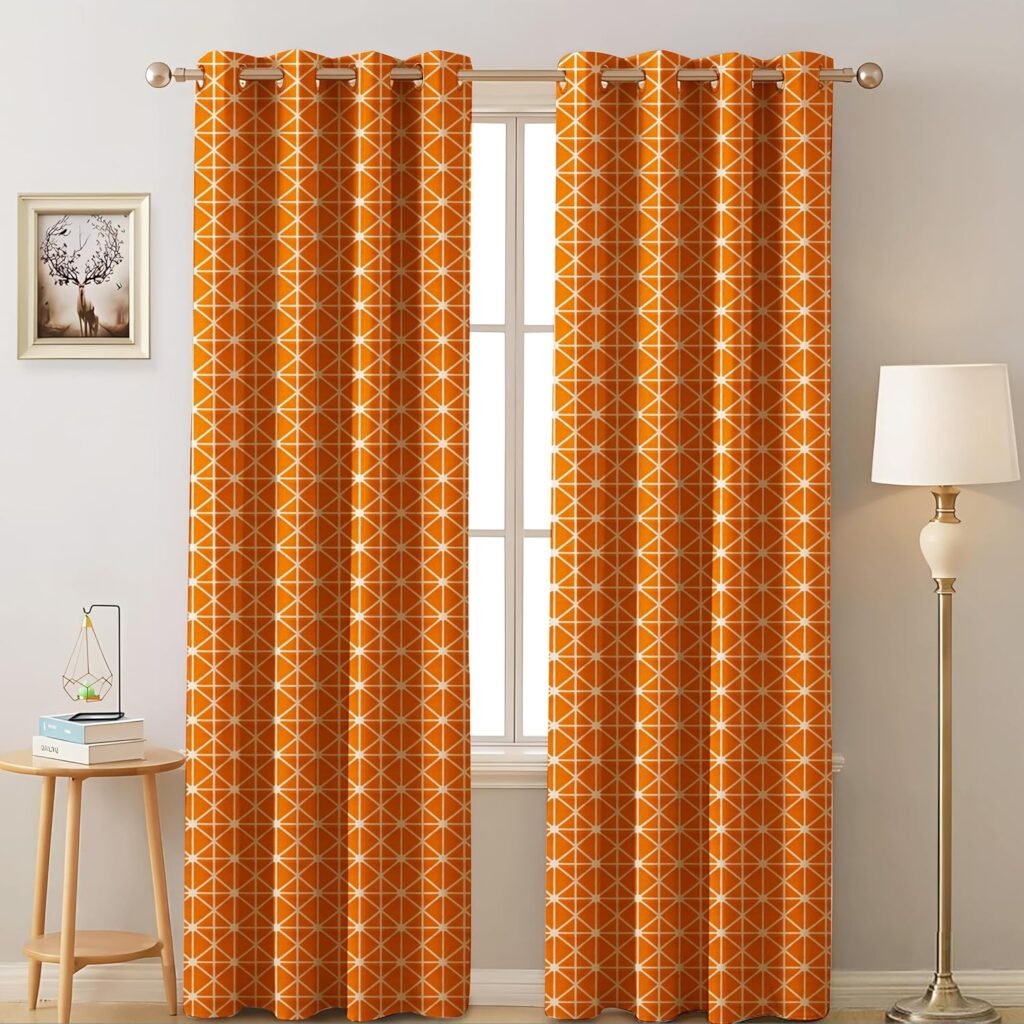
Breathability of cotton fabrics has some very practical benefits in bedrooms besides the beauty aspect. Unlike polyester, cotton curtains allow for more air circulation which can help to make sleeping environments more comfortable particularly in summer months. So if you are choosing curtains for your master bedroom where both fabric quality and daily curtain view matter, going with 100% cotton is a wise investment. On the other hand, for less personal spaces like children’s rooms and guest rooms where mainly functionality counts: polyester is certainly a more reasonable option.
Kitchen
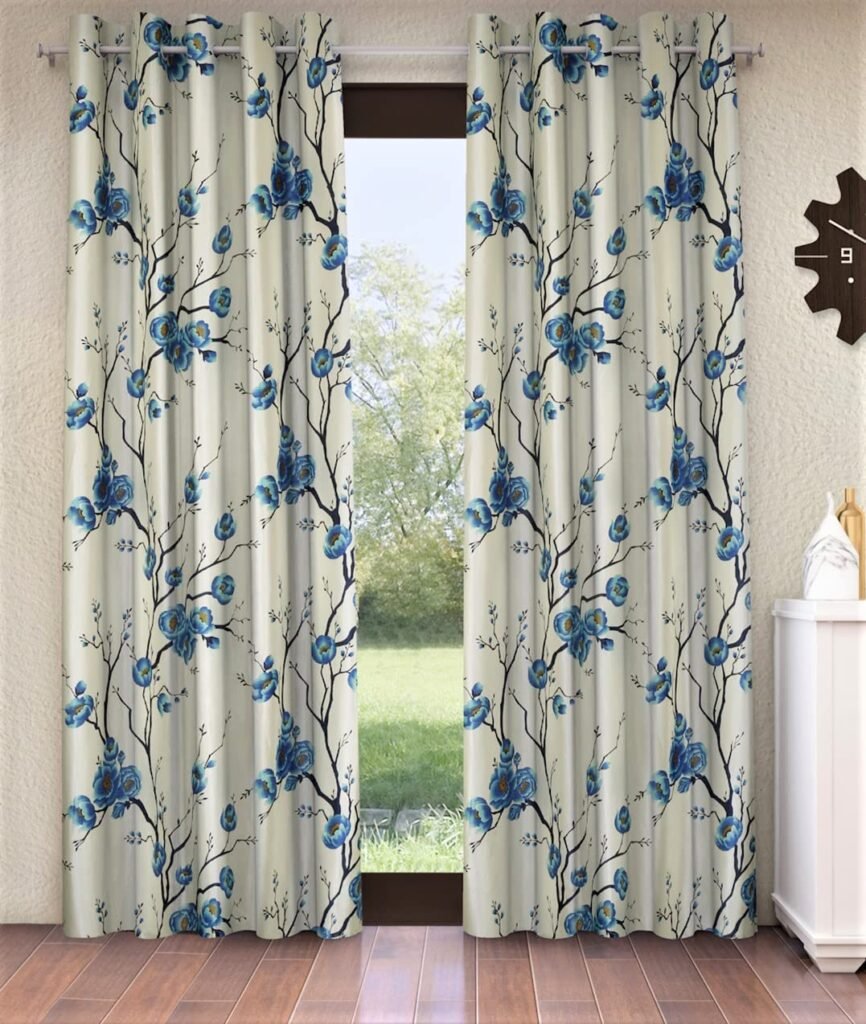
Polyester Curtains for Kitchen
Kitchens are the strongest argument for polyester over cotton. The combination of heat, cooking smells, grease, and frequent washing that kitchen curtains typically experience makes polyester’s easy-care properties genuinely advantageous. Kitchen curtains need to be washed frequently and at higher temperatures — polyester handles this significantly better than cotton.
Bathroom
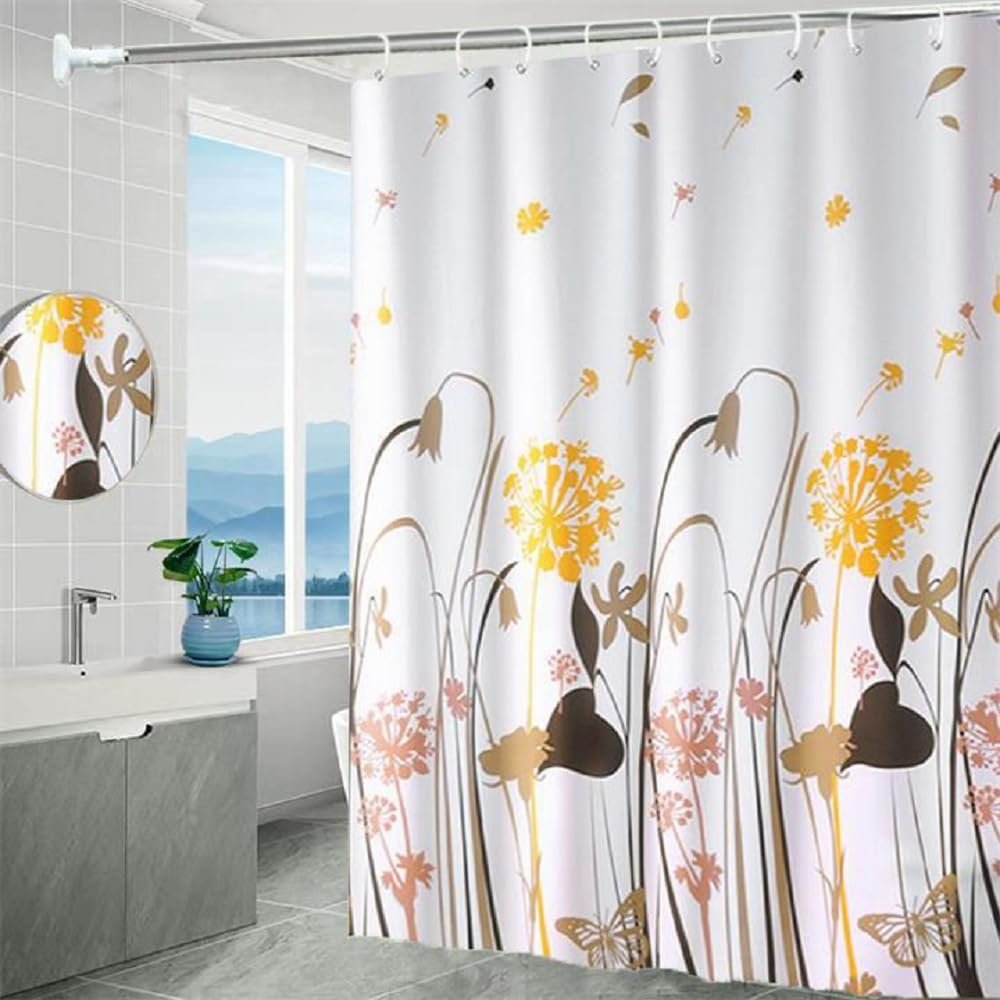
Polyester Curtains for Bathroom
Bathrooms present similar arguments to kitchens. High humidity, frequent washing needed, exposure to cleaning products — polyester’s resistance to these conditions is a practical advantage. If natural materials are really important in your bathroom, linen-cotton blend which is more resistant to washes than 100% cotton can be a good compromise.
Home office or study
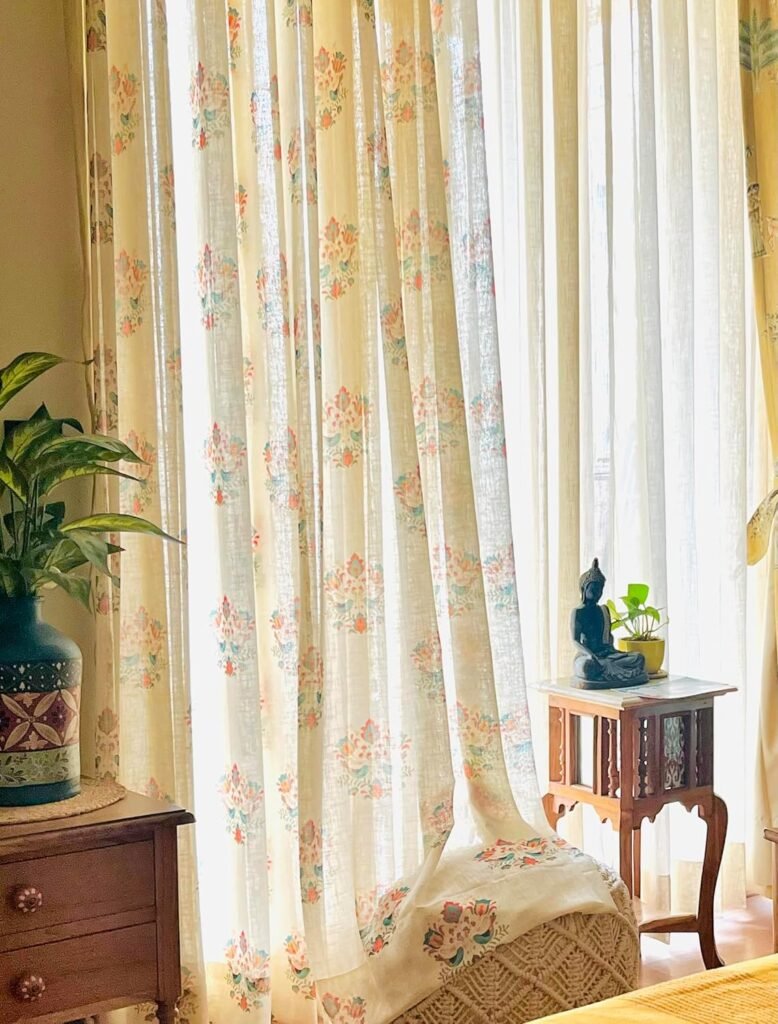
Cotton or a linen – cotton blend fabric is a good choice for a home office where you spend a lot of time and where the character of the room is important, as these fabrics provide a more thoughtful, high-quality touch than polyester. The effect of having natural fabric curtains in the room where you work versus having polyester curtains is very subtle but definitely present.
The Middle Ground: Cotton-Polyester Blends
Cotton-polyester blends – usually 50/50 or 60/40 cotton-polyester – mix lots of the good points of both fibres and at the same time lessen the bad points of each one.
- More wrinkle-resistant than pure cotton — the polyester content reduces wrinkling significantly
- More breathable than pure polyester — the cotton content allows more air circulation
- Better colour depth than pure polyester — the cotton content gives the dye a more natural quality
- More wash-tolerant than pure cotton — less likely to shrink, slightly more temperature-tolerant
- More affordable than pure cotton — blends are typically priced between pure cotton and pure polyester
For households that want something better than polyester but are hesitant about the full commitment of pure cotton, a cotton-polyester blend is a very practical and visually good option. The blend is also commonly used in blackout curtain construction — the blackout lining on the back of the curtain is usually polyester (for its thermal and light-blocking properties), while the face fabric may be a cotton or cotton blend.
✦ PRO TIP: If you are buying curtains for a room you care about and plan to keep for 5 or more years, cotton is almost always the better investment. If you are furnishing a temporary space, a rental property, a room you will redecorate soon, or any room where budget is the primary constraint, polyester is entirely reasonable. The choice should be proportionate to the context.
How to Identify Cotton vs Polyester When Buying
One of the practical challenges of curtain buying — particularly online — is that product descriptions are not always as clear as they should be about fabric content. Here is how to tell the difference:
- Check the fabric composition label or product description. It must explicitly mention the percentage of each fibre. ‘100% cotton’, ‘100% polyester’, ‘60% cotton 40% polyester’ are all clear and unambiguous statements. Descriptions such as ‘soft fabric’ or ‘premium weave’ that are not accompanied by the fibre content should be treated as warning
- Feel the fabric. Cotton feels warmer and slightly less uniform than polyester. Polyester feels slightly cooler and more uniform. This is easiest to assess in person but difficult online.
- Look at the texture in photographs. Cotton fabric shows natural variation in the weave. Polyester tends to look more perfectly uniform.
- Check the care label. Cotton curtains typically specify cold or 30-degree washing and ‘do not tumble dry on high heat’. Polyester curtains typically specify 40 degrees washing and faster drying.
- Pure cotton curtains of a particular size will pretty much always be pricier than their polyester counterparts. If the price is very attractive for the size and style, then probably it’s polyester.
📌 NOTE: ‘Linen-look’ and ‘cotton-look’ descriptions in polyester curtain listings are common. These describe the visual appearance of the fabric, not the fibre content. A ‘linen-look polyester’ curtain is still 100% polyester — it just has a textured weave that resembles linen visually. Always check the actual fibre content statement.
Caring for Cotton and Polyester Curtains
Cotton care
- Wash at 30 degrees maximum — cold preferred
- Gentle cycle to avoid mechanical damage to the fibres
- Air dry rather than tumble dry — hang back on the rod while slightly damp, the weight pulls out creases as they dry
- Iron while damp if needed — cotton irons beautifully when slightly moist
- Steam to refresh between washes — a fabric steamer from 20–30cm distance refreshes cotton curtains without washing
Polyester care
- Wash at 30–40 degrees — polyester is more temperature-tolerant than cotton
- Standard cycle is fine — polyester fibres are less susceptible to mechanical damage
- Can be tumble dried on low heat — check individual product label
- Iron at low temperature only — polyester melts at high iron temperatures
- Wipe surface stains with a damp cloth before washing — polyester’s smooth surface makes spot cleaning easy
One should also know the tips and tricks of how to clean the curtains without taking them down.
Final Thoughts
It really depends on the situation when deciding between cotton and polyester. If the room is such a place where the curtains will be noticed and appreciated every day, and where quality, durability, and natural materials are important, then cotton definitely stands out as the better buy and the better drapery. However, if the room is focused on practicality, the budget, or there are certain performance features needed (like UV resistance, frequent washing), then polyester would be quite a sensible option.
The worst outcome is choosing polyester by default simply because it is the most widely available option, when cotton would have served the room better and represented better long-term value. The best outcome is making an informed choice based on the actual requirements of each room — cotton where quality matters, polyester where practicality takes precedence.
If you are ready to explore pure cotton curtain fabric — available by the metre for custom length curtains or as ready-made panels — our range covers natural undyed cotton, warm-toned cottons, and cotton-linen blends in a full range of weights suitable for every room type.
Frequently Asked Questions
Q: Are cotton curtains better than polyester?
A: In most situations where the curtains are a focal point of the room and quality matters, yes — cotton curtains are better than polyester. They, for example, can breathe better, and even get better with age. Also, they are more natural-feeling and can be more beautifully draped. However, in the presence of strong UV exposure, in high-wash-frequency settings (like kitchens) and in the situations of lack of funds, polyester is really the more practical choice. The truth is that it hinges on your particular priorities and situation.
Q: Do cotton curtains last longer than polyester?
A: Quality cotton curtains, properly cared for, typically outlast polyester curtains in structural terms — the fibres are stronger and do not degrade in the same way over very long periods. Cotton curtains also improve with age rather than degrading. However, polyester is more resistant to UV fading and more dimensionally stable. In very sunny rooms, polyester may outlast cotton on colour retention even if the fabric structure is less durable.
Q: Can cotton curtains be machine washed?
A: Yes — cotton curtains can be machine washed, but at cold or 30-degree temperatures on a gentle cycle. Ending cotton with a hot wash (a temperature greater than 40 degrees) will shrink it, even very much at times. When the cotton curtains are washed and just slightly damp, the best way of having that hung back on the rod is to let the weight of the curtain pull the cotton out while they get dry so you will have fewer wrinkles and less ironing.
Q: Why do polyester curtains wrinkle less than cotton?
A: Polyester fabric is made from synthetic materials and possesses a natural ‘memory’ which enables it to get back to its original form after being folded. On the contrary, cotton fabric is made from natural materials and lacks this elastic memory feature – once folded, they remain folded until heat and moisture (ironing or steaming) work to loosen the fibers to a smooth appearance. That is why polyester fabric wrinkles less during wash and why cotton needs extra care to maintain a smooth appearance.
Q: Is a cotton-polyester blend worth considering?
A: Yes, in general, a 50/50 or 60/40 cotton-polyester blend is a really great compromise for most rooms. The blend is less likely to wrinkle than pure cotton, more breathable than pure polyester, able to withstand more washing than pure cotton, and usually less costly than pure cotton. For those families who want a compromise between polyester and cotton but are not willing to meet the complete cotton care requirements, a nice blend is a great option.
Q: What curtains are best for a sunny room?
A: Polyester holds up better against UV fading than cotton in rooms with strong direct sunlight — in fact, modern polyester dyes retain their color much better than even most natural or synthetic cotton dyes. Nevertheless, if you desire natural fiber curtains in a sunlight-exposed room, go for cotton with a UV-resistant lining or interlining. Another option is velvet curtains (which absorb rather than reflect light), velvet as a third fabric option for living rooms, as they fade at a slower rate than flat-weave fabrics irrespective of the fiber type.