

Bay windows rank among the prettiest architectural details that a home can feature. They protrude from the wall, thus not only adding the illusion of space, but also allowing light to enter the room through three sides, while at the same time, they impart the house a charm that windows with flat fronts simply cannot achieve. In the UK especially, due to a large percentage of Victorian and Edwardian dwellings with bay windows in their sitting-rooms, they are as much a pleasure as a continuous styling problem.
The challenge is this: most curtain advice, most readymade curtains, and most standard curtain hardware is designed for a flat wall with a single window. A bay window has three panels, two angled corners, and a depth that ordinary curtain poles do not know how to navigate. The solutions that work for a flat window — hang a pole, thread some curtains — produce awkward, badly-proportioned results when applied to a bay.
This guide covers the approaches that actually work. From the hardware options that solve the bay window’s structural challenge, to the fabric and length choices that make the most of the feature, to the specific styling approaches that make a bay window the focal point it deserves to be.
Understanding the Bay Window Curtain Challenge
Before choosing a curtain solution, it helps to understand exactly what makes bay windows different from standard windows. There are three main challenges:
- The angles. A bay window has two return angles — typically 45 degrees for a standard bay, though some period bays have shallower or deeper returns. Standard straight curtain poles cannot navigate these angles without a bracket and junction system.
- The three panels. Generally, a bay window consists of a central panel (often the largest) flanked by two side panels set at angles. When we use each panel as a separate window and hang three pairs of curtains, it results in a disjointed, divided appearance. However, seeing them as one window and using a single, continuous curtain treatment is way more classy and visually
- The depth. A bay window protrudes from the main wall of the room. This means the window treatment needs to work in a three-dimensional space rather than against a flat wall — and any curtain that is drawn needs somewhere to stack that does not block the view from the angled panels.
Luckily, there are clear and reachable solutions to all these issues. The only factors that really decide one versus the other are your finances, the exact shape of your bay, and the look you desire.
Solution 1: A Flexible Curtain Track — The Most Elegant Option
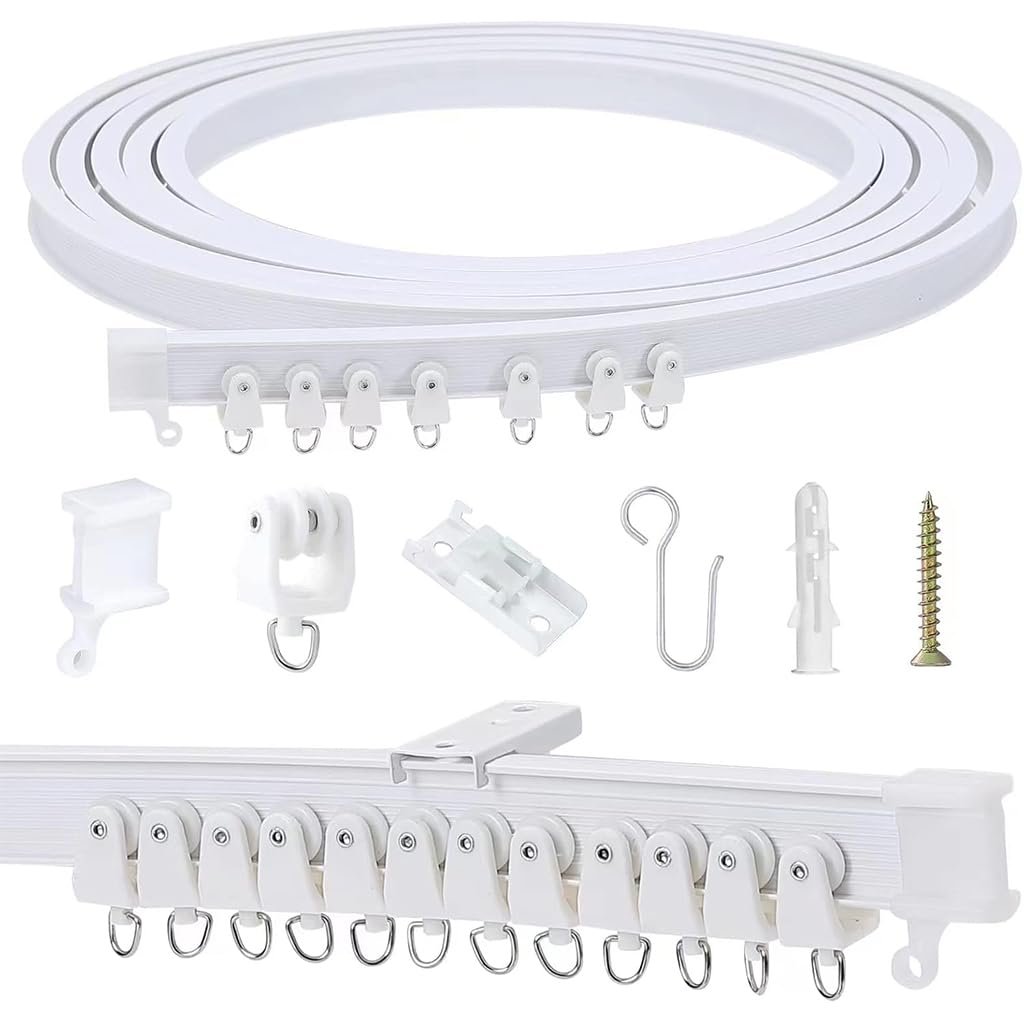
For most bay windows, a flexible or bendable curtain track is the cleanest and most versatile solution. A flexible track can be shaped to follow the exact contour of your bay — bending around the corners so that curtains hang smoothly across the entire bay as one continuous treatment, without gaps or awkward junctions.
Flexible tracks are ceiling-mounted or wall-mounted brackets, and they are available in standard lengths that can be cut to size. The key advantage is that curtains hung on a flexible track slide continuously along the entire bay — meaning that when you draw them open, they stack neatly at the far sides of the bay rather than bunching at each panel junction.
For a particularly clean look, a ceiling-mounted flexible track is the ideal choice. The track is invisible when the curtains are hung, giving the appearance that the curtains fall directly from the ceiling around the entire bay. This approach photographs beautifully and works well in contemporary and period homes alike.
- Best for: any bay window where you want a unified, designer look. Works for both floor-length curtains and shorter lengths.
- Hardware cost: mid-range. Flexible tracks are more expensive than simple poles but considerably less expensive than bespoke joinery solutions.
- Curtain type: eyelet or pencil pleat curtains both work well on a flexible track. Ring clips also work if you want a more casual look.
✦ PRO TIP: When measuring for a flexible track on a bay window, measure the length of each panel separately and add them together, then add 20–30cm on each outer side to allow the curtains to stack beyond the bay when fully open. This prevents the stacked curtain fabric from blocking the light from the angled panels.
Solution 2: A Three-Section Bay Window Curtain Pole
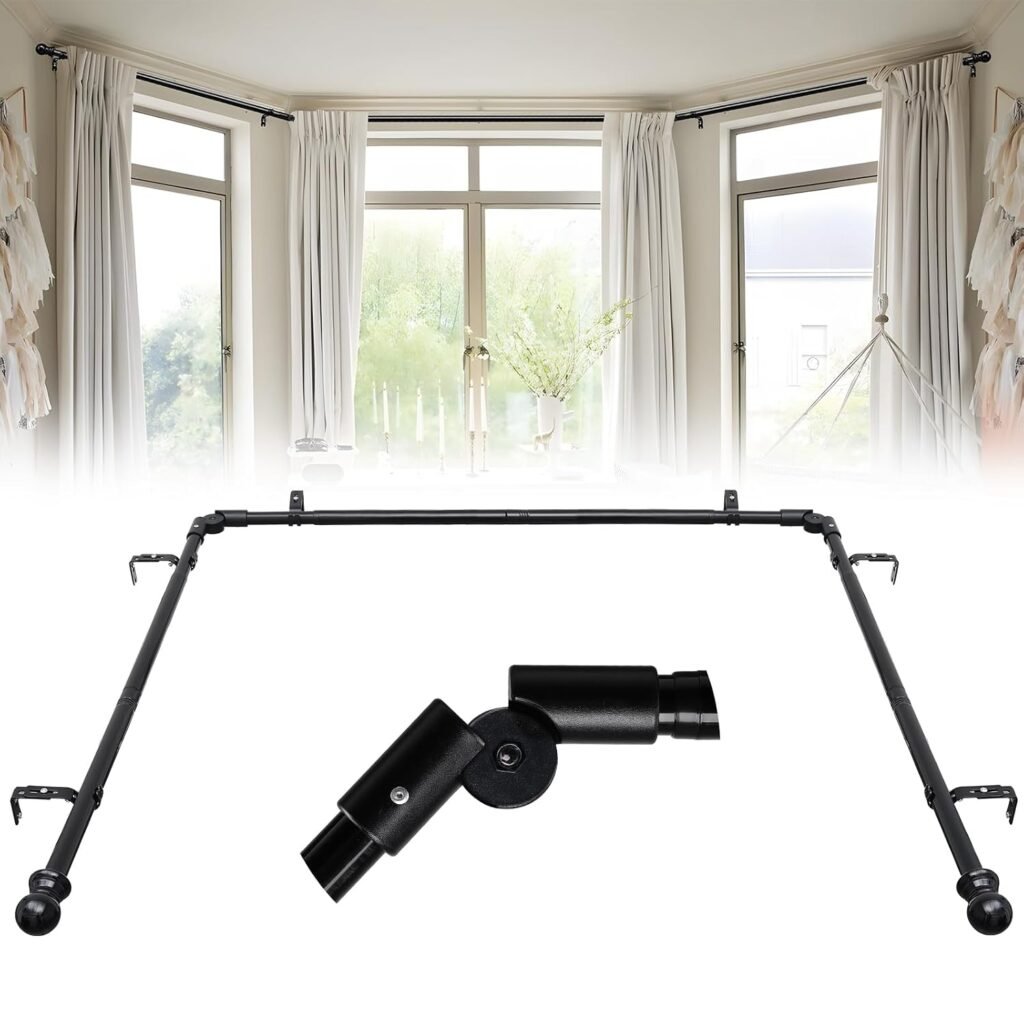
Bay window curtain pole 3 section adjustable 45 degree
A three-section bay window curtain pole is a purpose-designed rod system consisting of a central section, two angled corner connectors, and two side sections. The corner connectors are available in different angles — typically 30°, 45°, and 90° — to match the specific geometry of your bay.
The aesthetic of a bay window pole is slightly more traditional and decorative than a functional track. The pole and finials are visible even when the curtains are drawn, which makes it better suited to rooms where the hardware is part of the visual character — period homes, traditional living rooms, and spaces where ornate curtain hardware is appropriate.
One limitation of a bay window pole is that the corner junctions prevent curtains from sliding continuously around the full bay. In practice, this means you tend to use separate pairs of curtains for each panel — one pair for the central window and one pair for each side panel — which can create a more compartmentalised look than a flexible track.
- Best for: traditional or period-style rooms where visible hardware is appropriate and expected. Victorian terraces, Georgian houses, traditionally furnished living rooms.
- Hardware cost: varies widely from affordable standard sizes to expensive custom lengths for non-standard bays.
- Curtain type: eyelet or tab-top curtains work well. Ring top or pencil pleat also work.
⚠ WATCH OUT: Check the angle of your bay window corners carefully before ordering a bay pole kit. Most standard kits come in either 45° or 30° corner angles — using the wrong angle will leave gaps at the corners or cause the curtains to buckle.
Solution 3: Separate Curtains Per Panel — The Simplest Approach
The simplest approach to a bay window is to treat each of the three panels as a separate window and hang individual curtains on each — one pair on the central panel and one pair on each of the two side panels, each on their own straight rod or track.
This approach has the advantage of using completely standard hardware. Ordinary straight curtain poles or tracks, sized to fit each individual panel, are widely available and inexpensive. There is no complex measuring, no specialist hardware, and no installation challenge beyond fitting three separate sets of brackets.
The visual limitation is fragmentation. Three separate pairs of curtains, each on their own rod, divided by the bay returns, can make the bay look smaller and the window treatment look piecemeal rather than unified. This is particularly visible if the curtains are drawn, when the three separate pools of fabric against the returns can look overcrowded.
This method is most effective in the situation of a room where the bay is not the main decor element, budget is limited, or the panels are so big that the separate curtains do not seem as if they’ve just been thrown together.
📌 NOTE: If using separate curtains per panel, choose exactly the same fabric, colour, and heading style for all three pairs. The only way to make individual panel curtains look intentional is absolute visual consistency. Even a slight tonal difference between panels looks like a mistake rather than a design choice.
Solution 4: One Pair of Full-Length Curtains Across the Entire Bay
Perhaps the most dramatic and visually impactful approach to a bay window is the simplest conceptually: one rod positioned at the front of the bay (across the bay’s opening, rather than inside the bay), with one pair of very wide floor-length curtains that can be drawn across the entire bay when closed.
This approach treats the bay window as a single, very large window rather than three smaller ones. When drawn open, the curtains stack on the walls on either side of the bay — completely out of the way. When drawn closed, they create a single curtain panel that closes off the entire bay, making the room feel more enclosed and cozy.
The advantage is maximum drama and simplicity. One rod, one pair of curtains — no bay-specific hardware required. The disadvantage is that when the curtains are closed, you lose the angular depth of the bay entirely. The curtain hangs flat across the front of the bay rather than following its contours.
This approach works best when the bay window is being treated as a decorative backdrop rather than a view to be maximized — a front room in a Victorian terrace where the bay faces the street, for example, where privacy is valued over view.
- Best for: Victorian street-facing bays where privacy matters more than enjoying the bay’s geometry. Budget-conscious solutions. Rooms where the bay is more backdrop than feature.
- Hardware: one straight rod or track, extended to span the full width of the bay plus a generous return on each side.
Getting the Length Right — The Most Important Decision
Whatever hardware approach you choose, the single most impactful decision for a bay window is curtain length. Bay windows suffer more from incorrectly proportioned curtains than almost any other window type.
Short curtains on a bay window — sill-length or mid-length — emphasize the awkward geometry of the bay rather than celebrating it. The three-panel structure becomes more visible and the window looks smaller than it is.
Floor length window dressings on a bay window can elevate the look of the feature dramatically. Vertical lines of floor length panels not only draw the eye upwards but also downwards so it inures the window look taller and the ceiling seem higher simultaneously. Curtains generously frame the bay and instead of a problematic element the entire feature becomes a focal point.
For almost all bay windows, floor-length curtains are the correct choice. The only exception is kitchens and rooms where practical constraints prevent floor-length curtains — in which case sill-length curtains hung individually per panel are the most practical compromise. That’s why floor-length curtains always work best for this types of windows.
✦ PRO TIP: Hang your curtain track or pole as high as possible — within 5–10cm of the ceiling if the room allows. On a bay window, this is even more important than on a flat wall, because the tall curtain lines help disguise the complexity of the bay’s geometry and make the whole window treatment look more intentional and designed.
Measuring a Bay Window for Curtains
Measuring a bay window correctly is critical and slightly more involved than measuring a standard window. Here is the process for step by step curtain measuring guide:
- Step 1: Decide which approach you are using (flexible track, bay pole, individual panels, or flat front rod) before measuring, as each requires a different measurement approach.
- Step 2: For a flexible track or flat front rod, measure the width of each of the three panels separately. Add them together to get the total track length needed. Add 20–30cm on each outer side for the curtain to stack beyond the bay when open.
- Step 3: For individual panel curtains, measure each panel separately — the central panel and each side panel are likely different widths. Note each measurement separately and buy or make curtains to fit each individual panel.
- Step 4: For drop (length), measure from the top of where the track or pole will be positioned to the floor, and subtract 1–2cm for clearance. All three sections of a bay window should be the same drop for a unified look.
- Step 5: For curtain width, each curtain pair should be 2 to 2.5 times the width of the section it covers for full, gathered curtains. Do not underestimate this — thin, ungathered curtains on a bay window look particularly mean.
Fabric Choices for Bay Windows
Velvet — for maximum drama
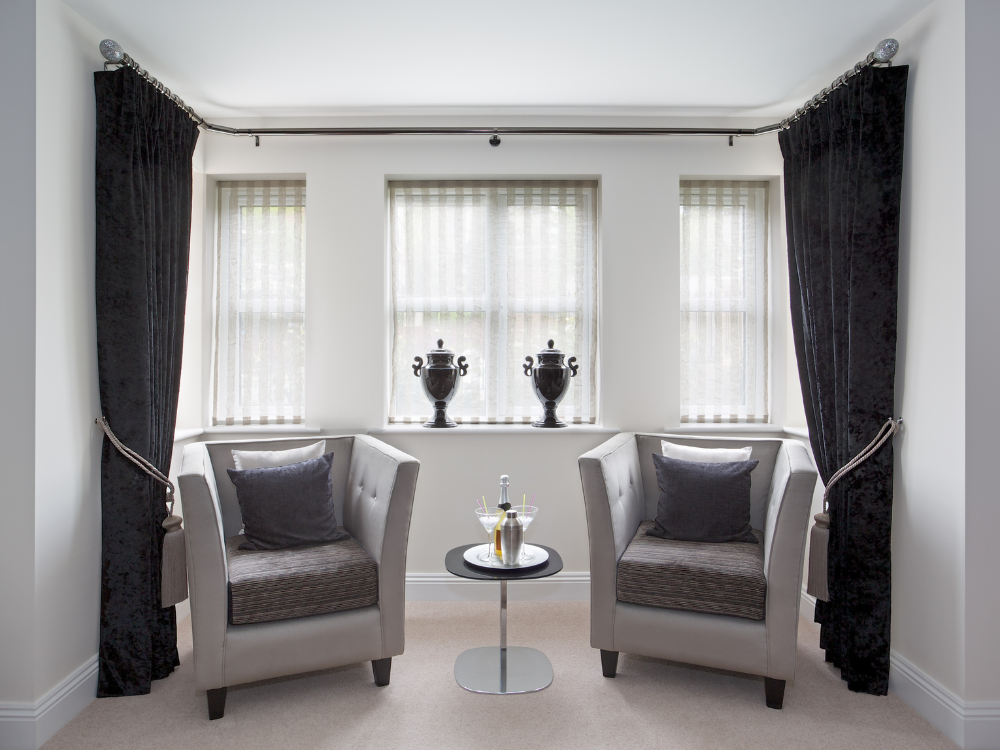
Velvet curtains on a bay window create one of the most striking looks in domestic interior design. The weight of velvet means the curtains hang with exceptional vertical presence, and the pile catches light across the bay’s three facets in a way that makes the window look like a deliberate, architectural design statement. One should know everything about velvet curtains for living room before choosing velvet fabric for curtains.
Deep tones work best — forest green, navy, burgundy, plum — against light walls. The contrast between the bay window’s three white-painted panels and the rich fall of velvet curtains is a combination that has been used in fine British interiors for two centuries and continues to look magnificent.
Linen — for natural, airy elegance

For bay windows in rooms that should feel light and airy — a south-facing sitting room, a breakfast room, a room with garden views — natural or stonewashed linen is an ideal choice. Linen’s slight translucency means the curtains filter and warm the light coming through all three bay panels during the day, creating a beautiful diffused quality in the room.
Linen’s slightly relaxed, softly textured nature makes it an ideal fabric for bay windows as it requires less precision. The natural flow and subtle flaws of linen fabric allow it to be very adaptable to the corners and connections of a bay window in a stylish way. Linen curtains for bay windows and living room is one of the best combination to have the most elegant look.
Sheer layered with blackout
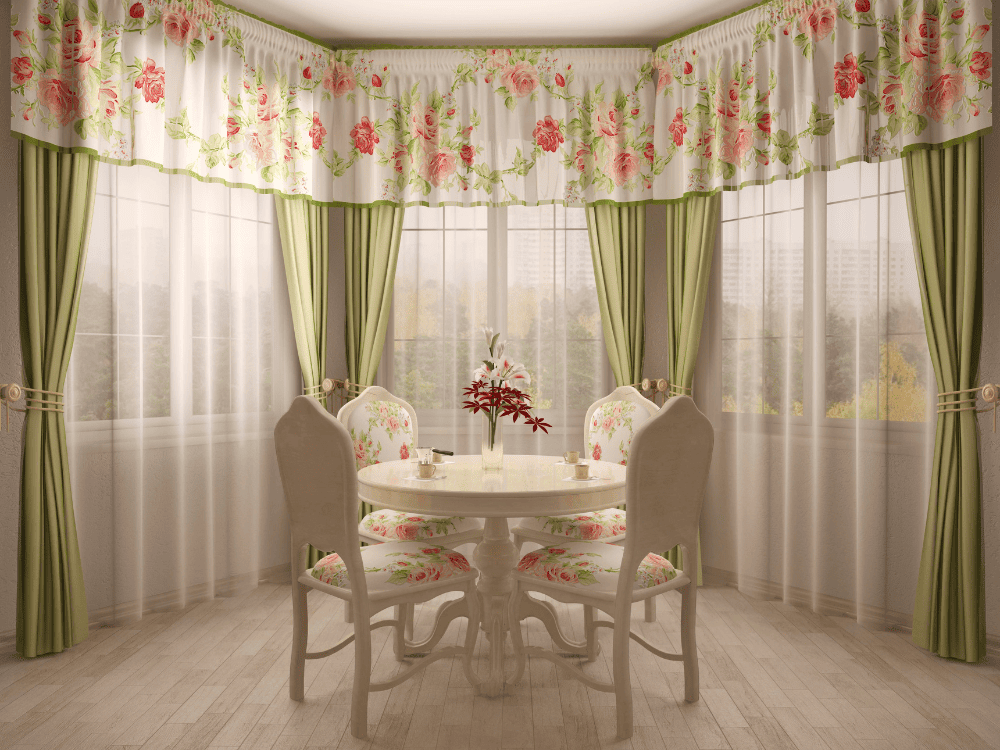
The perfect solution of layering curtains on a bay window in bedrooms or any other rooms where you want to let light in during the day and have privacy at night. A sheer inner layer on a track fitted inside the bay follows the bay’s contours closely, giving filtered privacy during the day. A heavier outer layer — on a flexible track or a bay pole — can be drawn across the full bay at night.
The Most Common Bay Window Curtain Mistakes
- Choosing sill-length curtains. Short curtains emphasize the awkward geometry of the bay and make the window look smaller. Floor-length is almost always better.
- Using the wrong hardware angle. A bay pole in the wrong corner angle (using 45° for a 30° bay) leaves gaps at the corners that look amateurish and allows light to leak through.
- Not measuring for fullness. Curtains that are not wide enough look thin and flat when drawn. Each section of curtains should be 2–2.5x the width of the window section for proper fullness.
- Three different-looking pairs. If using individual curtains per panel, they must be identical in fabric, colour, drop, and heading. Any variation looks like a mistake.
- Hanging the rod too low. At window frame height rather than ceiling height, curtains on a bay window look stuck to the window rather than framing it. Always go as high as possible.
- Forgetting the depth. When curtains are drawn open, they need somewhere to stack that does not block light from the angled side panels. Extend the track or pole well past the bay opening on each side.
Final Thoughts
Bay windows are a gift — they add light, space, and architectural interest that most rooms simply do not have. They deserve curtains that celebrate rather than apologize for their unusual shape.
The main decisions become quite simple once you are aware of the choices: a flexible track for the most graceful, one-look; a three-section bay pole for a classic, ornamental style; single panel curtains for straightforwardness and economy; or a flat front rod for great impact and very little fuss.
Whatever method you select, these three rules are always true: hang the curtains as high as you can, use curtains that go from the ceiling to the floor, and make sure the curtain material is full enough to hang nicely. If you do these three things well, the exact hardware and fabric selections are nearly solved on their own.
Frequently Asked Questions
Q: Can I use standard curtains on a bay window?
A: Ready-made standard curtains might just do the trick on a bay window but hooking up them up correctly will require the right hardware. For example, if you install a flexible bay track, you can easily hang standard eyelet or pencil pleat curtains with the suitable total width over the entire bay. On the other hand, if you decide to use individual curtain poles for each panel, you will have to get three separate pairs of curtains in the sizes that match each panel. The main thing here is accurate measuring — standard curtain drop sizes (90cm, 137cm, 228cm, 274cm) often do not correspond to floor-to-ceiling measurements.
Q: What is the best curtain track for a bay window?
A: Generally, the best folding or bendable curtain track is the one that follows the exact shape of your bay window. Such a track allows curtains simply to slide all the way, along the full width, giving a very neat and minimal look. The track can be installed on the ceiling (most elegant), on the wall at the height of the ceiling, or just above the bay window frame. On the other hand, a ready-made three-piece bay window curtain pole creates a more classical and decorative appearance with the hardware being visible.
Q: How do I stop light coming through the gaps at bay window curtain corners?
A: Light gaps at bay window corners are usually caused by curtains that are not wide enough to completely cover the corner return, or by corner junctions on a bay pole that leave small gaps. The solution is to ensure curtains extend well past the bay corners on each side when drawn, to use a flexible track rather than a jointed pole where gaps are most likely, and to ensure the track or pole projects far enough from the wall at each end that the curtain wraps around and seals against the wall surface.
Q: Should bay window curtains go to the floor?
A: Yes — for almost all bay windows in living rooms, bedrooms, and dining rooms, floor-length curtains are the right choice. They enhance the bay window, making it appear higher and grander, the room seem more styled and the curtain arrangement more deliberate. The only places where floor-length curtains would be out of question are kitchens and utility rooms. However, even in such cases where the bay window is not given the first priority in a room, floor-length curtains on a bay outperform the shorter versions by a wide margin in terms of looks.
Q: How wide should bay window curtains be?
A: For gathered curtains on a bay window, each curtain pair has to be 2 to 2.5 times the width of the section it covers. If you use a flexible track over the whole bay, the total curtain width (both panels together) needs to be 2 to 2.5 times the total length of the track. Under-width curtains are the single most common mistake on bay windows — curtains that lack fullness look thin and flat, particularly when half-drawn. When in doubt, add more width rather than less.
Q: Can I use cafe-style curtains on a bay window?
A: Cafe-style curtains — covering only the lower half of the window — can work on a bay window in kitchen and bathroom settings where full-length curtains are impractical. The key is to use the same fabric and style across all three panels and to ensure the curtain header sits at the same height on each panel. In living rooms and bedrooms, however, cafe curtains on a bay window rarely look as good as full-length alternatives and should generally be avoided.