Two curtain runs meeting at a corner need to work together. Poorly placed hardware can leave privacy gaps, bunch fabric or stop panels opening properly. Choose the system around your window layout, available space and light-control needs.
This guide explains the hardware choices, panel arrangements and measuring checks that help both windows look good and work every day.
First Identify What Type of Corner Window You Have
Identify your configuration before buying hardware:
Two separate windows on adjoining walls. The most common setup. Each window has its own frame, with a section of wall between the frame edge and the corner. The size of that wall section determines your hardware options.
Windows meeting closely at an inside corner. The frames sit very close to the corner, leaving little or no mounting space on the wall between them.
Glass wrapping around the corner. The glazing continues around the corner with minimal framing. Common in modern builds and apartments.
One large window plus a smaller side window. The two windows are different sizes but read as one corner feature.
Corner windows near a door or balcony opening. A door or opening on one side limits where curtains can stack.
Measure each window width, frame-to-corner distance, outer wall space and ceiling height. Note the window-opening direction and where open curtains could stack. These checks determine your hardware and panel arrangement.
For a step-by-step measuring method, see our guide on how to measure curtains and windows.
Should You Use Separate Rods, a Corner Rod or a Ceiling Track?
Choose hardware for the available mounting space and the way you want the panels to move.
Two Separate Curtain Rods
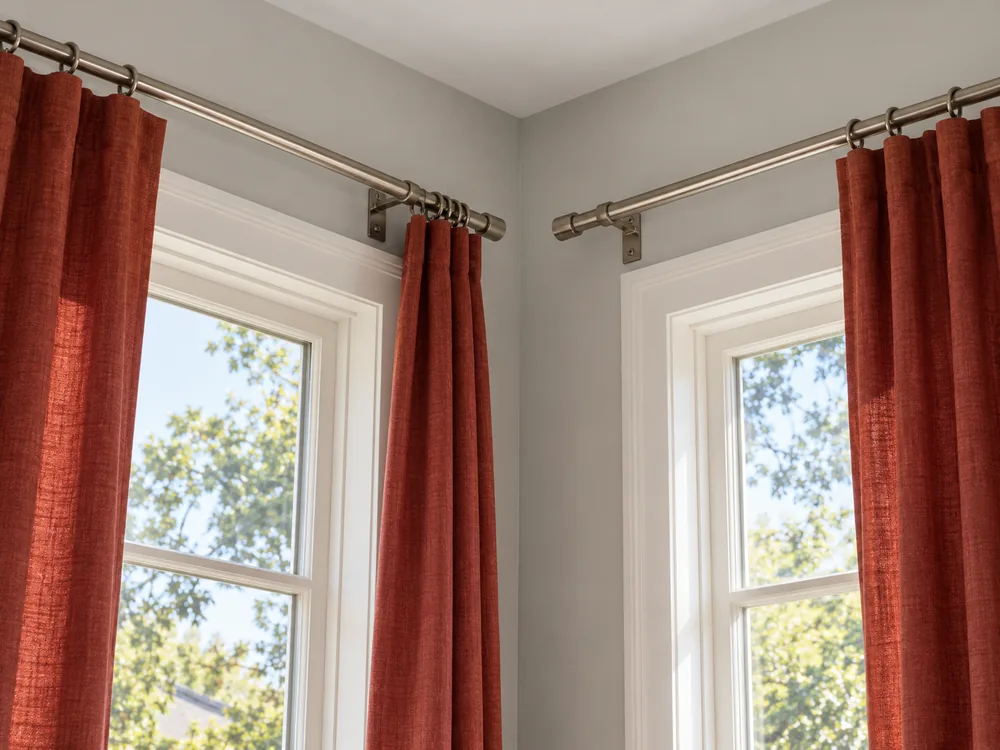
Separate rods suit distinct windows with room for brackets and end caps near the corner. Each window operates independently.
Keep the rods at the same height and use small end caps near the corner. Large finials can clash or crowd the join.
Continuous Corner Rod (L-Shaped Rod)
A compatible elbow or corner connector joins two rod sections, giving adjoining windows one continuous visual line.
A corner connector may join rods visually without allowing rings to pass through. Check the connector, rings and support brackets if you need curtains to travel around the corner. A compatible corner track is another option.
Check the rod diameter, connection type and manufacturer compatibility. Follow the system’s support and weight requirements.
For more on rod types and connectors, see our curtain rod types guide.
Ceiling-Mounted Curtain Track
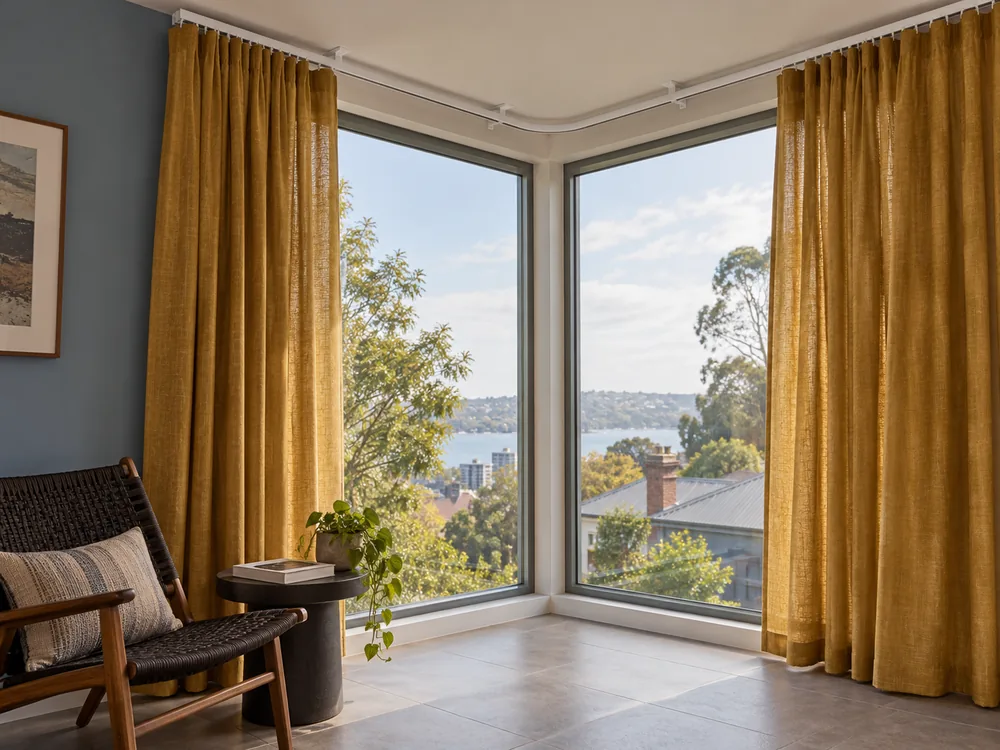
A track designed for corners can let curtains travel around the bend. Choose compatible corner sections and gliders, and confirm that carriers can pass through each join. Some tracks can be curved only as directed by the manufacturer.
Ceiling tracks are useful where wall mounting space is scarce or windows sit close to the ceiling. Their slim profile keeps the hardware unobtrusive.
Ceiling tracks require secure fixings. Check ceiling suitability, curtain weight and the manufacturer’s bracket spacing before installation. They still involve drilling.
8 Corner Window Curtain Ideas That Work
- Separate rods with matching curtains. Best when the windows are clearly distinct with enough wall between them. Matching fabric and identical rod height make the two windows feel intentional. The limitation is the visible hardware at the corner, so keep end caps small.
- Continuous corner curtain rod. Best when adjoining windows read as one feature. A compatible connector unifies the rod line. Check whether panels must operate separately or can pass through the join and brackets.
- Ceiling-mounted corner track. Best when wall space is tight or curtains need to travel around the corner. Choose a system designed for carrier movement through the bend. It keeps hardware discreet but needs suitable ceiling fixings.
- Sheer curtains wrapping both windows. Best when daylight and a soft look matter more than full coverage. A single sheer layer on a continuous track can wrap both windows with very little bulk. Sheers can provide some daytime privacy depending on fabric density and lighting, but they will not block views completely.
- Layered sheers plus main curtains. Best when you want filtered daylight during the day and full coverage at night. A sheer inner layer softens the light, and a heavier outer layer adds privacy or blackout when needed. This works well on a double ceiling track but takes up more depth, so check that the corner can accommodate two layers without the fabric pressing against the glass.
- Curtains stacking away from the corner. Best when you want to keep the corner itself clean and uncluttered. Panels pull toward the outer walls when open, leaving the corner glazing clear. This requires enough wall space on the outer sides for the stacked fabric.
- One dominant window with a simpler treatment on the second. Best when one window is significantly larger. Dress the main window with full curtains and use a Roman blind, roller blind or shorter curtain on the smaller one. This avoids forcing symmetry where the windows are not symmetrical.
- Minimal treatment where the view is the feature. Best when full coverage is not needed. Fixed dress curtains framing the outer edges keep the sightline open. For some light control, add sheer panels or blackout roller blinds fitted inside the recess.
How to Reduce the Gap Between Curtains at the Corner
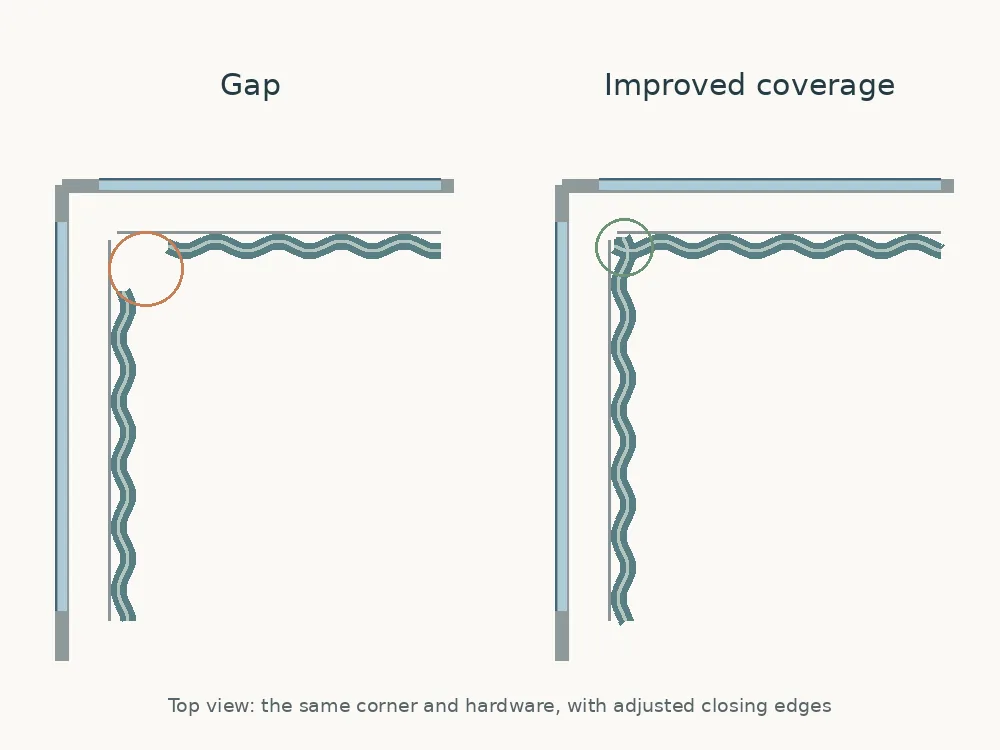
Check the closed curtains from both inside and outside where practical. Coverage depends on the panel edges, hardware position and fabric, so a connected system alone does not guarantee privacy or blackout.
With separate rods, extend toward the corner beyond the glass only where space allows. Position adjoining panel edges to overlap slightly without colliding or restricting movement.
On a continuous track, a panel may travel through the bend rather than end at it. If two panels meet, check their closing edges. Calculate fabric width from the rod or track length covered and the heading manufacturer’s fullness instructions.
Test opening and closing before finalising the arrangement. Excessive overlap can create a bulky, awkward stack.
Where Should Corner Window Curtains Stack?

Plan the open position as carefully as the closed one. Outer-side stacking often leaves the corner and more glass clear. Stacking both runs into a tight corner can block daylight.
If an outer wall is short or has a door, consider less bulky fabric, one-way drawing or fitted blinds with decorative panels. Do not reduce functional panel width so far that closed coverage suffers.
Mounting Height and Extension
Keep mounting height consistent across both walls. Allow clearance for the frame, headings and opening windows. Extend toward the outer walls where there is room for stacking. A track may curve away from the glass only if suitable ceiling space exists and the stack will not obstruct a door, walkway or window.
Layering Sheer and Main Curtains on Corner Windows

Sheers filter daylight and can give some daytime privacy, depending on fabric density and lighting. Close opaque main curtains for night privacy; choose blackout fabric or lining when darkness matters.
Use double rods or separate compatible tracks where space permits. Check clearance for headings, handles and both fabric layers. A slim-looking track does not remove the space needed by the curtains themselves.
For more on combining curtain layers, see our guide to layering curtains.
Choosing Curtain Fabric for Corner Windows
Fabric weight and thickness affect stack size, especially where two runs meet.
Sheers suit light filtering. Linen-look and cotton-blend curtains offer everyday coverage; check opacity before buying. Blackout lining can increase stack size. Velvet or interlined curtains need more room and hardware rated for the load.
Choose by privacy, light control and available space. A fabric sample helps you judge thickness and opacity.
Corner Window Curtains for Bedrooms
For bedrooms, check the corner gap and side coverage for streetlight and morning sun. Layer sheers with blackout-lined curtains if space permits. If two layers are too bulky, consider fitted blackout blinds with a single curtain layer. Recessed blinds may still leak light at their edges.
Make sure curtains do not block window handles or restrict how far the window opens for ventilation.
Corner Window Curtains for Living Rooms
For living rooms, coordinate fabrics and mounting heights while preserving daylight. Sheers soften light; main curtains provide coverage when needed. Keep open stacks clear of glazing where the room allows.
Common Corner Window Curtain Mistakes
These problems come up repeatedly:
- Using large decorative finials that crash into each other at the corner
- Ignoring stacking space, so fabric blocks the glass even when curtains are open
- Leaving an obvious privacy gap at the corner meeting point
- Mounting rods at different heights on the two walls
- Choosing curtains too bulky for the available space
- Blocking window handles or opening mechanisms
- Buying standard rods before checking whether the manufacturer makes a corner connector
- Treating both windows as unrelated when they visually form one feature
- Forcing a continuous system where separate rods would work better, or the reverse
- Choosing appearance without checking how the curtains will actually open and close
How to Choose the Right Corner Window Solution
- Clearly separate windows with mounting space: start with two matching rods.
- Windows wrapping the corner: consider a connected rod for visual continuity or a compatible track for travel around the bend.
- Very little wall space: assess ceiling mounting and suitable fixings.
- Privacy first: check closed coverage and the meeting edges.
- Daylight first: reserve space for the open stacks.
- Blackout needed: address corner and side gaps as well as fabric choice.
If renting, obtain any required permission before drilling. A tension rod may suit an individual recessed window with suitable opposing surfaces, but it does not bridge an open corner. Check fit and load limits rather than assuming a no-drill solution will work.
FAQs
How do you hang curtains on corner windows?
Identify your corner type, measure both windows and the wall space at the corner, then choose separate rods, a corner rod or a ceiling track. Mount all hardware at the same height.
Can two curtain rods meet in a corner?
Yes. Two separate rods can end near the corner, or a corner connector can join two rod sections into one visual line. Use small end caps rather than large finials to keep the corner tidy.
What type of curtain rod works for corner windows?
Standard rods work when there is enough wall space for brackets. For windows wrapping the corner, an L-shaped rod with a corner connector or a ceiling track is usually a better fit.
Are ceiling tracks better for corner windows?
They can be, especially when wall space is limited. A track with a corner connector lets gliders travel through the bend. The trade-off is that they require ceiling fixings.
How do you stop a gap between corner curtains?
Extend the rod or track slightly past the glass at the corner side, use enough fabric fullness for your chosen heading, and consider overlapping adjoining panels slightly.
Can you use blackout curtains on corner windows?
Yes. Pay attention to the corner gap and consider combining blackout curtains with recessed blinds for maximum darkness.
Should corner-window curtains match?
Coordinated fabric and consistent rod height generally looks better. If the windows are different sizes, a simpler complementary treatment on the smaller one can work well.
Can you layer sheer and blackout curtains on corner windows?
Yes, using a double rod or dual ceiling track. Check that the corner has enough depth for both layers without fabric pressing against the glass.