
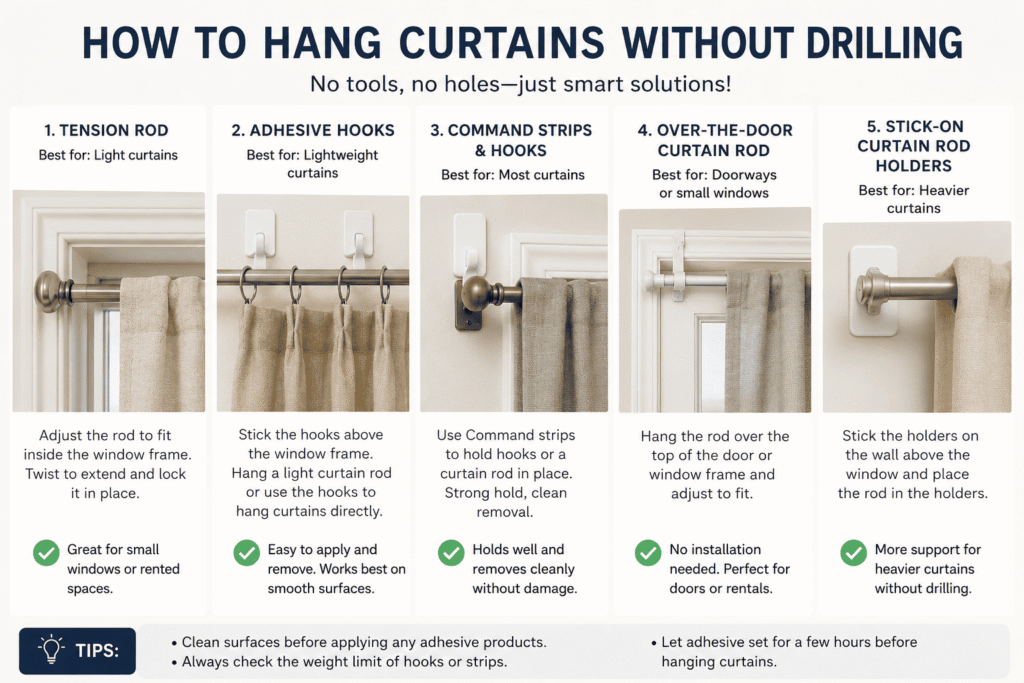
If you rent your home, you already know the drill. Or rather, you know you cannot use one. Landlords, letting agents, and rental agreements have strong opinions about holes in walls — and most of those opinions involve words like ‘deduction’ and ‘deposit’.
However, you shouldn’t accept having bare windows in a rental as if it’s a fact of life. Curtains can transform a room more than pretty much any other single thing: they provide heat, seclusion, a friendly feeling, and they make the space feel like it’s been inhabited someone rather than just occupied temporarily. Fortunately, at present there really are some brilliant solutions for putting up curtains with no need to make a single hole in the wall.
This guide presents six methods that are effective in real homes – not merely in theory. Each of them has different advantages, different constraints, and is suitable for different kinds of windows and curtain weights. When you finish, you will be certain of the solution that is right for your particular case.
Before You Choose a Method — What to Consider
Not every no-drill curtain solution is the same, and the correct decision is influenced by a few main factors. Consider these carefully before purchasing anything:
How heavy are your curtains?
This is the most important variable. A pair of lightweight sheer curtains weighs very little and can be supported by almost any of the methods below. A pair of heavy velvet or blackout curtains is a different matter entirely. Heavy curtains need stronger support — and some no-drill solutions simply cannot carry that weight safely or reliably.
As a rough guide: sheer and voile curtains are low weight and work with any method. Standard polyester or cotton curtains are medium weight and work with most methods. Heavy velvet curtains, thermal, or blackout curtains are high weight and need the stronger options specifically noted below.
What are your walls and window frames made of?
Adhesive-based solutions stick differently to different surfaces. Smooth painted plaster walls are the ideal surface for adhesive hooks and brackets. Textured or porous walls — bare brick, rough plaster, stone, or heavily textured paint — are significantly more difficult for adhesives to bond with. Window frames made of u PVC are excellent for tension rods. Old wooden frames or curtain pelmets may work but can sometimes be uneven.
How long does the curtain need to span?
Tension rods work brilliantly for standard-width windows but have practical limits — most are designed for spans up to around 150 to 180 cm (about 60 to 70 inches). For very wide windows, you will need either multiple tension rods with a join, or a different method entirely.
✦ PRO TIP: Always measure your window width before buying any rod or hanging system. A tension rod stretched beyond its rated span will sag in the middle and eventually either bend or spring off the wall — usually taking the curtains with it.
Method 1: Tension Rods — The Easiest and Most Reliable Option
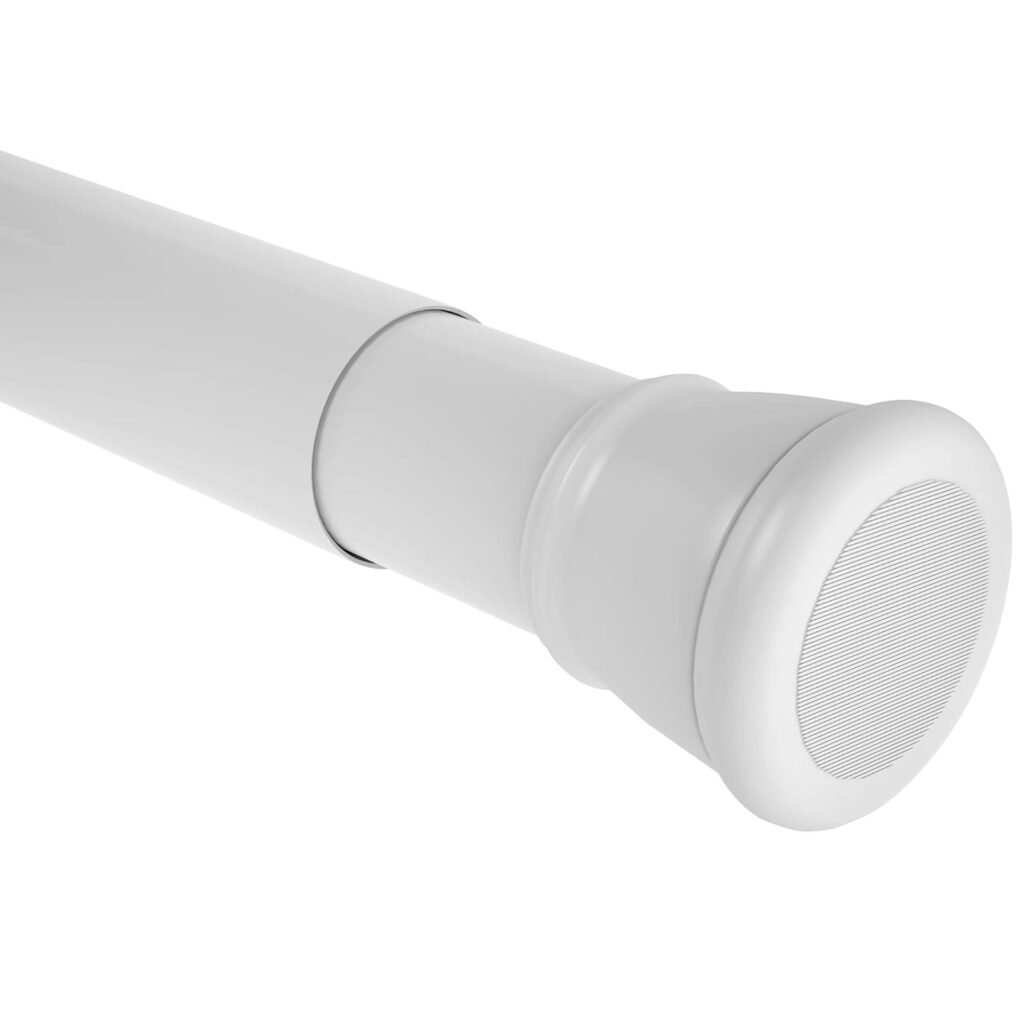
A tension rod is a spring-loaded rod that wedges itself between two surfaces using internal tension — no brackets, no hooks, no adhesive, and absolutely no drilling. You simply compress the rod, position it between the window recess walls or frame sides, and release. The spring tension holds it firmly in place.
This is the single most reliable no-drill curtain solution for most standard windows, and it is also the cheapest. Tension rods are available in a range of sizes from around 30 cm all the way up to 150 cm for wider windows, and in finishes including chrome, white, black, and brushed brass.
Where tension rods work best
- Inside window recesses where the rod sits within the frame rather than across the wall above it — this is the ideal setup, as the rod has equal walls on each side to push against.
- Cafe curtain style setups where the curtain covers only the lower half of the window — very popular in kitchens and bathrooms.
- Lightweight to medium weight curtains — sheers, voiles, thin cotton panels.
- Rental apartments and flats where zero damage to walls or frames is essential.
Where tension rods struggle
- Very wide windows beyond 150 to 180 cm — the rod may sag under its own weight across this span.
- Heavy velvet, blackout, or thermal curtains — the weight can overcome the spring tension and cause the rod to fall.
- Windows without parallel sides for the rod to press against walls.
✦ PRO TIP: If you are buying tension rods, consider ones with rubber end caps instead of plastic or bare metal ones. Rubber not only has a better grip on the window frame and is much less likely to slip or leave marks, but it also prevents small scratches which plain metal ends can cause on uPVC frames.
Method 2: Command Strips and Adhesive Curtain Rod Brackets
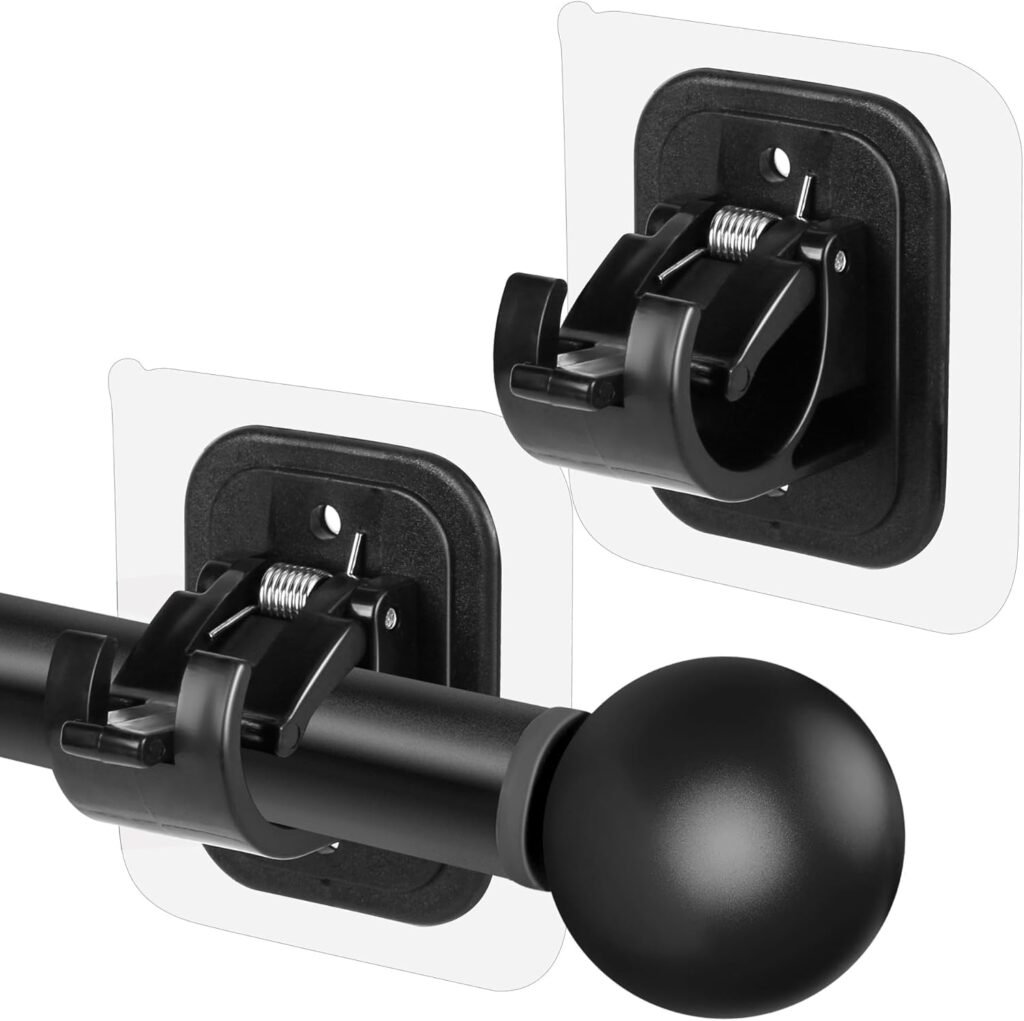
Buy Adhesive Curtain Rod Holder Without Drill
Command strips — the removable adhesive strips made by 3M — have become a genuine game-changer for renters. They bond strongly to smooth, clean, painted walls, hold significant weight, and when removed correctly leave absolutely no mark, no residue, and no damage.
3M manufactures command hooks and strips that are very suitable for curtain rods. The bracket design of these hooks holds the rod from the wall at the perfect distance. On the packages of these products, it states the maximum weight of the curtain rod that can be supported by the hooks.
How to use Command curtain rod hooks correctly
- Remove any dust, grease, or moisture from the wall surface cleanly — if not, it will greatly weaken the adhesion. Take some rubbing alcohol on a cloth and after wiping, let the surface dry
- Press the glue hard on the wall for a minimum of 30 seconds — simply pressing briefly and walking away is not what you should do. The longer the first contact, the better the
- Wait the full 24 hours as it says on the packaging before putting any weight on the hooks. This gives the adhesive time to fully cure. A lot of people hang curtains the very same day and then are surprised to find the hooks fell overnight.
- When you remove it, you should pull the strip slowly and steadily downwards parallel to the wall — you shouldn’t pull it outward. Pulling at the proper angle causes the adhesive to be stretched away cleanly without damaging the paint.
⚠ WATCH OUT: Command strips have a stated weight limit. Always check the packaging and ensure your curtain rod and curtains together are within the rated limit. Exceeding the weight limit causes the strips to fail — often at the worst possible moment.
Adhesive curtain rod brackets — a stronger alternative
Purpose-made adhesive curtain rod brackets are a step up from Command strips for heavier curtains. These use a very strong industrial-grade adhesive — often similar to what is used in construction — to bond a proper curtain bracket to the wall. They hold significantly more weight than Command strips and look exactly like drilled-in brackets from the front.
The trade-off comes with removal: Though they do get off walls, they need more work and at times, a bit of paint may come off with them. They fit the best to renters who are sure they will stay in a property for a while and are okay with doing a little paint touch-up when they leave.
Method 3: Magnetic Curtain Rods
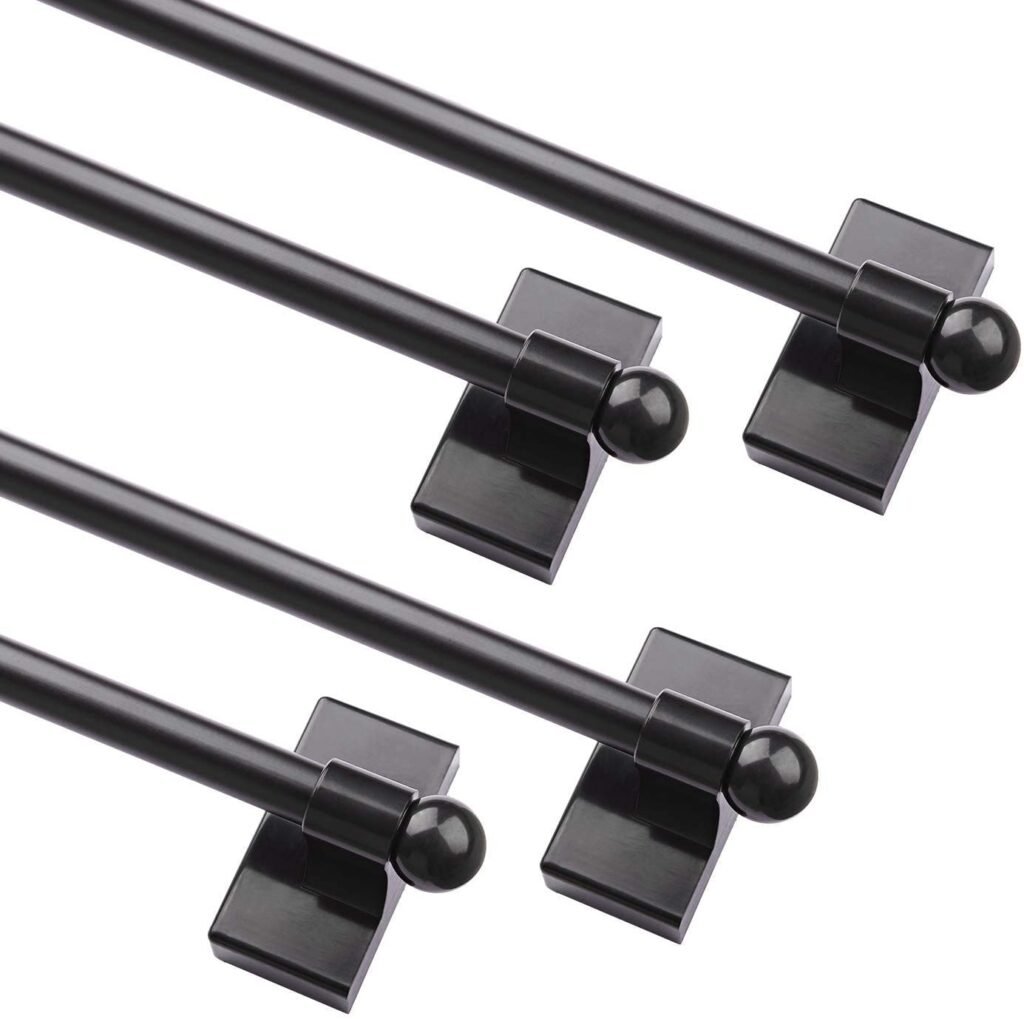
If your window frames or the wall area around your windows is metal — which is the case in some modern apartments, industrial-style conversions, and homes with steel window frames — magnetic curtain rods are an elegant and extremely simple solution.
Magnetic rods has strong magnets at the ends instead of brackets or tension. They connect quickly to any ferrous metal surface, holding firm and releasing easily. No need for preparation, adhesive does not have to cure, and no risk of damage at all.
The limitation is obvious: they only work on metal surfaces. On plaster walls, uPVC frames, or wooden frames, they have nothing to attach to. If you are not sure whether your window frame is magnetic, hold a household magnet against it — if the magnet sticks, a magnetic rod will work.
Method 4: Curtain Wire with Hook and Eye Fixings
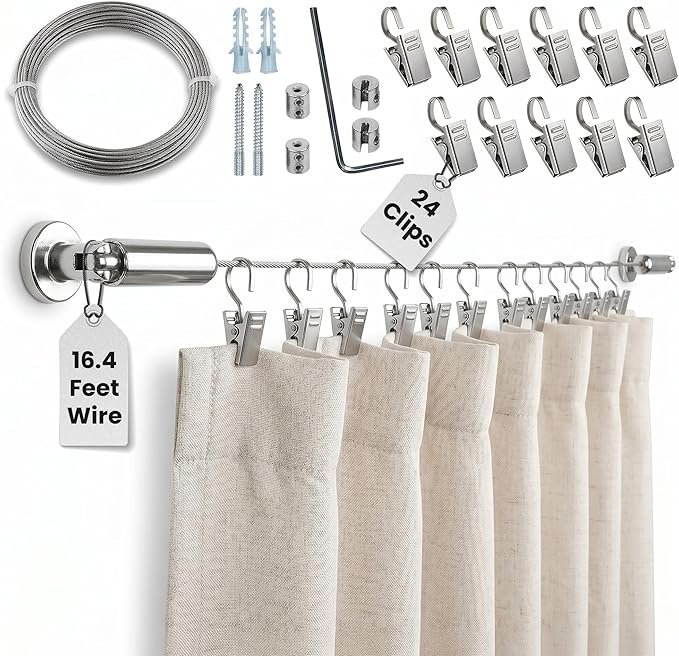
Curtain wire — thin cable or cord strung between two wall-mounted hook-and-eye fixings — is a minimal, almost invisible way to hang lightweight curtains, particularly sheers and voiles. The wire itself is barely visible from a distance, which gives the curtains a clean, floating appearance that works beautifully in modern and Scandinavian-influenced interiors.
Renters can use curtain wire along with adhesive hook-and-eye fixings at each end, so no drilling at all. These fixings must be able to support the weight of the curtains plus the tension of the wire, so do check the packaging thoroughly before buying.
Curtain wire is best suited to lightweight curtain fabrics. It will sag under heavier curtains, and while some sag can be corrected by tightening the tension, very heavy fabrics are simply beyond what wire can support safely.
Method 5: Ceiling-Mounted Curtain Track Without Drilling
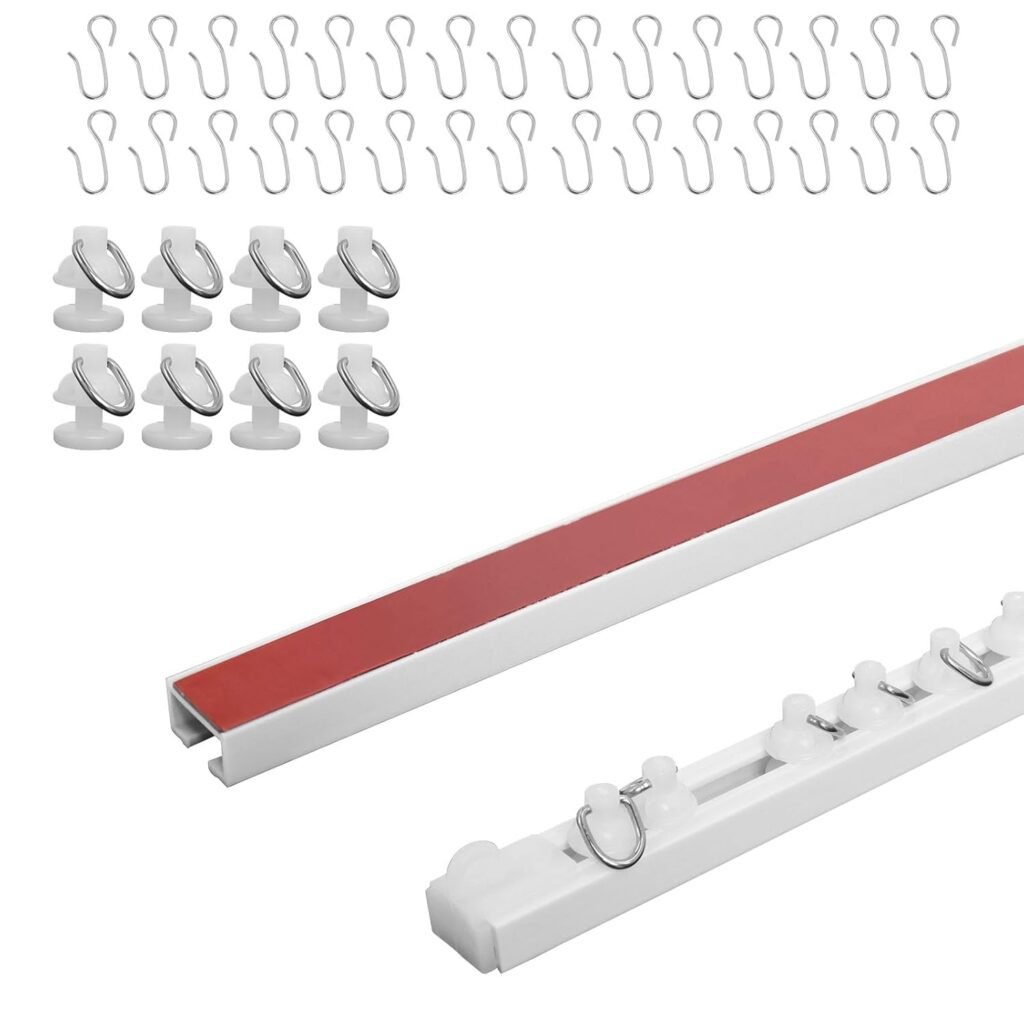
Ceiling-Mounted Curtain Track Without Drilling
For renters in properties with suspended ceilings — common in modern flats and apartments — ceiling-mounted curtain tracks can sometimes be installed without drilling into the main ceiling structure. Some tracks clip into suspended ceiling grids; others use adhesive pads rated for ceiling installation.
This is also the method used to hang curtains in rooms where walls are not suitable for any hanging method — for example, rooms with all-glass walls, tiled walls, or very rough stone walls that adhesives cannot bond to reliably.
Ceiling track gives curtains a clean, modern look with no visible rod or bracket. The curtains appear to fall directly from the ceiling, which is particularly effective with floor-to-ceiling panels in tall rooms.
📌 NOTE: Always check with your landlord before using ceiling-mounted tracks, even the no-drill type, as some properties have regulations about what can be attached to ceilings.
Method 6: Over-the-Door and Furniture-Mounted Curtains
This is the most out-of-the box idea from the list, however if implemented in the right context it can yield pretty good results. Instead of affixing anything to walls or window frames, the curtain rod simply sits on or hooks over an existing item in the room – a door frame, an open bookcase, a cupboard/wardrobe or even a big piece of freestanding furniture placed next to the window.
This works particularly well for partition curtains — curtains used to divide a room into sections rather than to cover a window — and for doorway curtains in rooms where doors have been removed. It is also useful in very short-term rentals where even adhesive solutions feel like too much commitment.
The practical constraint is that the rod needs to be supported at both ends by something solid and at the right height. In many rooms, this simply is not possible for window curtains without the furniture arrangement looking forced.
Choosing Curtains for No-Drill Methods
Your choice of method will be only partly determined by the type of curtains you want to hang. Some curtain types are compatible with every method; some require a bit more thinking:
Sheers and Voiles
These are the most versatile curtains for no-drill methods. They are lightweight enough to work with tension rods, command hooks, curtain wire, and magnetic rods. If you are unsure which method to use, starting with sheer curtains gives you the most options.
Standard Cotton or Polyester Curtains
Medium-weight curtains work well with tension rods (for narrower windows), command rod hooks (within the weight rating), and adhesive brackets. Check the curtain weight before committing to any adhesive solution.
Heavy Velvet, Thermal, or Blackout Curtains
These need the strongest solutions: heavy-duty adhesive brackets rated for significant weight, or ceiling track systems. Tension rods and standard command hooks are generally not sufficient for heavy curtains, and attempting to use them risks the entire curtain assembly falling — potentially damaging both the curtains and whatever is below them.
✦ PRO TIP: If you are really into heavy velvet or blackout curtains but only have no-drill options available, maybe you should think about a fabric of lighter weight first. Most curtain manufacturers, among other things, produce velvet-looking curtains made from light poly blends so that you can get the same look for less weight.
Making No-Drill Curtain Solutions Look Intentional
Many times one of the biggest concerns renters have is that the no-drill type of solutions would frankly look like something temporary or improvised. But minor changes can fully remove this disadvantage:
- Pick a rod finish that complements the metalwork in the room – brass rods go well with brass door handles, chrome rods are a perfect match with chrome taps and fixtures, black rods blend nicely with black frames and fittings.
- Use full-length panels that reach the floor — curtains that are the right length look intentional regardless of how the rod is mounted
- Position the rod (or the curtain top) as high as possible — even tension rods inside the window recess look more deliberate when positioned at the top of the recess rather than halfway down
- Use two panels rather than one — a single panel pulled to one side always looks less finished than two panels that meet in the middle
- Add curtain tiebacks or holdbacks to keep the panels neatly back from the window when open — these make any curtain setup look more considered
What to Do If Your No-Drill Solution Keeps Falling
Have you attempted the no-drill method and still failed multiple times? Then, before throwing in the towel, you should probably check these things:
- Surface preparation for adhesives: If there is any dust, moisture, or grease on the wall — even a trace amount which is not visible — the adhesives will not work. Clean with disinfectant, dry thoroughly, and redo every step again.
- Weight: failure to consider weight is the biggest mistake when choosing a solution. So it is advisable to weigh your curtains and check the reading of the product’s weight-bearing limit.
- Tension rod fit: a tension rod that suddenly changes its position can be caused by the recess being slightly inclined or uneven. Then you can try wrapping the rubber end caps with a non-slip material, or changing a rod with wider, more grippy end caps.
- Temperature and humidity: adhesives do not work well in cold rooms (below about 10°C / 50°F) or very humid environments like bathrooms. In cold rooms, heat the area of the wall softly before applying the adhesive.
⚠ WATCH OUT: You should not attempt to hang heavy curtains via an already loose or deflecting solution. A rod falling from a height has significant weight and can result in damage or personal injury.
Renter’s Quick Reference — Which Method for Which Situation
Here is a simple guide to match your situation to the right method:
- Small window, lightweight sheers, need zero damage: Tension rod inside the recess — fastest, cheapest, most reliable
- Medium window, standard curtains, smooth painted walls: Command curtain rod hooks — clean, removable, no damage
- Medium to large window, heavier curtains, smooth walls: Heavy-duty adhesive brackets — stronger than command, minor touch-up needed on removal
- Metal window frames or metal walls: Magnetic curtain rod — instant, no damage, completely reversible
- Suspended ceiling or all-glass/tiled walls: Ceiling-mounted curtain track — works where walls cannot
- Ultra-temporary or constantly changing setup: Over-furniture or over-door rod — zero installation, completely reversible
Final Thoughts
Renting should not mean living with bare windows and the curtains that came with your property forever. Today’s no-drill solutions are truly effective; not stopgap compromises; proper products that hold curtains securely yet look clean and intentional and leave no trace when it’s time to move on.
Match the method to the curtain weight and surface type – that will result in curtains that stay where they belong, look seamless when coming down, and take off easily when time for their removal arrives.
Once your hanging system is sorted, the next question is which curtains to choose. Whether you want sheers for a light and airy feel, blackout panels for a darker bedroom, or something with a bit of colour and warmth — the fabric matters as much as the method.
Frequently Asked Questions
Q: Do no-drill curtain solutions actually hold properly?
A: Absolutely — if you pair the correct technique with the correct scenario. The main reasons why no-drill fixing products fail are: using a glued method on an inappropriate surface (rough or very dusty), going beyond the weight that the product is designed for, or not following the steps for installation correctly in particular the waiting time for the glue to cure). Choose a method that fits your curtain’s weight and your wall type; then, no-drill fixing solutions are pretty dependable.
Q: Will Command hooks damage walls when removed?
A: No damage is done when a Command strip is removed properly — that is, pulling the tab at a slow and steady pace straight down, parallel to the wall. The crucial word is ‘properly’. If the hook is pulled from the wall at an angle or if it is ripped off quickly, paint can be chipped. So, simply follow the removal instructions on the packaging and these will come off cleanly.
Q: Can I hang blackout curtains without drilling?
A: Yes, but the solution has to match the problem. Ordinary blackout curtains are probably going to be too heavy for both tension rods and Command hooks. A good solution would be to use heavy-duty adhesive curtain rod brackets that have a weight capacity, or a ceiling-mounted track system. If your blackout curtains are very heavy, it makes sense to weigh them and check the weight limit of the product before purchasing any hanging system.
Q: How do I hang curtains in a rental without losing my deposit?
A: Use one of the damage-free methods in this guide: tension rods, Command hooks (properly applied and correctly removed), curtain wire with adhesive fixings, or magnetic rods on metal frames. If you do use adhesive brackets that require more force to remove, a small pot of matching paint for a touch-up is a worthwhile investment and usually costs less than any deposit deduction.
Q: What is the maximum width a tension rod can span?
A: Most standard tension rods is rated for spans up to approximately 120 to 150 centimeters (around 48 to 60 inches). Tension rods can be stretched to 180 cm (about 70 inches). If it is longer than this the rod may sag under its own weight. For wider windows use two tension rods with a little overlap in the middle or go for another hanging method.
Q: Can I hang curtains without any rod at all?
A: Yes — Curtain wire stretched between two hook-and-eye fittings can act without the need for rods, while there are curtain panel systems which use clips attached to ceiling tracks, completely eliminating rods altogether. Both options can look extremely contemporary when placed in the right space.