
Sheer Curtains – What They Are, How to Style, and How to Buy
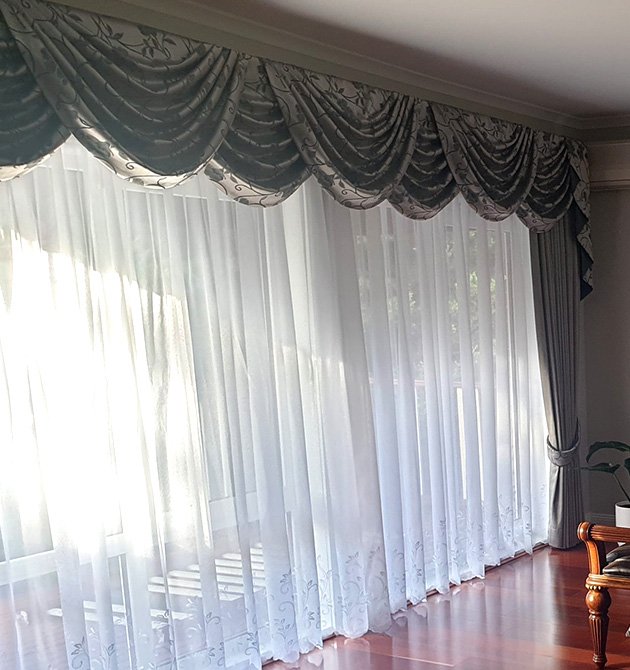
Sheer curtains are lightweight, semi-transparent curtains made from fabrics like voile, chiffon or organza. They soften daylight instead of blocking it, add privacy without shutting a room off, and work best either on their own in low-privacy-need rooms or layered with a heavier blackout curtain behind them. A plain cotton or polyester voile in white or warm white is a versatile starting point for most homes — it drapes well and suits almost any room style.
What Makes a Curtain Count as “Sheer”?
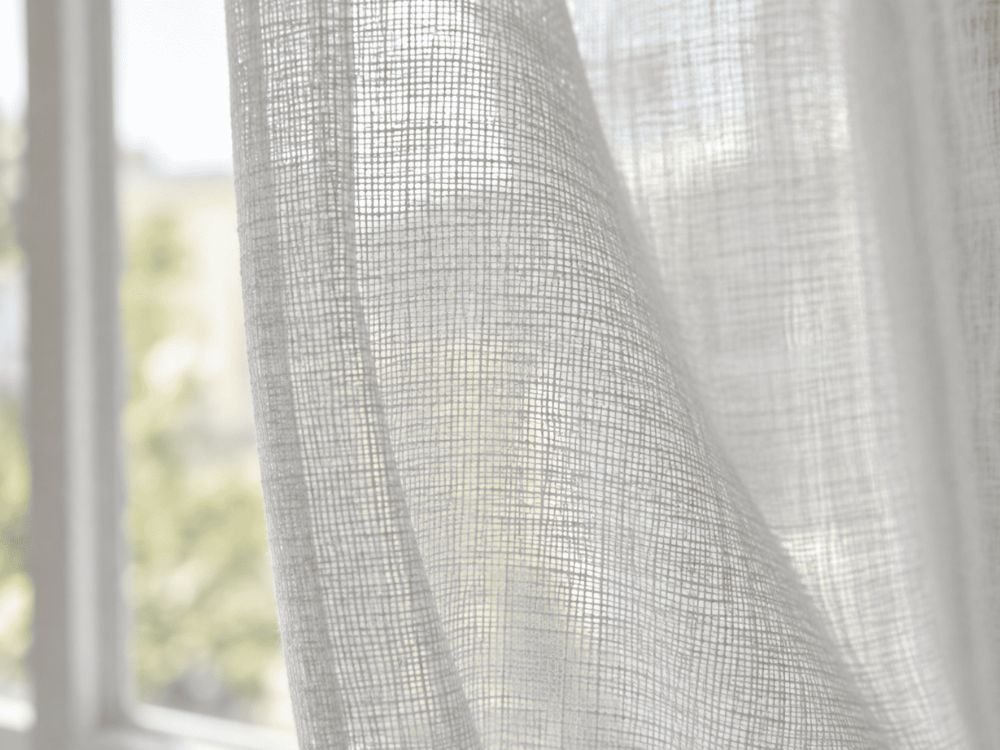
“Sheer” isn’t a fabric. It’s a description of how open the weave is. Any fabric woven loosely enough to let light pass through and shapes show faintly on the other side counts as sheer — which is why voile, chiffon, organza, and even some loosely woven polyesters all get sold under the same “sheer curtain” heading, despite behaving quite differently once they’re actually hanging in a window.
What sheers have in common is what they’re for. They diffuse hard sunlight into something softer. They give a window a finished look without shutting out the outside world. And in warm climates, they let a room breathe — genuinely useful anywhere cross-ventilation matters for a good part of the year.
What they’re not for is privacy after dark or blocking morning light. A sheer curtain lit from behind at night turns a room into a lit stage for anyone outside. If that matters to you — and for most bedrooms and street-facing rooms, it does — sheers are a layer, not the whole solution. More on that below.
When Sheer Curtains Make Sense – and When They Don’t
Climate does a lot of the deciding here, more than most buying guides admit.
Through the hotter months, a sheer curtain lets a room stay bright without turning into a greenhouse under direct sun. It takes the edge off harsh afternoon light without you needing to keep curtains fully drawn all day, which is the usual alternative and makes a room feel closed and dim even when it’s daytime outside.
Through humid or rainy seasons, sheers left as the primary window treatment help a room feel less shut-in on grey, damp days when you still want light but a heavier curtain feels like overkill. Because they’re lightweight and loosely woven, they also dry faster after washing than a dense, heavy curtain, and are less likely to hold onto a musty smell if a window’s been left cracked open in wet weather.
In colder climates, especially through a real winter, sheers alone won’t do much for warmth or light-blocking on a short, dark morning — this is where the layered approach earns its keep.
Rooms where sheers are usually the right call: living rooms with a view worth keeping, balconies and covered porches or verandah doors, kitchens (where full blackout is rarely needed and airflow matters), and any window that gets good natural light you don’t want to lose. Rooms where sheers alone fall short: bedrooms facing strong morning sun, any street-facing ground-floor window, and rooms where you specifically want to sleep past sunrise.
Voile vs Chiffon vs Organza: Which Sheer Fabric Should You Choose?
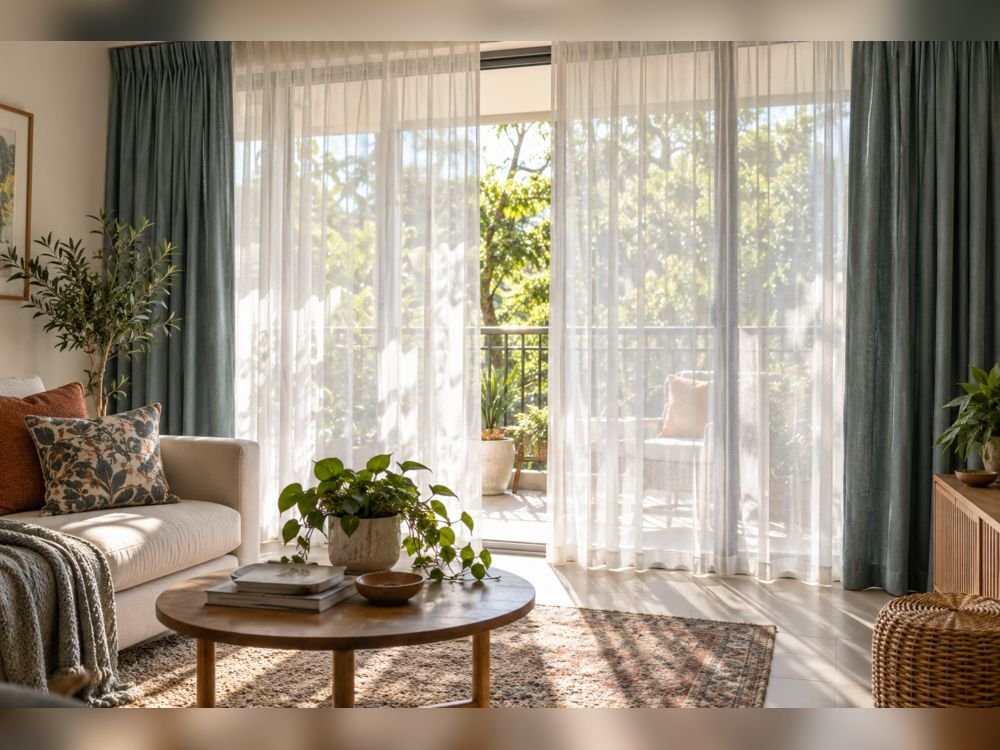
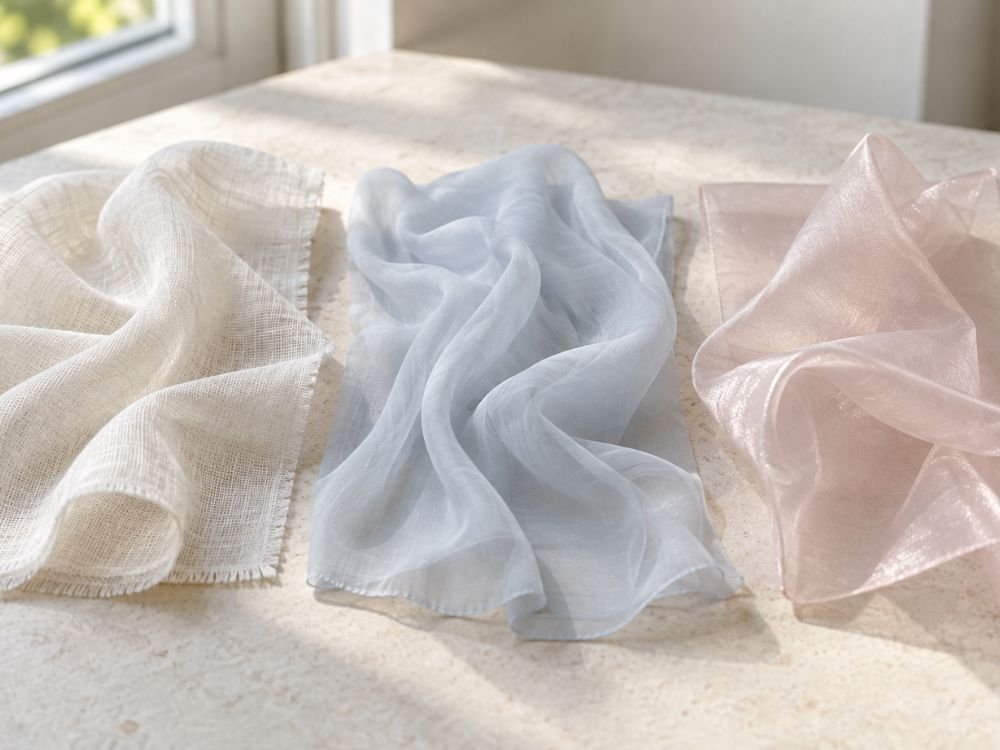
Walk into a curtain retailer or scroll a listing page and “sheer” almost always narrows down to one of three fabrics. They photograph almost identically. They don’t behave the same way at all.
Voile is the workhorse. Usually cotton, polyester, or a cotton-poly blend, plain weave, matte rather than shiny. It drapes softly, generally holds up well to repeated washing, and is the easiest of the three to keep looking good over time. If you only remember one word from this guide, remember this one — voile is the sensible default for most rooms. [AFFILIATE: link “voile” to a general search for “cotton voile sheer curtains” on Amazon or a home textiles retailer]
Chiffon is thinner and has a slight sheen most voiles don’t. It moves more in a breeze, which some people love for a balcony door and others find a bit fussy for a still living room. Polyester chiffon is common and inexpensive; being a lighter, more open weave, it can also be more prone to snagging than voile, so it’s worth handling carefully in a room with young children or pets who might tug at it. [AFFILIATE: link “chiffon” to a general search for “polyester chiffon sheer curtains”]
Organza is crisper and holds its shape rather than falling in soft folds — think of it as sheer with structure. It suits a more formal or contemporary room where you want the curtain to hold a defined silhouette rather than pool softly. It’s also the least forgiving fabric here if the curtain isn’t hemmed and hung properly, since every crease shows.
| Fabric | Feel | Drape | Care | Best For |
|---|---|---|---|---|
| Cotton/poly voile | Soft, matte | Falls in gentle folds | Machine washable, holds up well | Everyday rooms — living room, bedroom, kitchen |
| Polyester chiffon | Light, slight sheen | Fluid, moves easily | Machine washable, can snag more easily | Balconies, doors, rooms wanting movement |
| Organza | Crisp, structured | Holds shape, less soft | Often needs hand wash or gentle cycle | Formal or contemporary rooms |
If none of that narrows it down for you: voile, in white or warm white, is where to start. It’s the fabric that goes wrong the least often.
Three Ways to Hang Sheer Curtains (And How to Pick the Right One)
Sheer on its own
Works when privacy from outside isn’t a major concern — a first-floor-and-above balcony, a garden-facing living room, a study that doesn’t face the street. The appeal is simplicity: one curtain, softened light, done. The trade-off is that after dark with the lights on inside, the room is visible from outside through the sheer, so this only makes sense where that isn’t a problem.

Sheer layered in front of a blackout curtain
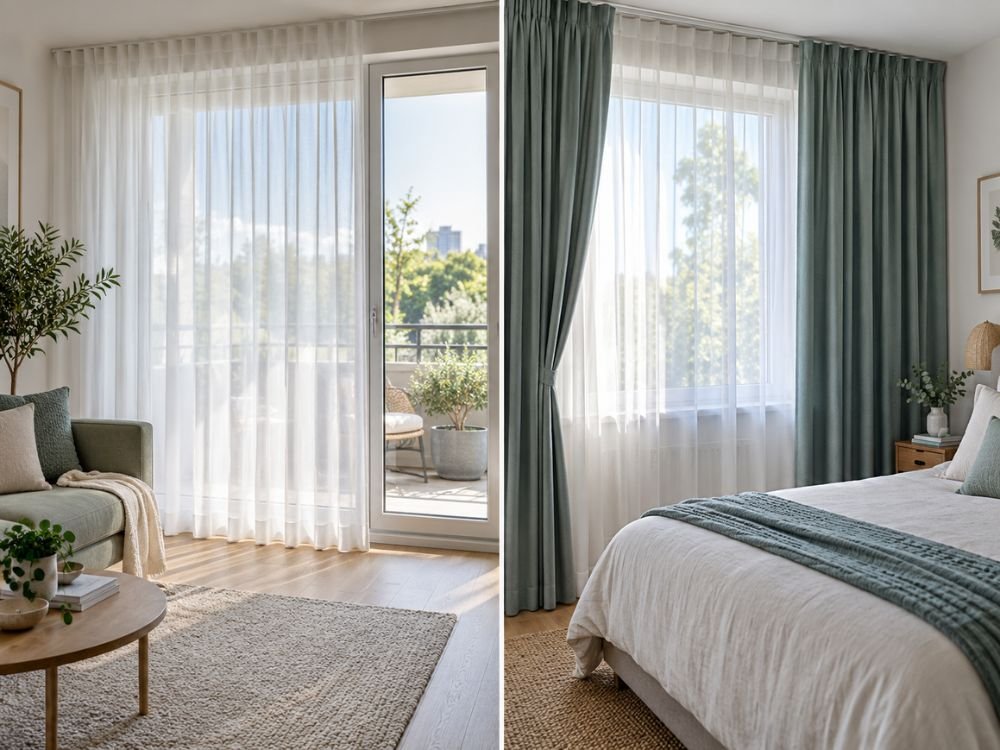
The setup most bedrooms actually need, and the one we’d point most readers toward if pressed to pick one. During the day, the blackout curtain stays open and the sheer alone filters the light — bright, private enough, breathable. At night or during an afternoon nap, the blackout curtain closes behind the sheer for full darkness and privacy. Two curtains, two rods (or a double track), and a room that adjusts through the day instead of being stuck in one mode. If you’re deciding between rod styles for this setup, our grommet vs rod pocket comparison is worth reading before you buy hardware, since a double-rail setup usually wants different headings on each layer. And if you’re still weighing up whether you need both layers at all, our sheer vs blackout curtains guide goes deeper into that decision specifically.
Sheer with a decorative outer curtain
Instead of blackout, some rooms pair a sheer with a heavier decorative curtain — velvet, block print, a patterned cotton — that’s more about style than light-blocking. The sheer does the daily light-softening work; the outer curtain gets pulled across for occasions, evenings, or simply when you want the room to feel more closed-in and cosy. This suits living rooms and dining spaces more than bedrooms, where you usually want the outer layer to actually block light rather than just decorate the window.

What to Check Before You Buy Sheer Curtains
Retail listings for sheer curtains rarely tell you what you need to know, so here’s what to look past the photo for.
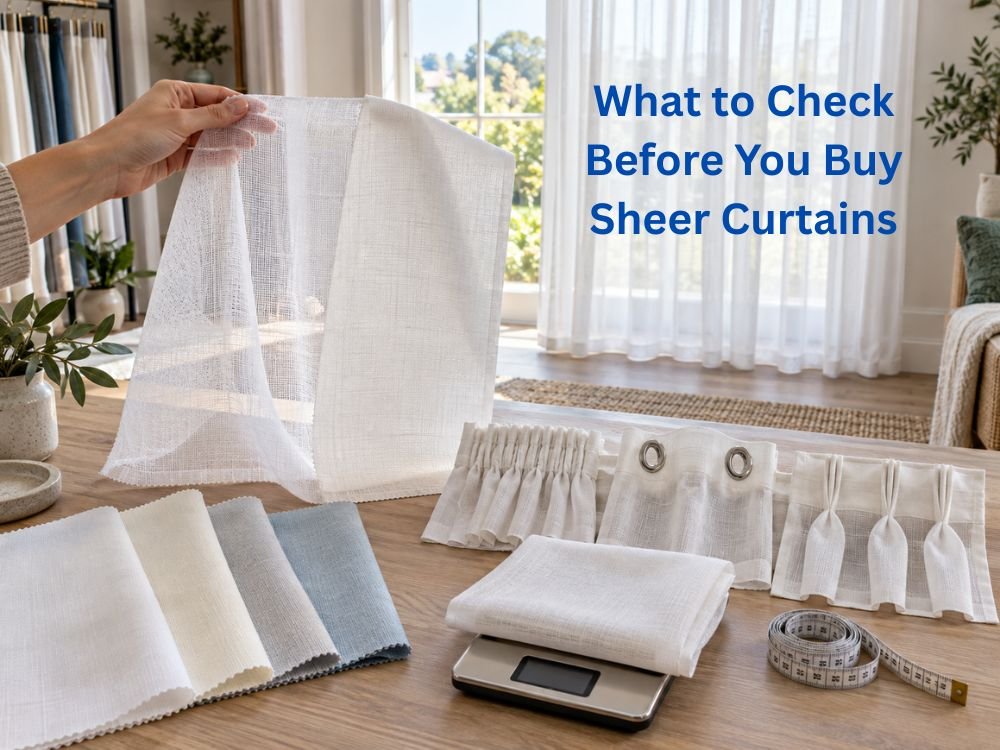
GSM (grams per square metre). Curtain listings often quote this, and sheers are typically somewhere in the range of roughly 60 to 150 GSM — noticeably lighter than an opaque cotton curtain. This isn’t a strict industry standard and varies by manufacturer, but very low GSM (under 60) tends to feel flimsy and see-through in a way that reads as cheap rather than deliberately airy.
Weave density, which photos hide. A tightly woven sheer diffuses light more evenly; a loosely woven one lets more direct light and more of the outside view straight through. Product photos taken against a lit window make almost any sheer look elegant — they don’t tell you how the fabric behaves in your actual room’s light. Where possible, buying from a retailer with a genuine no-questions return window is worth more than trying to judge weave density from a thumbnail.
Colour. White and warm white are the safe, versatile choices that suit the widest range of light conditions and wall colours. Cream and dusty pastels work well in softer, indirect light but can look slightly grey in strong direct sun. Darker or saturated sheers exist but change the character of the light coming through quite noticeably — worth seeing a physical sample before committing a whole window’s worth.
Heading type. Eyelet/grommet headings suit sheers well because the fabric is light enough not to sag under its own weight, and the finished look is clean and contemporary. Rod pocket also works and is often the more affordable option. Pinch pleat and tab-top are less common for sheers specifically because they add bulk to a fabric whose whole appeal is lightness.
Length. Sheers pool or brush the floor more gracefully than heavier fabrics because there’s no weight dragging them down awkwardly. If you’re unsure how to measure for length or height, our curtain length guide and measuring guide cover this in more depth than we can here.
Sheer Curtains Room by Room: What Actually Works
Living room. Usually the strongest case for sheers in the whole house — good light retention during the day, softened glare, and a view that stays at least partly visible. Pair with a heavier curtain if the room faces a busy street and evening privacy matters. See our broader living room curtain colour guide if you’re planning the whole window treatment rather than just the sheer layer.
Bedroom. Almost always wants the layered approach — sheer for the day, blackout behind it for sleep. Our bedroom curtain ideas guide covers the wider styling picture if you’re planning the whole room, not just the window.
Kitchen. A shorter sheer, often sill-length rather than full-drop, suits a kitchen window well — it keeps the room bright over the sink or hob without the practical hassle of a long curtain near cooking. Full privacy is rarely the priority here.

Balcony and porch doors. One of the best uses for sheer fabric in any home. It lets the door function as a door — light, breeze, an open feel — while giving a soft visual barrier during the day. Chiffon’s movement in a breeze often suits a balcony door better than the more static voile.
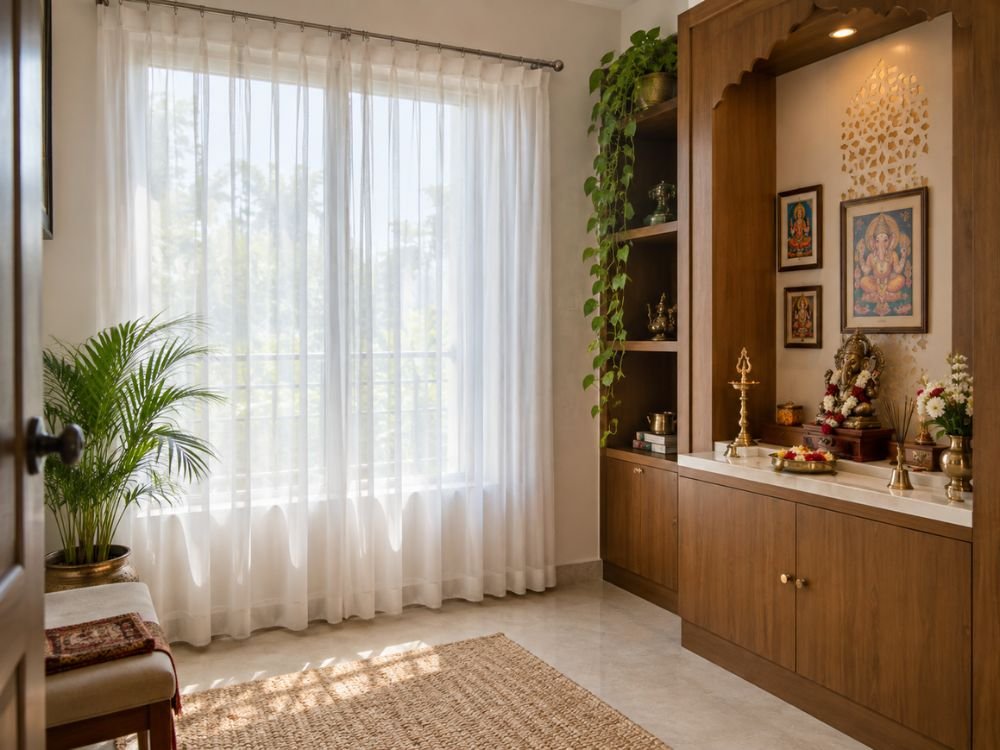
Prayer room or quiet corner. For readers with a dedicated pooja room or a small prayer space, a soft white or cream sheer at the window keeps things feeling calm and light-filled without the starkness of a bare window, and doesn’t compete visually with whatever else is already in a small, often quite decorated space.
How to Wash and Care for Sheer Curtains Without Ruining Them
Most cotton and polyester voile and chiffon can go through a gentle machine cycle in cool water — always check the specific care label first, since blends and finishes vary. Skip the tumble dryer; sheers dry quickly on their own and heat can set creases that are hard to work out of such a lightweight weave. Organza is the one to treat most carefully — many organza curtains do better with a gentle hand wash or a proper dry clean, since machine agitation can distort the crisp structure that’s the whole point of choosing organza in the first place.
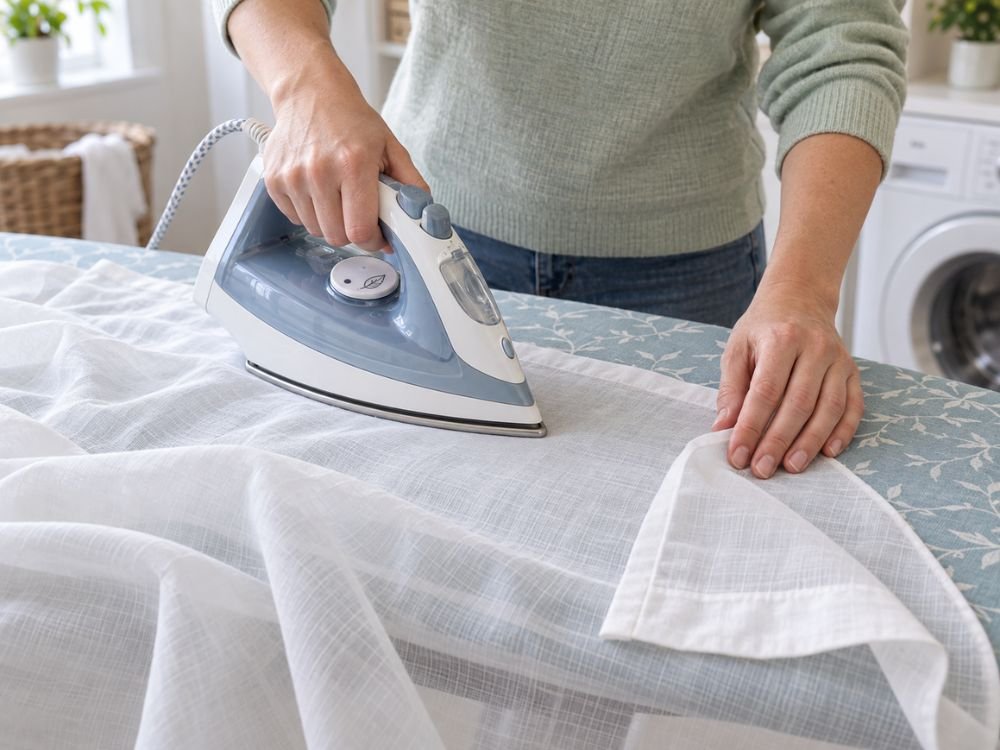
If you do iron, use a low setting with the curtain slightly damp, and iron on the reverse side if the fabric has any sheen, since direct heat on the right side can flatten and dull it. Polyester-based sheers, including many chiffons and organzas, can also be sensitive to heat and may scorch, pucker or partly melt on a setting that a cotton voile would tolerate fine — test an inside corner or hem first if you’re unsure what a curtain is made from.
Sheers near a kitchen or a heavily trafficked window will pick up dust faster than a heavier fabric because the weave is more open. A wash every four to six weeks in a dusty environment keeps them looking fresh rather than grey.
Keep Reading
Explore our curtain fabric guide for how sheer compares to cotton, linen, velvet and blackout fabric, or read how to layer curtains if you’re setting up the sheer-plus-blackout combination this guide recommends for most bedrooms. For the living room specifically, our living room lighting guide looks at how window treatments and lighting work together through the day.
Common Questions About Sheer Curtains
FAQs
Do sheer curtains block any light at all?
Yes, but not much and not evenly. A sheer softens and diffuses direct sunlight rather than blocking it, and it may cut down on some UV exposure compared to a bare window, though nowhere near as much as a proper blackout or UV-filtering fabric. It won’t darken a room or stop early morning light from waking a light sleeper — for that, you need a blackout layer behind it.
Can sheer curtains be used without any other curtain?
Yes, and for many living rooms, balconies and low-privacy-need windows this is the simplest and most practical setup. The main thing to weigh is evening privacy — once lights are on inside and it’s dark outside, a sheer curtain doesn’t hide much.
Which is better for humid climates, voile or chiffon?
There’s not a huge practical difference between the two. Both are lightweight and dry quickly compared to a denser curtain. If anything, polyester chiffon is a synthetic fibre and tends to resist moisture absorption slightly better than cotton voile, while voile breathes a little more comfortably against warm air. Either works fine in a humid climate — the bigger factor is how densely the fabric is woven, not which of the two you choose.
How do I stop sheer curtains from looking cheap or flimsy?
Fullness makes the biggest difference — a sheer curtain hung at roughly double the width of the window, rather than stretched flat, falls in soft folds that read as intentional rather than sparse. A mid-range GSM rather than the very lowest end also helps, as does hanging it close to the ceiling rather than just above the window frame.
Do sheer curtains work well in a rented home?
Yes — they’re generally inexpensive relative to heavier fabrics, easy to take down and reuse in a new home, and don’t need a major hardware investment if you’re using a simple tension rod rather than a fixed track. If you’re renting and want to avoid drilling, it’s worth checking whether a tension-rod setup can comfortably hold your chosen sheer’s weight before buying.
Is white the only sensible colour for a sheer curtain?
No, but it’s the safest and most flexible one. Warm white and soft cream both work well in most light conditions. Pastel sheers can look beautiful in softer, indirect light but tend to lose some of their colour depth in strong direct sun, so it’s worth checking how a sample looks in your specific room before committing to a full set in a colour beyond white or cream.