Most bedroom rugs that look wrong are the right colour and pattern. The problem is size or placement. A rug that barely peeks out from under a queen bed, or one that stops short of the nightstands when you wanted a unified look, can make even a well-decorated room feel unfinished.
The fix is straightforward: match the rug dimensions to your bed size, decide how much of the bed and furniture should sit on it, and measure the room before you order. This guide covers rug sizes for every standard bed, from twin to California king, with placement layouts, a measuring method and the common mistakes that lead to returns.
Bedroom Rug Size at a Glance
This table pairs each standard bed size with the rug dimensions that most commonly work. Use it as a starting point, then adjust based on your room dimensions, placement preference and whether nightstands will sit on the rug.
| Bed size | Mattress dimensions | Good starting rug size | Larger option | Typical placement |
| Twin / Single | 38 × 75 in (3 ft 2 in × 6 ft 3 in) | 5 × 8 ft | 6 × 9 ft | Partial under-bed or runner beside the bed |
| Full / Double | 54 × 75 in (4 ft 6 in × 6 ft 3 in) | 6 × 9 ft | 8 × 10 ft | Lower portion of bed on the rug |
| Queen | 60 × 80 in (5 ft × 6 ft 8 in) | 8 × 10 ft | 9 × 12 ft | Lower two-thirds or full bed coverage |
| King | 76 × 80 in (6 ft 4 in × 6 ft 8 in) | 9 × 12 ft | 10 × 14 ft | Large centred rug, often including nightstands |
| California King | 72 × 84 in (6 ft × 7 ft) | 9 × 12 ft | 10 × 14 ft | Large centred rug |
A note on rug orientation: in the examples throughout this article, the shorter rug dimension runs across the width of the bed and the longer dimension runs toward the foot. So an 8 × 10 ft rug sits 8 ft wide and 10 ft long relative to the bed.
These are guidelines, not rules. A 9 × 12 ft rug might be ideal for one queen bedroom and too large for another. Room dimensions, furniture layout and how much bare floor you want visible all affect the best choice.
How Far Should a Rug Extend Past the Bed?
A common starting guideline is to allow roughly 18 to 24 inches of visible rug beyond each accessible side of the bed. That means the sides you actually step out on and the foot of the bed, not the side pushed against a wall. This is not a strict requirement, and many rooms look great with slightly more or less, but it is a useful reference point when choosing a rug size.
Why that range works:
- It gives your feet a soft landing when you get out of bed.
- It makes the rug look intentional rather than barely visible.
- It keeps the bed and rug visually proportionate.
In a smaller bedroom, 12 to 18 inches may be all you can manage, and that is perfectly fine. The goal is enough rug showing that it reads as a deliberate part of the room, not an afterthought tucked under the mattress.
One important detail: measure from the actual bed frame, not from the standard mattress dimensions alone. Upholstered, sleigh and platform frames are often wider than the mattress, and even a couple of extra inches on each side will affect how much visible rug remains.
Where Should You Place a Rug Under a Bed?
There is no single correct position for a bedroom rug. The best layout depends on your rug size, room dimensions and how much furniture you want anchored on it. Here are the most common options.
Lower two-thirds of the bed on the rug
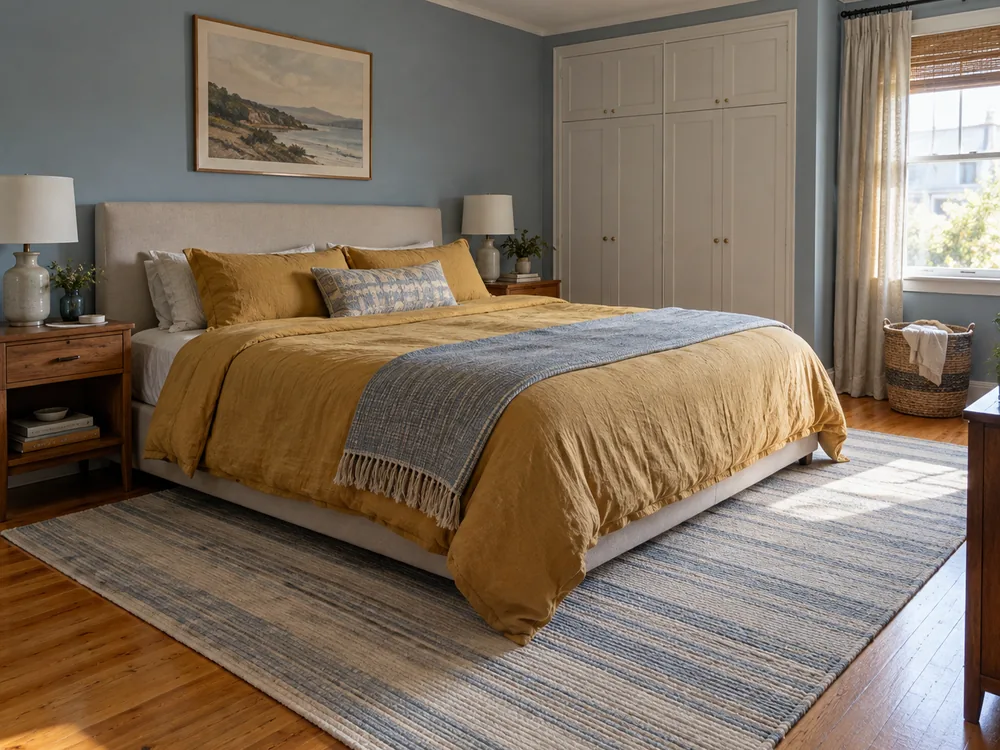
The rug starts roughly a foot or so ahead of where the nightstands sit and runs beneath the lower two-thirds of the bed, extending past the foot. This is the most popular bedroom rug layout because it concentrates the visible rug exactly where you step out of bed in the morning.
It works well with mid-range rug sizes (8 × 10 ft for a queen, 9 × 12 ft for a king) and keeps the nightstands on bare floor, which can make the room feel a little more open.
Entire bed on the rug
With a larger rug, you can position it so the entire bed sits on it. The headboard may or may not touch the wall depending on your room. This layout gives the sleeping area a clear visual boundary and works especially well in open-plan rooms or bedrooms with hard flooring.
Aim for enough visible rug beyond the sides and foot of the bed that the rug reads as a deliberate part of the layout. The 18 to 24 inch guideline is a helpful starting point here.
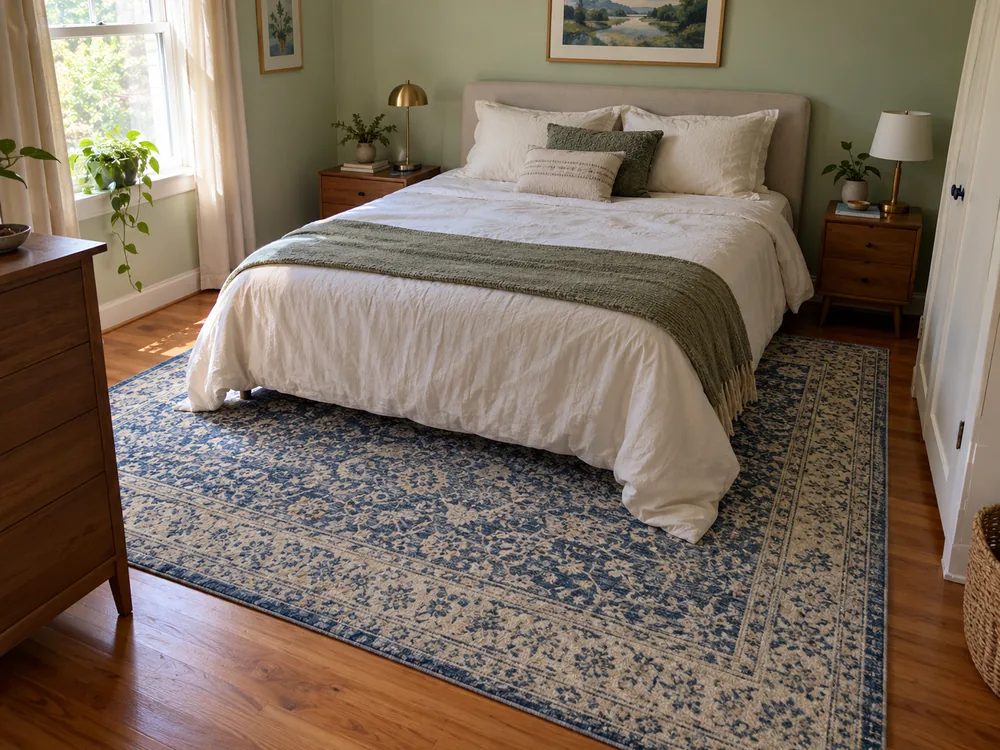
Bed and nightstands all on the rug
This is the most unified look. The rug supports the bed, both nightstands and sometimes a bench at the foot. It typically requires a 9 × 12 ft rug for a queen bed or a 10 × 14 ft rug for a king, and the room needs to be large enough that the rug does not run wall to wall.
The rug should extend a few inches beyond the outer edges of the nightstands so they are clearly sitting on it, not balancing on the edge. If you are also updating your nightstand setup, see our bedside table styling ideas for pairing options.
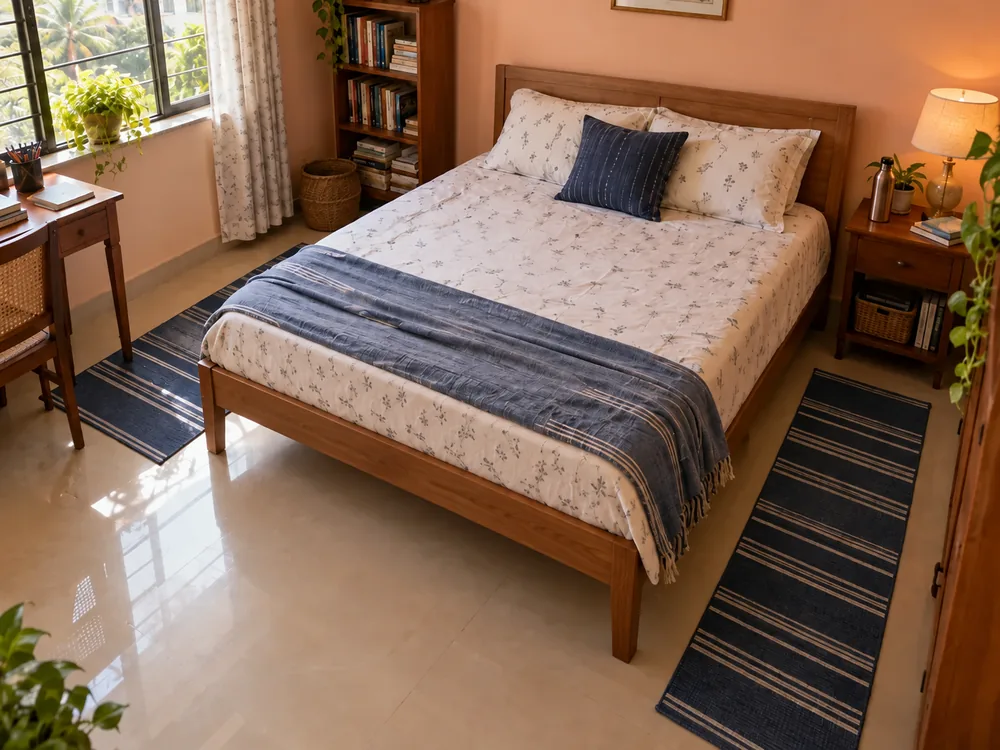
Runners beside the bed
Two matching runners placed on either side of the bed are a practical alternative to a large area rug. This approach is especially useful in narrow bedrooms, rental homes or on a smaller budget.
Choose runners long enough to cover the area where you step out of bed and wide enough to give your feet room to land. Centre each runner roughly with the length of the mattress.
Rug at the foot of the bed
A smaller rug placed only at the foot of the bed can work as an accent, particularly in bedrooms that already have carpet or where the bed is flanked by built-in furniture. Choose a size that extends a reasonable amount beyond the bed’s width, such as a 5 × 8 ft rug at the foot of a queen.
If using a rug at the foot, pull it far enough forward that it sits clearly in front of the bed rather than barely peeking out from underneath.
What Size Rug Goes Under a Queen Bed?
An 8 × 10 ft rug is the most commonly recommended starting size for a queen bed. A standard queen mattress is 60 × 80 inches (5 × 6 ft 8 in), so an 8 × 10 ft (96 × 120 in) rug centred across the bed width leaves approximately 18 inches of visible rug on each side.
If your bedroom is larger or you want the nightstands on the rug, a 9 × 12 ft rug gives you more room to work with. Whether it accommodates both nightstands depends on the width of your nightstands and frame. Measure the total outside width of the bed and both nightstands, then check whether the rug is wide enough to extend visibly beyond them.
Lower two-thirds placement with a queen bed. Position the 8 × 10 ft rug so it starts about a foot in front of the nightstands and runs under the lower portion of the bed and past the foot. This keeps the rug where your feet actually land and is the most popular setup for queen bedrooms.
Full bed on the rug. Centre the rug under the entire bed. With an 8 × 10 ft rug centred on a standard queen, you still get approximately 18 inches of visible rug on each side. How much shows at the foot depends on exactly where you position the rug, so test the layout before committing.
Including the nightstands. If you want the nightstands on the rug, a 9 × 12 ft rug can work with compact nightstands, but it depends on their width. Measure the total outside width of the bed frame and both nightstands. If that combined width leaves little room on a 9 ft (108 in) rug for a visible border, you may need a wider rug.
Small queen bedroom. In a compact room, a 6 × 9 ft rug placed under the lower third of the bed, or a pair of runners beside it, can still give you comfort underfoot without overwhelming the space. Check that the rug will not block wardrobe doors or drawers before ordering.
What Size Rug Goes Under a King Bed?
A 9 × 12 ft rug is the most commonly recommended size for a standard king bed. A king mattress measures 76 × 80 inches (6 ft 4 in × 6 ft 8 in), which means the bed itself takes up a significant portion of any rug beneath it. Smaller rugs tend to disappear under a king faster than under any other bed size.
With a 9 × 12 ft (108 × 144 in) rug centred across a king bed’s width, you get approximately 16 inches of visible rug on each side. How much shows at the foot depends on where you position the rug lengthwise, but with this size there is generally plenty of rug visible beyond the bed.
Why king beds expose undersized rugs quickly. At over 6 ft wide, a king mattress on an 8 × 10 ft rug leaves less than 10 inches of visible rug on each side, which can look undersized. If an 8 × 10 ft rug is your only option, placing it under the lower two-thirds of the bed rather than centring it fully can make the proportions work better.
Lower two-thirds placement. Slide the 9 × 12 ft rug so it begins ahead of the nightstands and extends well past the foot of the bed. This layout puts the most rug where you need it and is the most practical for a standard king bedroom.
Full coverage. Centre the rug under the entire bed. You will want at least a 9 × 12 ft rug for this, and a 10 × 14 ft rug if you also want the nightstands supported.
Including the nightstands. Measure the total outside width of the bed frame and both nightstands. King nightstands vary widely, and the combined width often exceeds what a 9 ft wide rug can cover with a visible border. A 10 × 14 ft rug is a common recommendation when you want the full bed-and-nightstand grouping on the rug.
Small-bedroom compromise. If your bedroom cannot accommodate a 9 × 12 ft rug, consider placing an 8 × 10 ft rug under the lower portion of the bed, or use runners on either side. In a tight room, two well-placed runners will look more intentional than a too-small area rug trying to cover a king bed.
California King note. A California King mattress is 72 × 84 inches: 4 inches narrower but 4 inches longer than a standard king. The same rug sizes apply, though the extra length means you may want to shift the rug slightly toward the foot to keep the proportions balanced.
Rug Sizes for Full/Double and Twin Beds
Full / Double bed
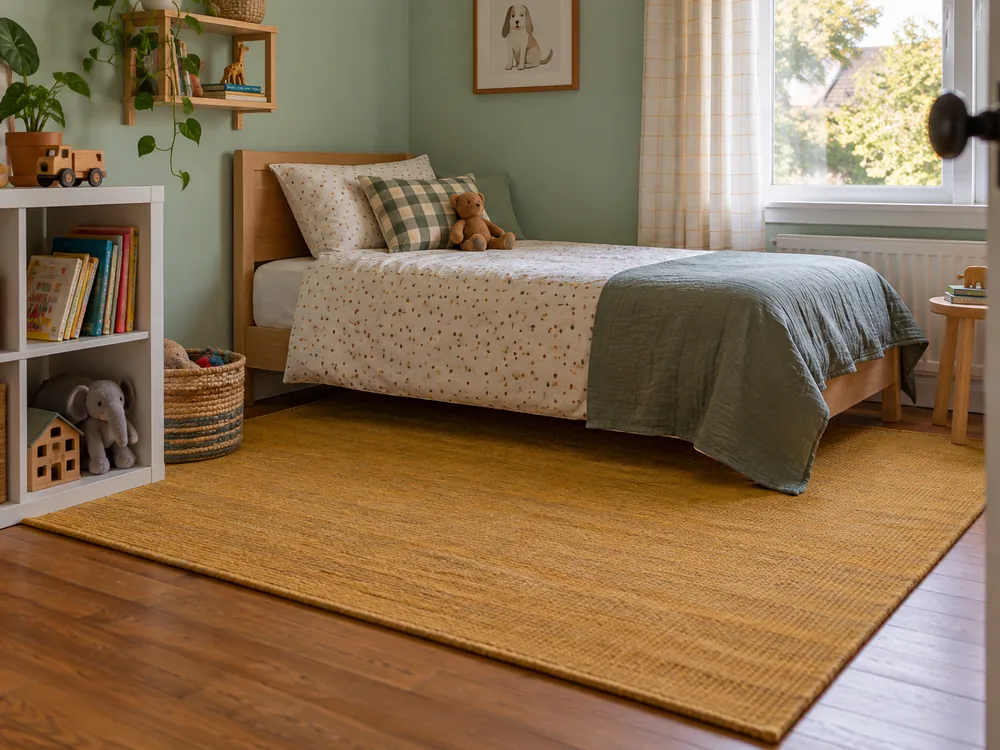
A full (double) mattress is 54 × 75 inches. A 6 × 9 ft rug is a practical starting point: it provides about 9 inches of visible rug on each side with lower two-thirds placement. For a larger room or fuller coverage, step up to an 8 × 10 ft rug, which gives you enough space to include the nightstands or place the entire bed on the rug.
Full beds are often found in smaller bedrooms, guest rooms and children’s rooms, so measure the floor space carefully before sizing up.
Twin / Single bed
A twin mattress is 38 × 75 inches. At that width, even a 5 × 8 ft rug provides decent coverage. You can place it under the lower two-thirds of the bed with visible rug on both sides, or position it beside the bed as a landing zone.
In a child’s room or a shared room with two twin beds, runners between the beds or a single larger rug beneath both beds (an 8 × 10 ft rug can often work for two twins placed side by side with space between them) are worth considering.
For both bed sizes, the same placement principles apply. Choose how much of the bed you want on the rug, allow for visible rug on the sides you use, and check door and drawer clearances.
Bedroom Rug Placement in a Small Bedroom
Small bedrooms need a different approach. A large rug that nearly fills the room can make the space feel smaller, not cosier, especially if there is no visible floor between the rug and the walls.
Prioritise where your feet land. In a compact room, the most useful rug coverage is beside the bed and at the foot. A lower two-thirds placement with a moderately sized rug (one size down from the chart above) often works better than trying to fit the recommended size into a tight floor plan.
Runners work well in narrow rooms. If the gap between the bed and the wall is narrow, a pair of runners (as described in the placement section above) can be more practical than a full area rug.
Check doors and drawers. Before ordering, open every door and pull out every drawer in the room. A rug that blocks a wardrobe door or bunches under a dresser drawer will cause daily frustration. Make sure there is enough clearance for everything to open freely.
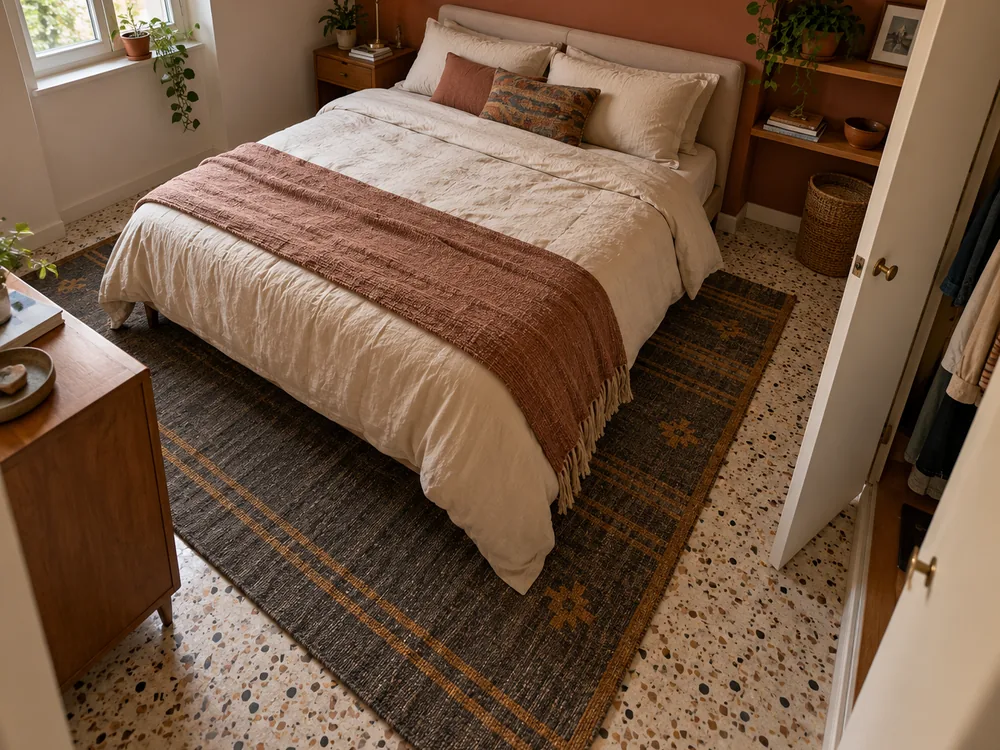
Leave intentional bare floor. Leaving a visible strip of floor between the rug edge and the nearest wall helps a small room feel less crowded. How much depends on the room, but as a starting point, a few inches of clear floor on each side looks more intentional than a rug that nearly reaches the wall but does not quite make it.
Measure before you buy. The painter’s-tape method described in the measuring section below is especially valuable in a small room, where a few inches can make the difference between a rug that works and one that crowds the space.
For more ideas on making a compact bedroom feel more spacious, see our guide to making a small bedroom look bigger.
How to Measure for a Bedroom Rug Before Buying
Measuring takes about 10 minutes and can prevent an expensive sizing mistake. Here is a simple process.
- Measure your actual bed frame. Use a tape measure across the width and length of the frame, not just the mattress. Upholstered headboards, sleigh beds and platform frames often extend several inches beyond the mattress on each side.
- Measure the available floor area. Note the distance from the bed to each wall, including the wall behind the headboard.
- Decide on your placement layout. Choose whether you want the rug under the lower two-thirds of the bed, under the full bed, or under the bed and nightstands.
- Calculate the visible rug you need. Add 18 to 24 inches to each accessible side of the bed. For example, a queen bed frame that measures 64 inches wide needs a rug at least 100 inches (about 8 ft 4 in) wide for 18 inches of visible rug on both sides.
- Account for furniture. If nightstands will sit on the rug, add their width to each side. Check that dressers, wardrobes and any other furniture will not crowd the rug edge.
- Check doors and drawers. Walk around the room and open every door (including the bedroom door and wardrobe doors) and pull out every drawer. Mark anything that would catch on a rug.
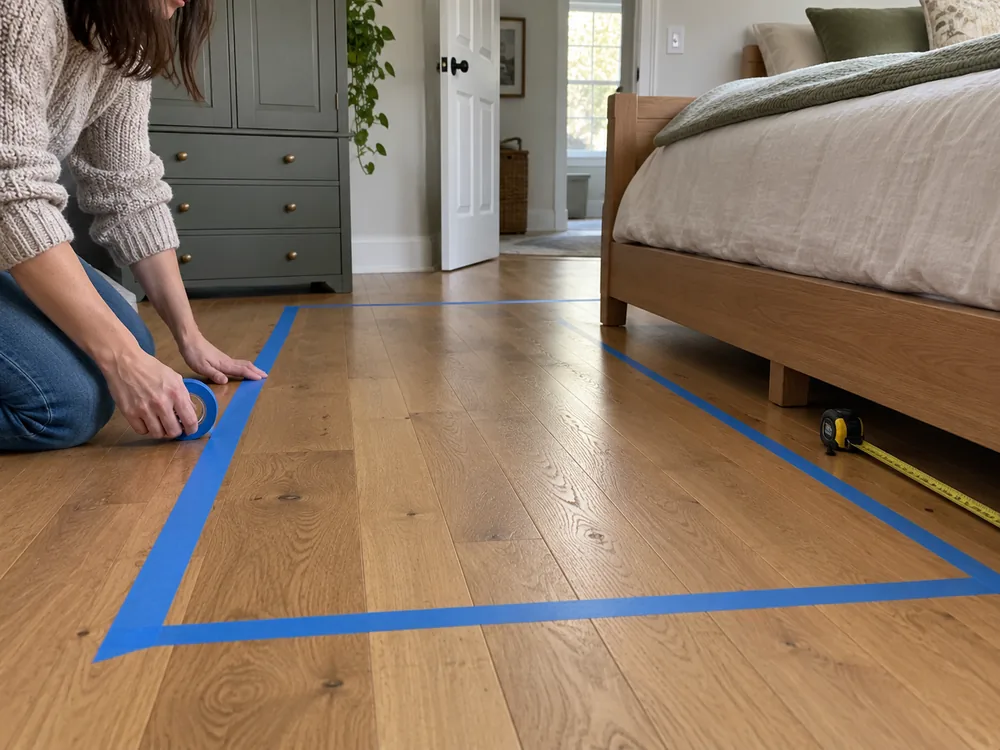
- Test with painter’s tape. Mark the proposed rug outline on the floor. Walk around it, step out of bed onto it and open all doors and drawers. Live with it for a day if you can. Adjust the dimensions before ordering.
This process works whether you are shopping online or in a store. Bringing your measurements with you (or keeping them in your phone) makes it much easier to compare rug sizes on the spot.
Common Bedroom Rug Placement Mistakes
The rug is too small
If only a few inches of rug are visible beside or beyond the bed, the rug can look undersized. A quick test: if you cannot clearly see the rug from across the room, it is probably too small for the bed.
The rug is hidden almost entirely under the bed
Pushing a rug far under the bed means you are paying for rug area that does nothing visually and does not give your feet a landing spot. If most of the rug is invisible, pull it forward so more shows at the foot and sides.
The rug is not centred with the bed
Centring the rug on the bed is a useful starting point in most layouts. Because the bed is usually the largest piece of furniture in the room, aligning the rug with it tends to look more balanced than centring the rug on the room itself, especially if the bed is not centred between the walls.
Forgetting the nightstands
If you want the nightstands on the rug, you need to account for their width on both sides when choosing the rug size. A rug that just barely reaches the outer edge of the nightstands will look cramped. Allow a few extra inches beyond each nightstand.
Blocking doors or drawers
This is particularly common in compact bedrooms. A rug that interferes with a wardrobe door, bedroom door or dresser drawer will be a daily annoyance. Always check clearances before committing to a size.
Buying before measuring
Eyeballing a rug in a shop or online photo is unreliable. Rooms always look different than you remember. The painter’s-tape test described in the measuring section above takes minutes and costs nothing.
How to Choose Between Two Rug Sizes
If two rug sizes both technically fit your bedroom, compare them on these points.
Visible border around the bed. The larger rug will show more rug on each side. If you want a generous, grounded look, that matters. If you prefer more bare floor visible, the smaller rug may be the better fit.
Room proportions. In a bedroom that is already spacious, a slightly larger rug will not overwhelm the space. In a room where the bed takes up most of the floor, the smaller rug may leave the room feeling less crowded.
Nightstand placement. If you want the nightstands on the rug, the larger size is usually necessary. If the nightstands will sit on bare floor, the smaller size may work fine.
Door and drawer clearance. The larger rug is more likely to interfere with doors and drawers, especially in bedrooms that are only a foot or two wider than the rug. Check clearances with painter’s tape before deciding.
Budget. Rug prices increase significantly with size. A 9 × 12 ft rug can cost considerably more than an 8 × 10 ft in the same material and design. If the smaller size works well in your room, the saving may be worth it.
Exposed flooring. Think about how much bare floor you actually want to see. Some people prefer a rug that clearly defines the sleeping area with floor visible around it. Others want the rug to cover most of the bedroom floor. Neither preference is wrong.
The common advice to “always buy the bigger rug” is an oversimplification. The right rug is the one that fits your room, your furniture layout and the look you are after.
Frequently Asked Questions
What size rug should go under a queen bed?
An 8 × 10 ft rug is the most common recommendation for a queen bed. It provides roughly 18 inches of visible rug on each side with a centred layout. If your room is larger or you want the nightstands on the rug, consider a 9 × 12 ft rug instead.
What size rug should go under a king bed?
A 9 × 12 ft rug is the standard starting point for a king bed. A king mattress is 76 inches wide, so smaller rugs tend to leave very little visible rug on the sides. Measure your frame and room before ordering, as some king bed setups work better with a 10 × 14 ft rug.
How far should a rug extend past the sides of a bed?
About 18 to 24 inches on each accessible side is a common starting guideline. In a smaller bedroom, 12 to 18 inches can still look balanced. The key is having enough rug visible that it looks like a deliberate part of the room.
Should a bedroom rug go under the nightstands?
Both layouts work. With a lower two-thirds placement, the rug begins in front of the nightstands and does not support them. With a larger rug, you can include the nightstands for a more unified grouping. The deciding factor is usually rug size and room space.
Can you put a rug beside the bed instead of underneath it?
Yes. Runners on either side of the bed are a practical alternative, especially in narrow bedrooms or on a smaller budget. Place each runner roughly centred with the mattress length so it sits where you step out of bed.
Can you put an area rug over bedroom carpet?
You can. Layering an area rug over carpet can add visual definition and a change in texture. The main considerations are making sure the rug lies flat, stays in place when you walk on it and does not create a trip hazard at the edges. A rug pad can help with stability, and thinner, flatweave rugs tend to sit more neatly over carpet than thick, high-pile options.