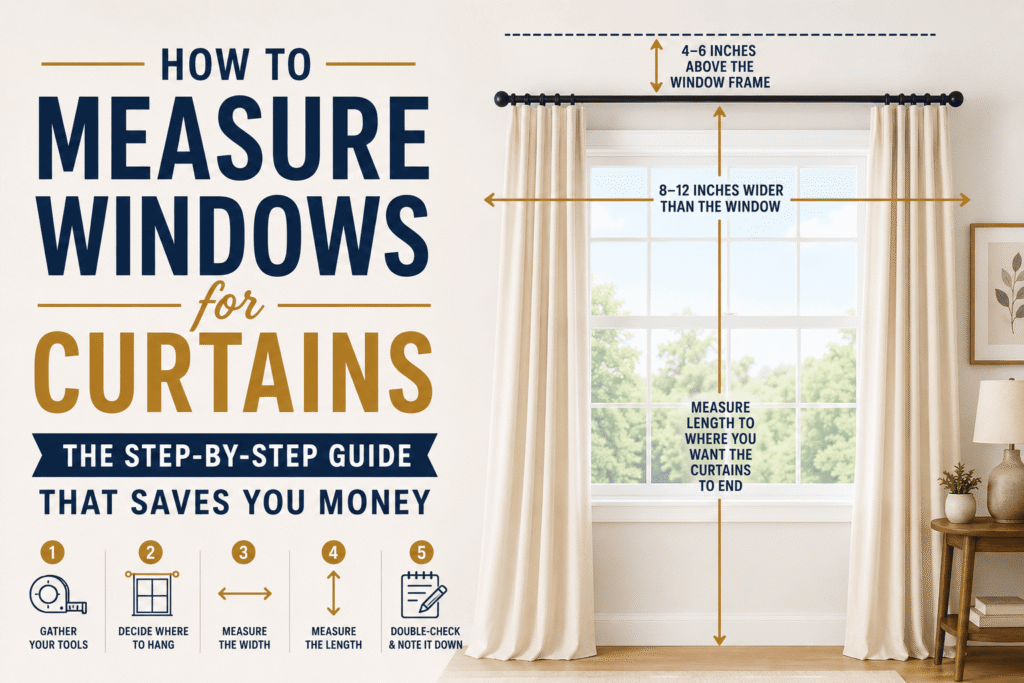
Small windows are one of the most common frustrations in home decorating — and one of the most fixable. Whether it is a bedroom in a Victorian terrace, a bathroom in a flat conversion, a living room in a compact apartment, or a kitchen in an older house, small windows have a way of making the entire room feel darker and more cramped than it needs to.
Curtains are one of the best tools available to change how a window, and therefore a room, appears. By strategically applying sizes, positions, fabrics and colours that make an effectual statement about size, fabric and colour selections can make a small window appear much larger than it really is, creating a brighter, taller and more spacious feel throughout a room.
This guide covers ten curtain strategies for small windows, each one explained so you understand not just what to do but why it works — because understanding the principle means you can apply it intelligently to your specific window rather than following advice blindly.
Why Small Windows Feel So Problematic
Small windows create two problems simultaneously: they allow in less natural light than larger ones, making rooms feel darker; and they create visual imbalances — having a large wall with one small gap can draw attention away from its scale and draw more toward that smaller gap instead.
The instinct many people have is to minimize curtains on small windows — shorter curtains, narrower panels, blinds instead of curtains — to avoid drawing attention to the window. This instinct is almost always wrong. Minimizing the curtain treatment minimizes the window further. Expanding the treatment beyond the window, paradoxically, makes the window look larger.
The strategies below work by exploiting this principle: the eye reads the curtain treatment as the window, not just the glass. Make the curtain treatment larger, and the perceived window becomes larger too.
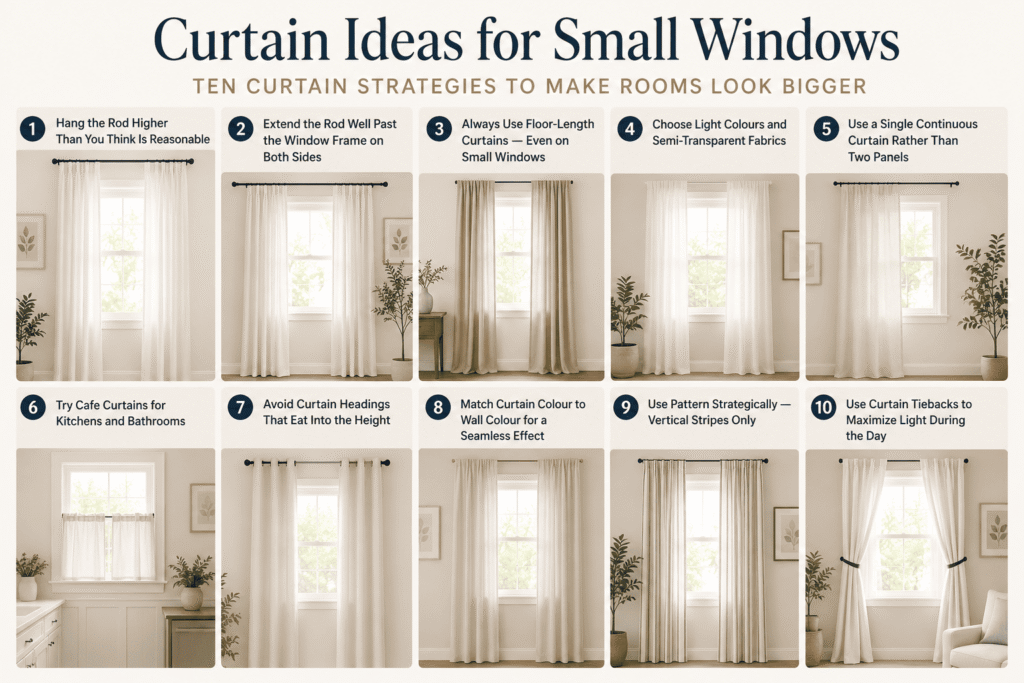
1. Hang the Rod Higher Than You Think Is Reasonable
Doing this one simple step will have an enormously positive effect on any window and costs nothing extra if you already own a curtain rod. Simply install your rod significantly higher than 10 cm above your window frame – 20, 30, even 40 cm is ideal, although in rooms where ceiling space permits it, mounting it just beneath a cornice is possible too!
Here’s why this works: when curtains start high above a window and cascade all the way to the floor, our eyes follow along the entire vertical length as part of its perceived window size; even though actual glass area covers only part of this perceived width; thus making an 80 cm window read like 220 cm visually.
This technique can be found in virtually every luxury hotel room and many professionally-designed residential spaces, where windows often appear large only because of where their curtains begin.
✦ PRO TIP: If your ceiling is low and space between window frame and ceiling is limited, even 15 cm more of rod height makes a noticeable difference – every centimetre counts!
2. Extend the Rod Well Past the Window Frame on Both Sides
Change number two requires almost no cost and only five minutes of implementation: move curtain rod brackets outward so the rod extends at least 25-30 cm beyond each window frame side; larger windows may need even longer curtain rod extensions to maximize this change’s effectiveness.
At night when curtains are drawn back from both sides during the daytime, their panels rest entirely against the walls instead of covering any part of the glass surface, increasing natural lighting levels by maximizing exposure of full glass area. When drawn closed at night time they cover not only glass but also walls on each side for an impression of wider window space.
Extending the rod outward has another practical benefit, too: when opened, an extended curtain does not block light – an invaluable feature in rooms where window space is already limited and every lumen of natural lighting counts!
3. Always Use Floor-Length Curtains — Even on Small Windows
People often are taken aback when hearing this strategy because the tendency is for small windows to use shorter curtains that match its scale; using short curtains on such windows makes the window appear exactly the size it actually is while floor-length curtains make both room and window appear grander in comparison to using shorter drapes.
The curtain length does the heavy lifting here. A floor-length panel hung high above a small window creates a vertical line that dominates the room in the best possible way — it draws the eye upward and downward rather than letting it fixate on the modest dimensions of the glass.
Contrary to popular belief, floor-length curtains do not need large windows in order to justify themselves; their purpose lies more in what they add to any given space and room — making every area appear larger, thoughtfuler and decorated more deliberately. This is why the floor length curtain always work, it gives your room a bigger look.
4. Choose Light Colours and Semi-Transparent Fabrics
Fabric and color choices can convey quite a striking message regarding the darkness of the rooms. For example, thick dark curtains which absorb even the scarce light that comes in through the small window, can make the room look darker. On the other hand, light colors and semi transparent fabrics also called as sheer curtains which don’t block the light but diffuse it, are ideal for making the room brighter, especially if the window is small.
White, cream, pale grey and natural linen are a few of the colors that work well with small windows that don’t get enough natural light. Sheer fabrics like fine voile, lightweight linen or cotton fabric will let the light in the room while also keeping the privacy during the day and visually giving you the advantage of floor-length curtains.
One way of adding a bit of color to a small window without cutting down on the light is to go for a pale version of the color you are considering rather than the full, saturated one. Pale green, dusty blush or soft sky blue in sheer or lightweight fabric can be very warming without adding any darkness.
5. Use a Single Continuous Curtain Rather Than Two Panels
For really tiny windows—bathroom & small bedroom windows or utility room windows that are just a bit bigger than a standard door panel — a single continuous curtain panel pulled to one side can actually do a better job than two separate panels, the typical two-panel method.
One panel, pulled back completely to one side when the curtains are open, gives rise to a more relaxed, “I meant to do this” look as opposed to two half-panels that are not quite right and have been taken out of the closet. Furthermore, it only needs one curtain tieback or holdback instead of two, making the window treatment appear neat and simple.
This is especially effective when done with the more weighty fabrics such as cotton, linen or velvet because the weight of a single gathered panel makes for such a wonderful drape. Single panel sheers are very light and can often appear minimal to the point of it being lost.
✦ PRO TIP: When you do only one panel it should be at least double the width of the window when it is flat — so it can be gathered generously when it is pulled to one side. A single narrow panel will look accidental; a single wide panel that pools luxuriously to one side looks designed.
6. Try Cafe Curtains for Kitchens and Bathrooms
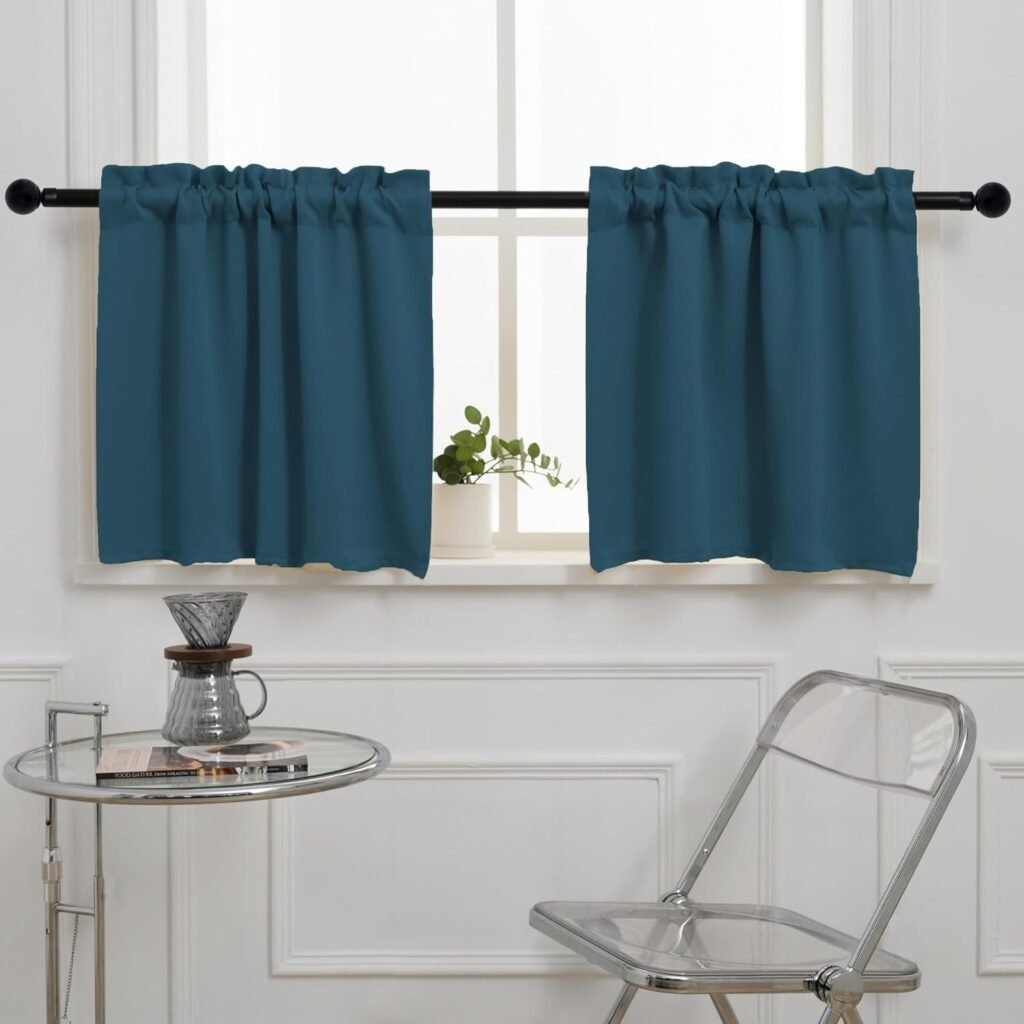
Cafe curtains — panels that cover only the lower half of the window, mounted on a tension rod inside the recess — are one of the most practical and most attractive small-window solutions available for kitchens and bathrooms specifically.
This arrangement offers privacy at standing height (people outside can see in) while keeping the upper half of window unobstructed for maximum light and privacy. A charming continental aesthetic matches both classic and contemporary kitchen designs nicely.
Cafe curtains work best in cotton or linen in neutral colours — white, cream, or natural — and at sill length rather than longer. The simplicity of the treatment is part of its appeal, and overcomplicating it with elaborate fabric or length defeats the point.
7. Avoid Curtain Headings That Eat Into the Height
The heading style you choose affects how much of your curtain’s stated length actually appears as visible curtain in the room. Some heading styles use up several centimetres at the top that do not contribute to the length of the hanging curtain.
For small windows where every centimetre of height is precious, eyelet or grommet headings are the most efficient — the metal ring sits at rod level and the full stated curtain length hangs below it. Rod pocket headings sit slightly above the rod and lose some length. Tab top headings lose the tab length between the rod and the start of the curtain proper.
To maximize visual height on small windows, opt for eyelet curtains mounted close to the ceiling on an eyelet rod hung as low as possible; their full length should hang freely behind their top with any rod relatively hidden within its material.
8. Match Curtain Colour to Wall Colour for a Seamless Effect
One of the most effective tricks for making a small window feel like part of a larger, more coherent wall — rather than a small hole in it — is to choose curtains that are the same colour or very close to the wall colour.
In case curtain and wall share similar colors, the focus does not remain only on curtain edge as it happens when they are contrasting. Actually, the curtain is perceived as part of the wall visually, and the window seems to be included in a smooth vertical composition rather than being a separate, isolated element.
Living rooms and bedrooms are very good places for this to work because the aim there is to develop a peaceful and united background instead of making a loud statement. It is not so good in rooms where you want the curtains to be the star of the show in their own right.
📌 NOTE: Tonal doesn’t equal identical. Curtain fabric and wall paint will reflect light differently and never look exactly identical, even in terms of hue or tone. Aim for similar hue and tone rather than trying for perfect matching; any variation should read as intentional layering rather than as failed attempts at matching.
9. Use Pattern Strategically — Vertical Stripes Only
Pattern curtains for small windows should only be considered risk worth taking when they feature vertical patterns such as stripes, vertical geometric lines or patterns which read predominantly upward. Vertical stripes draw your gaze up rather than side-to-side which reinforces an impression of height which helps make rooms seem larger.
Horizontal stripes, bustling florals, or large-scale patterns on small windows only serve to accentuate their horizontal limits and make a room seem smaller rather than wider. If pattern is something you love, use it on cushions or throws instead – curtains needn’t get all patterned!
Narrow vertical stripes in a combination of cream on white, and grey on silver can add visual interest without overshadowing a small window, and their vertical emphasis helps make any room seem taller.
10. Use Curtain Tiebacks to Maximize Light During the Day
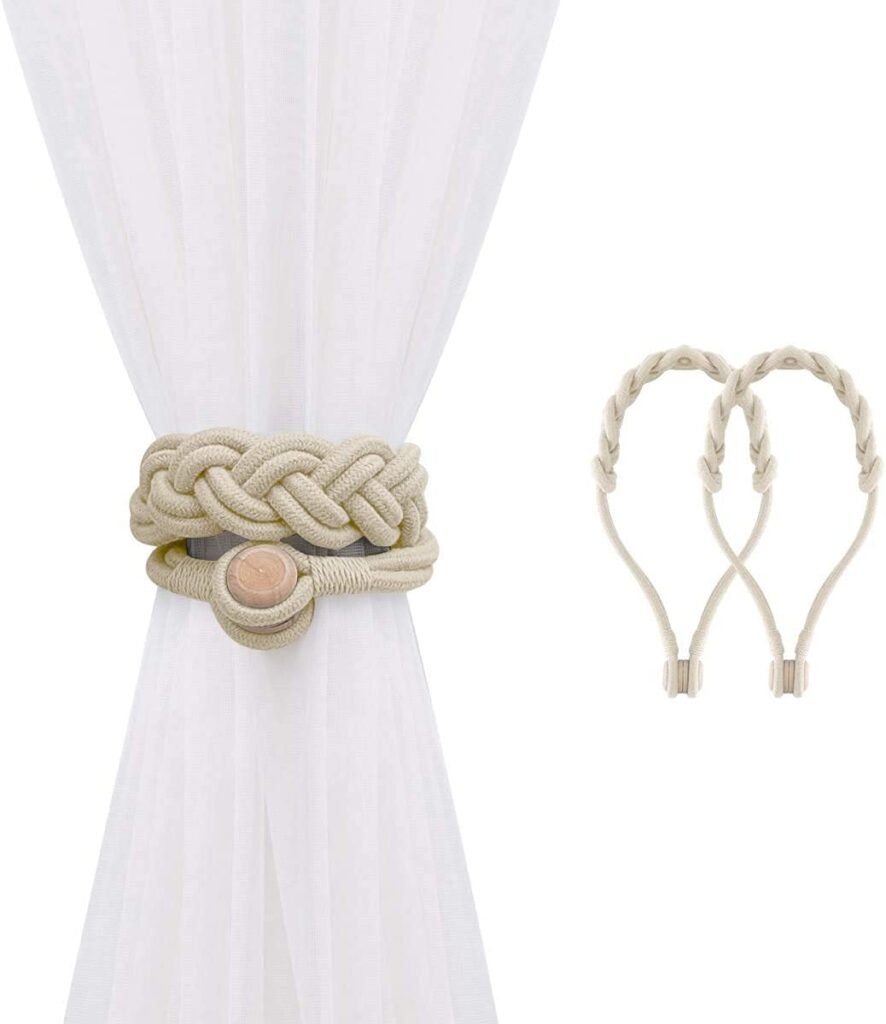
Curtain Tieback Rope Tassel Set
Small windows that rely heavily on natural lighting require every bit of natural illumination possible, so how you hold back curtains during the day has an immense influence over how much light enters a room. Curtains held back loosely with fabric tiebacks can cover significant sections of glass even when nominally open – an effect made worse if no window blinds or shades exist to help control light leakage.
Curtain holdbacks – rigid arms mounted to a wall which are used to keep curtains at an angle from window frames – are highly effective at keeping all glass exposed. When properly heldback-mounted, curtains wrap around them without coming near to obscure view of glass from windows, leaving nothing but unobstructed view through.
Position is equally as crucial. A holdback placed at mid-height will create an elegantly curvilinear sweep of fabric; low mounts create sharper angles which maximize light exposure through smaller windows; in many instances lower holdbacks offer practical solutions even though their visual effect might not be quite so romantic.
Bonus: What Not to Do With Small Windows
These common approaches actively make small windows look smaller — avoid them:
- Blinds instead of curtains — roller and Venetian blinds frame windows exactly at their actual sizes to accentuate how small they actually are while curtains that extend past them create an overwhelming visual presence.
- Paneled curtains that just barely cover the glass – panels narrow enough to reach across a window but too short to pull across it — appear strained, giving an appearance of smallness to an already narrow space.
- Match the curtain length to window height — sill-length curtains on small windows highlight their short stature while floor-length ones place more focus on room height rather than glass height.
- Heavy, dark fabrics in already dim rooms – velvet in deep jewel tones looks exquisite in large bright rooms; but when used in smaller dark rooms with limited natural lighting such as those featuring small windows it absorbs much-needed illumination, making the entire area seem dark and oppressive.
- Complex heading treatments — such as goblet pleats, ornate pelmets and heavy valances on small windows — occupy valuable visual real estate while adding too much weight for their size to bear. Keep the heading simple.
Putting It All Together — The Small Window Formula
Small windows typically benefit most from this combination: rod mounted 20 to 30 cm above window frame or ceiling level if space permits, rod extending 25-30 cm past frame on both sides, floor-length panels in light colors or sheer fabrics held well away from glass with holdbacks;
This combination takes an otherwise small window and creates a curtain treatment that reads as generous, well-considered, and expansive. While nothing physically changes with regards to its physical presence in the room – its presence changes how we experience and perceive its contents significantly more strongly.
Curtains offer one of the greatest decorating tools: versatility. If a combination isn’t working in your room, just move or change out a rod position or panel; holdbacks can even be adjusted! No other decorative decision offers as much visual impact with as much flexibility in terms of adjustments.
Final Thoughts
Small windows shouldn’t be treated as problems to be minimized — rather they present design challenges to be met and often necessitate more than less to address: longer curtains, wider rods and higher mounting are often necessary solutions, as is an increase in fabric amounts for additional seating arrangements and wider drapes.
Homes that look and feel their best don’t necessarily boast the largest windows; rather, those where each window, regardless of size or purpose, has been treated thoughtfully and intentionally. A small window featuring beautifully-hung floor-length curtains made with light quality fabric may provide more satisfaction to live with than large ones with curtains that were purchased without consideration or intention.
Once your hanging strategy is in order, fabric choice becomes the last element in creating an effective window treatment that makes any room better. And there after you can decide about how to measure windows for curtain as well, then the picture is clear. From breezy voile and natural linen fabrics to lightweight cotton with subtle textures – you have numerous fabric choices from which to select when selecting window treatments that truly improve a room.
Frequently Asked Questions
Q: Should curtains go to the floor on a small window?
A: Absolutely not — interior designers still support this rule for small windows with curtains in an unconventional manner. Floor-length draperies create vertical lines which makes the room seem taller while making the window seem larger; short curtains that stop below or at window sill highlight its smallness by only covering its vertical surface instead of reaching all the way from ceiling and floor level.
Q: How wide should curtains be on a small window?
A: Your curtains must be a lot wider than the window – at least twice the width of the glass area, and even better, covering wall space on both sides of the window frame when drawn open. The curtain rod has to extend at least 25 cm beyond the window frame on both sides, while the curtain panels should be of a width that allows them to be fully placed against the wall when you pull them back and the glass is visibly clear. Thin curtains that barely cover the glass tend to visually shrink small windows further.
Q: What colour curtains make a small room look bigger?
A: Choose light colours — white, cream, pale grey, natural linen — if you want your small rooms to feel the most spacious. This is because such colours reflect light instead of absorbing it. Totally or nearly transparent pastel-coloured fabrics are the best solution if you want to maximize the amount of light and a feeling of airiness. In case you fancy a colour different from neutral, very light, less saturated versions of any colour perform better than saturated or dark versions in small rooms.
Q: Can I use blackout curtains on a small window?
A: Yes, but choose carefully. In a bedroom where light control is of essential importance yet window space is limited, blackout curtains remain an effective solution to improve sleep quality. The key lies in following other principles in this guide – hang high, wide and floor length while choosing light colors like white or pale cream which provide blackout properties without the drawbacks associated with dark fabrics.
Q: Are cafe curtains good for small windows?
A: Cafe curtains can provide privacy in kitchens and bathrooms while still allowing maximum light into the space, while still leaving an upper window open for maximum brightness. Unfortunately, cafe curtains tend to emphasize rather than compensate for small window sizes in living rooms and bedrooms – floor-length curtains hanging high and wide are usually preferable in these instances.
Q: How do I hang curtains on a very small window with no space above the frame?
A: When there’s very little space between your window frame and ceiling – as often occurs in bathrooms and utility rooms – installing tension rods inside window recesses rather than wall mountings can keep the rod out of sight and draw focus towards your curtain rather than its mounting hardware. Use sheer or light fabric curtains, since inside-recess curtains tend to shade glass more than wall-mounted options do.