
A room with high ceilings is one of interior design’s greatest gifts. The space, the light, the sense of volume — there is something about a ceiling that sits well above the standard eight feet that makes a room feel fundamentally more generous and more impressive. Period townhouses, Victorian terraces, Georgian rooms, and contemporary high-specification new builds all tend to feature ceiling heights of 3 metres and above.
First of all, the problem is standard ceiling height curtains will undoubtedly look out of place in the rooms where ceiling is very high. It’s not a minor discrepancy – even markedly, conspicuously wrong: curtains are too short, too thin, and dominated by vertical space which they are meant to cover visually. To get curtains right in a high-ceiling room, one must reconsider length, fullness, fabric weight, and hardware. This guide is a thorough exploration of these aspects.
The Golden Rule: Always Go Floor to Ceiling
Regardless of the room, it is my opinion that floor to ceiling curtains always look nicer than the short ones. For a room with a high ceiling, this rule is not even a choice – it’s a must.
This is because short curtains against a high-ceiling room visually contradict the proportions. The large part of the bare wall above the curtain’s hem instantly makes the window appear ‘cut off’, the ceiling look extremely high, and the whole room seem unfinished.
In a high-ceiling room, curtains have to cover the entire height from floor to ceiling to strike the right proportion that makes the room appear designed and not neglected. Therefore, if installed properly in a lofty room, drapes extending from floor to ceiling can really make the vertical stretch of fabric the most stunning and attention-grabbing element of the room.
If the ceiling height of a room is 3.5 meters, then the curtains should be 3.5 meters in length. A curtain that is 2.4 meters high only uses 70% of the height, leaving intact 1 meter of the wall which is visible at the top. Such a gap is very clearly perceived as a mistake rather than a design decision.
✦ PRO TIP: Hang your curtain track or pole as close to the ceiling as possible — 2 to 5cm below the ceiling cornice is ideal. The curtain heading conceals the small gap, and the curtain appears to begin at the ceiling itself. This effect is most dramatic in rooms with ceiling heights of 3 metres or above.
Finding Curtains That Are Long Enough
This is probably the most difficult part from a practical standpoint of dressing high-ceiling windows. Usually, store-bought curtains have lengths of 137cm, 183cm, 228cm, and sometimes 274cm. If the height of the room is more than 2.8 metres, even the longest size of the standard may not be enough.
For ceiling heights of 2.8 to 3.0 metres
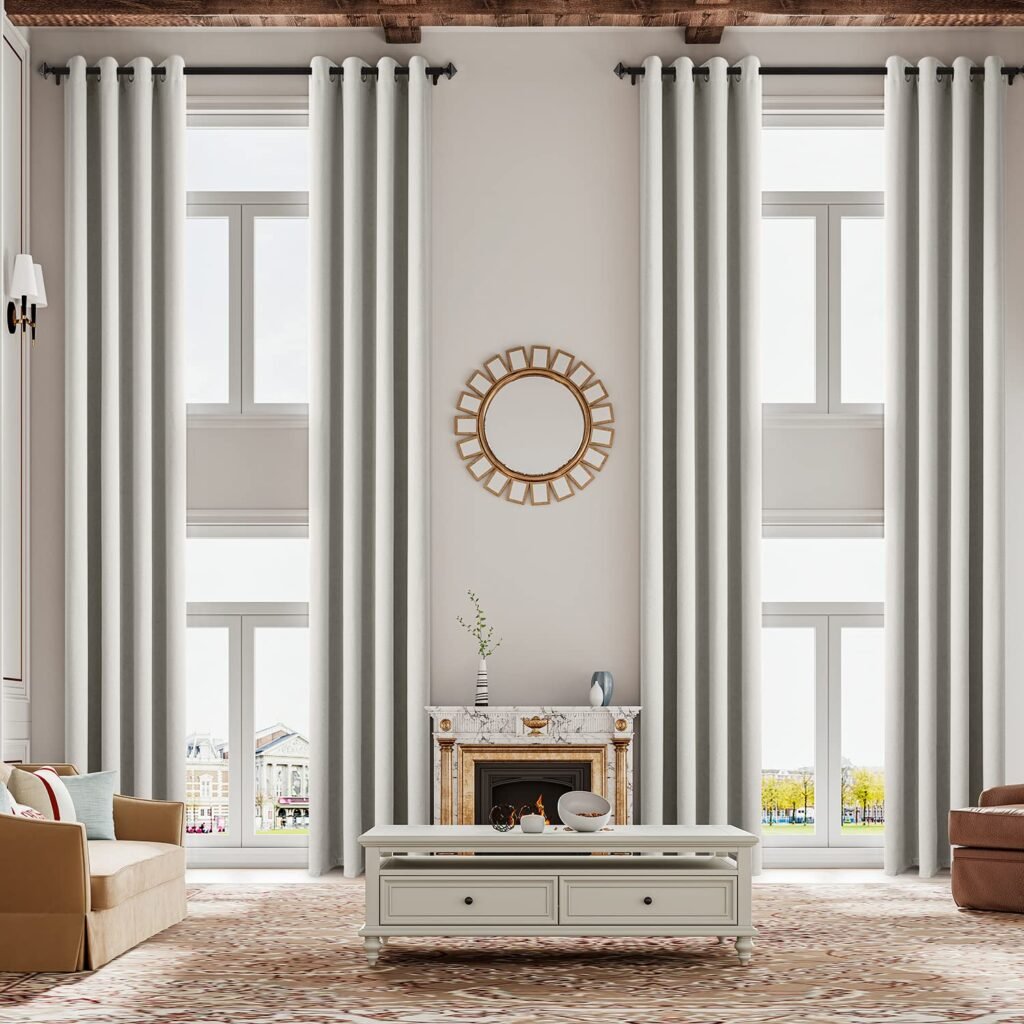
Extra long curtains 274cm floor length eyelet
Standard 274cm drop curtains will reach the floor from a pole positioned just below the ceiling. Check the measurement carefully: measure from the top of your planned pole or track position to the floor, and compare to the curtain’s stated drop length.
For ceiling heights of 3.0 to 3.5 metres
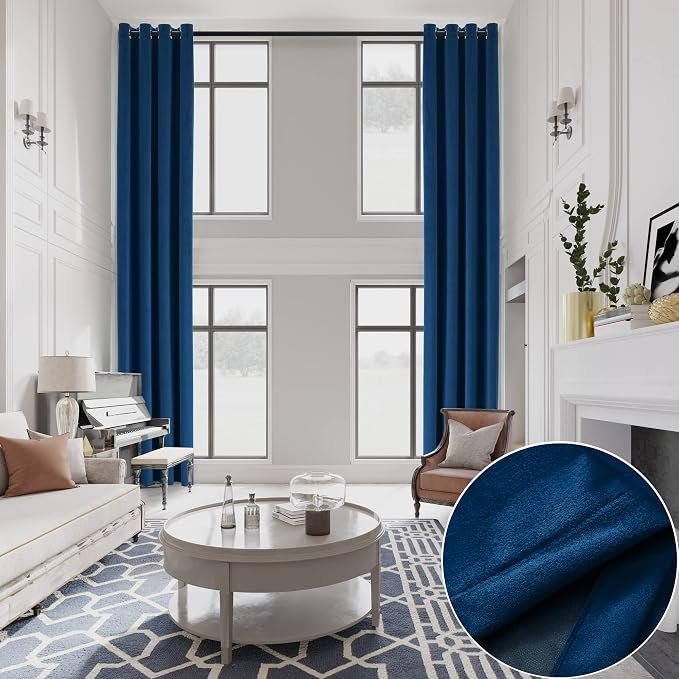
Finding ready-made curtains that have a 3m drop is not as easy at all. Only a few specialist retailers offer 300cm or 330cm drops but there is not much choice. Made-to-measure curtains are the most practical choice. Or else 274cm curtains with a slight puddle at the base can look great in a 3-metre room.
For ceiling heights above 3.5 metres
Rooms with very high ceilings — Georgian reception rooms, Victorian drawing rooms, double-height conversions — almost certainly require custom-made curtains. When you are this tall, the choice of fabric is very important: the curtain must have enough visual presence and volume to dominate the room. A sheer curtain at 4-metre height looks completely out of place. Heavy fabric with ample fullness is a must.
📌 NOTE: When ordering custom curtains for a high-ceiling room, add an extra 10–15cm to your measured drop. This allows for measurement adjustments, potential shrinkage after the first wash, and a small intentional puddle at the base — which looks luxurious at scale.
Fullness: Why It Matters More in High-Ceiling Rooms
Fullness — the ratio of curtain width to window width — matters in any curtain, but it matters disproportionately in high-ceiling rooms. A tall curtain with inadequate fullness looks thin and flat because the height emphasizes the narrowness of the fabric.
In a room with very high ceilings, you should aim to cover the window with 2.5 to 3 times the fabric width instead of the usual 2 to 2.5 times. The extra material will give the curtains heavier, more luxurious folds and make them stand out enough to fill the tall space they are in.
- Window width 1.2 metres: each curtain pair should be 3.0 to 3.6 metres total combined width
- Window width 1.5 metres: each pair 3.75 to 4.5 metres total width
- Window width 2.0 metres: each pair 5.0 to 6.0 metres total width
If this sounds like a lot of fabric — it is. Lots of fabric for tall windows is the way to go but may seem like an investment at first however the transformation a richly gathered drape brings vs a sparse one is so radical that it’s a whole new room to see.
Fabric Weight: The Most Important Choice
The fabric you choose for high-ceiling curtains must have enough weight to hang well over its full length. Lightweight fabrics — thin polyester, fine voile, light unlined cotton — do not have the mass to hang straight over a 3-metre drop. They move with air currents, develop irregular creases, and pull at the base.
Velvet — the best fabric for high-ceiling drama
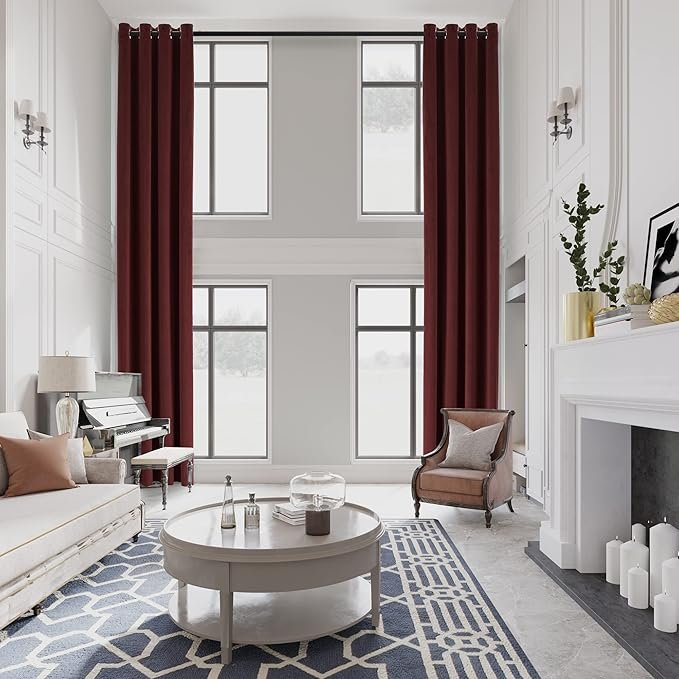
Velvet curtains extra long 274cm eyelet
Let’s understand why velvet is the ideal fabric for high-ceiling curtains. Its weight means it hangs with exceptional straightness over any drop. The curtain’s pile somehow manages to capture and soak up light uniquely. It results in the curtain being perceived as a living entity even though it is absolutely motionless. Among deep jewel tones – forest green, navy, plum, midnight blue – velvet floor-to-ceiling curtains in a double-height room can produce a stunning effect visually, which the other fabrics can hardly mimic.
Velvet also provides meaningful thermal insulation. Period buildings with high ceilings are often difficult to heat, and velvet curtains, particularly when lined, make a real difference to comfort and heating costs in winter.
Heavyweight linen — for natural, architectural elegance
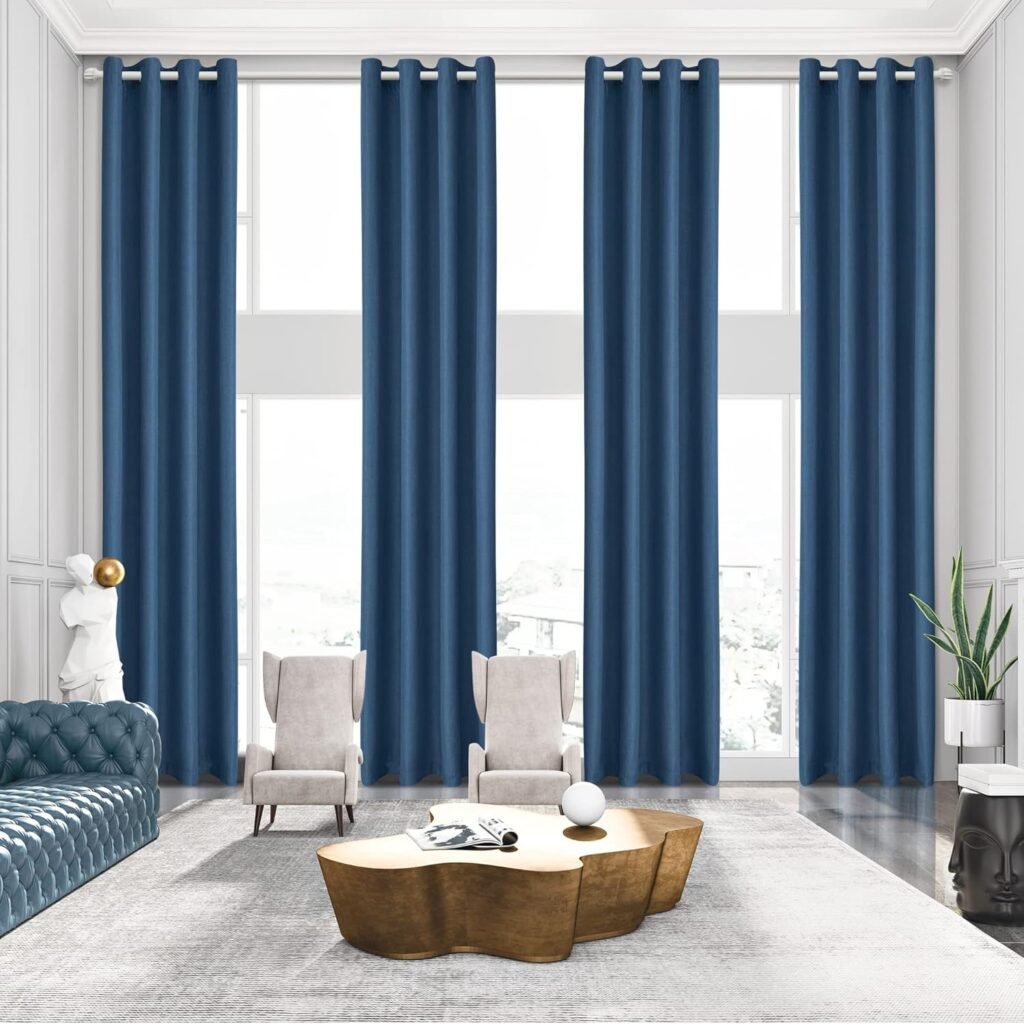
Heavyweight linen or linen-cotton blend is a beautiful alternative to velvet for rooms in which the style is more laid-back and natural. The main factor is weight: 300-400 grams of curtain-weight linen per square metre hang with sufficient presence even at full height. Lighter linens under 250gsm tend to look rather thin and insubstantial when folded over a 3-metre drop.
Natural, undyed linen in a high-ceiling room creates a calm, expansive quality — the tall curtains provide structure and warmth without heaviness. This approach works particularly well in rooms with exposed brick, stone floors, or heavily architectural detailing. So heavy weight linen for tall windows is one of the good option for double heighted living room interiors.
Silk and silk-look fabrics — for formal rooms
In formal reception rooms — dining rooms, drawing rooms, traditional living rooms in period properties — silk or silk-dupion curtains at full ceiling height have a quality that is difficult to replicate. The natural sheen catches light at different angles, and silk’s weight means it hangs with exceptional precision. Silk-look polyester jacquards provide much of the visual effect at a fraction of the cost, with considerably easier maintenance.
Heading Styles for High-Ceiling Curtains
Pinch pleat
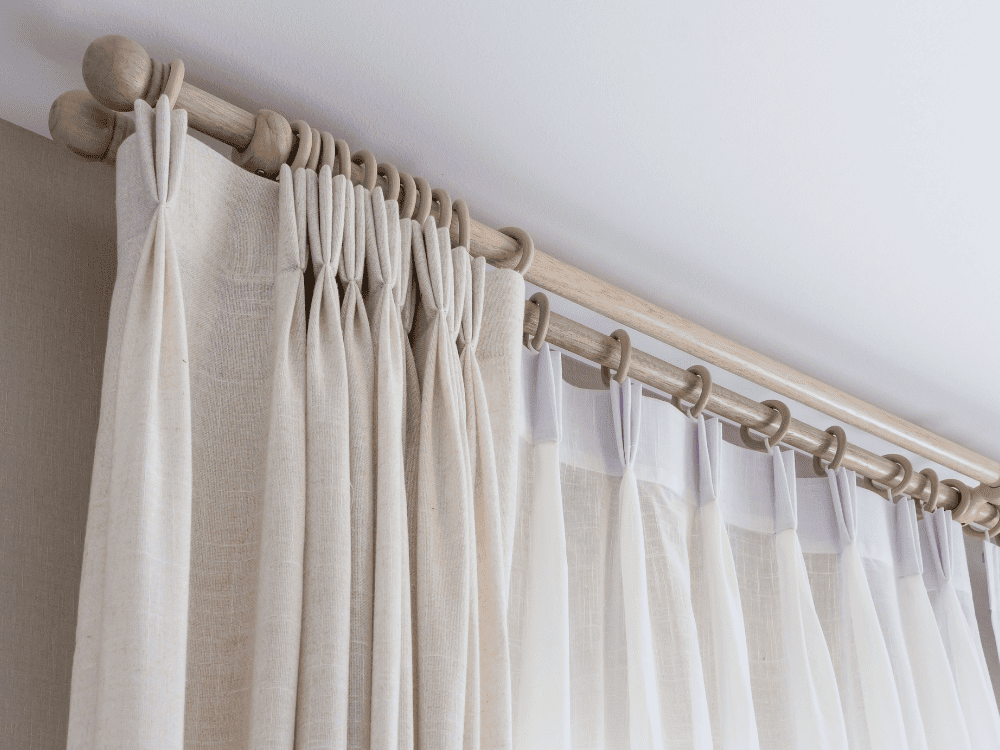
Pinch pleat headings — where fabric is gathered into regular pinched clusters — create the most formal, structured, and architectural look of any curtain heading. The exactness of the pleating provides a high curtain with a feeling of regulation and purpose which is especially suitable for period rooms. Pinch pleat drapes are very well received in the market and can be equally hung by a track or by rings on a pole.
Pencil pleat

Pencil pleat headings — closely gathered into a continuous even pleat — are versatile and widely available. They create a fuller, more generously gathered look than eyelet curtains and hang well from a track. At tall heights, pencil pleat creates richly textured vertical lines that read beautifully across a large expanse of wall.
Eyelet
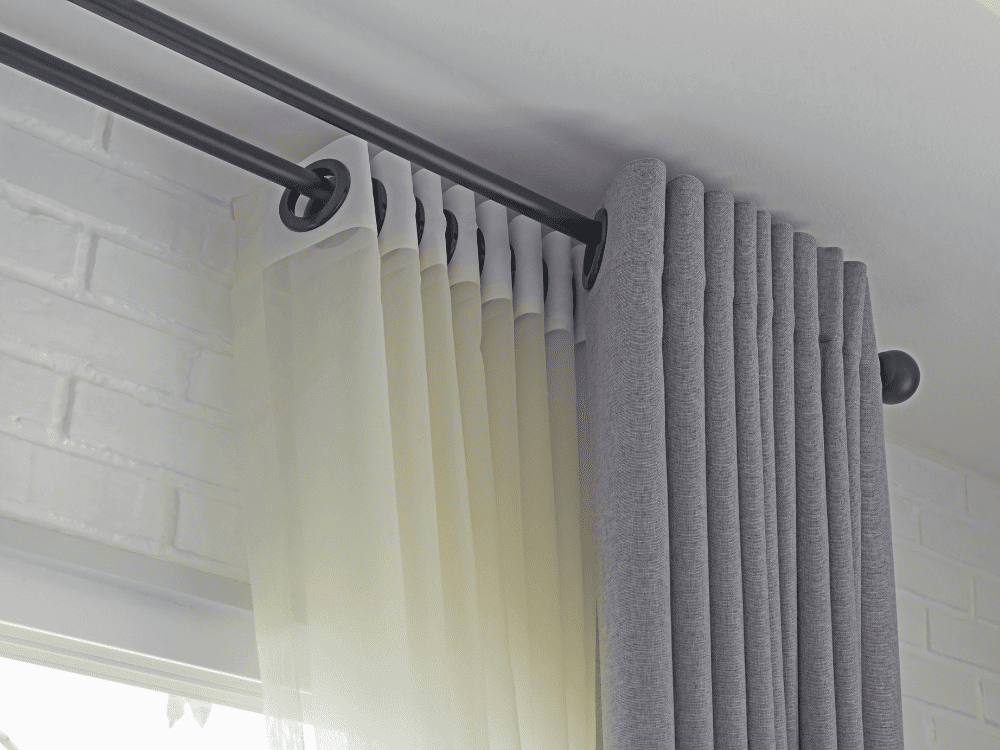
It is not a common practice to use eyelet curtains in formal rooms with very high ceiling as the rings make a group of horizontal wave pattern at the top which might give a casual look in a very tall space. However, if the high-ceiling room is contemporary and the space is open-plan, eyelet curtains can be a good option and quite easy to hang.
📌 NOTE: For tall curtains over 2.8 metres, avoid tab-top headings. Tab tops create too much visual gap between the pole and the curtain when the curtain is very tall, and the tabs can stretch and become uneven under the weight of a long, heavy curtain.
Hardware for High-Ceiling Rooms
Ceiling-mounted track
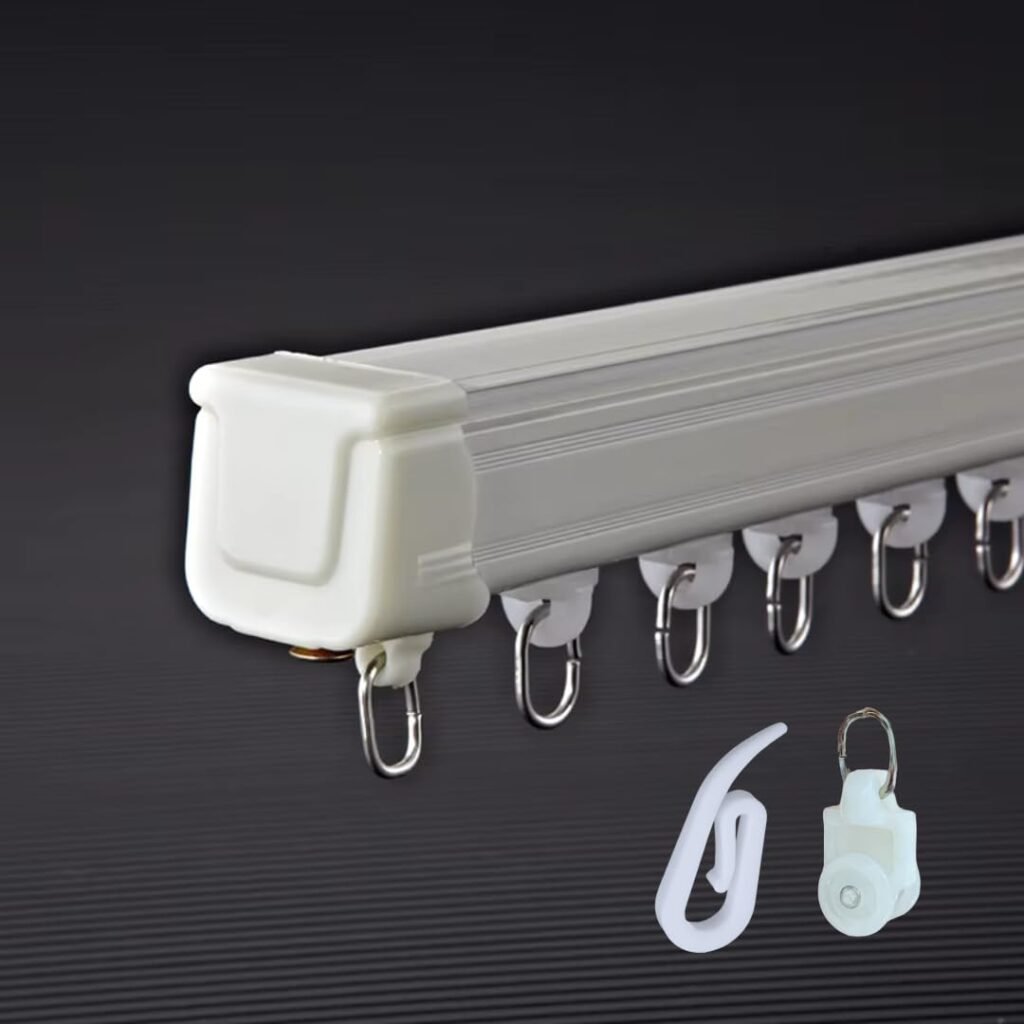
For rooms with very high ceilings, a ceiling-mounted curtain track tends to be the optimal option for hardware. Since it is installed right on the ceiling, it does away with any space between the ceiling and the top of the curtain, gives a sleek and minimal look, and makes it possible for the curtains to be stacked entirely away from the window when opened. Besides, in very tall rooms, this kind of fixing is the most secure.
Extra-long curtain pole with centre support
For rooms where a visible decorative pole is preferred, use an extra-long pole with a minimum of one centre bracket support. Any pole over 1.5 metres carrying heavy curtains will sag at the centre without a support bracket. In high-ceiling rooms where the pole may span 2.5 to 3 metres, two centre support brackets are often needed.
Styling Tips for High-Ceiling Rooms
- Emphasise the vertical. In order to start with floor-to-ceiling curtains, one can also use tall furniture, floor lamps, and vertical artwork to reinforce the vertical. Both the curtains and the other elements in the room need to highlight the
- Consider a puddle. In formal rooms with high ceilings, a deliberate puddle of 3–5cm indicates intention and luxury. The room will look like the curtains were made to fit the room. Velvet and linen, when heavy, puddle
- Use richer colours. High-ceiling rooms can feel cavernous. Rich curtain colours — deep greens, warm navies, burgundy, terracotta — add warmth and intimacy that brings the scale down to a more human level.
- Do not underestimate fullness. Thin curtains in a tall room look like theatre tabs rather than interior design. Use 2.5 to 3 times the window width without exception.
- Consider two panels per side. When windows are very wide, having two curtain panels stacked on each side when opened will give the effect of richness and visual weight more than one panel per
✦ PRO TIP: If your high-ceiling room has skirting boards you do not want the curtains to touch, measure to 5mm above the floor level for the curtain hem. The curtain grazes the floor without touching it — which creates the floor-length look without the fabric collecting dust.
Final Thoughts
High-ceiling rooms deserve curtains that are equally grand. If a 3-meter-high room has curtains that end at 2.4 meters, it indicates that the room is incomplete – its greatest architectural feature has been overlooked rather than highlighted.
The cost of doing it right is more than returned it will make a room look and feel completely different. A high-ceiling room fitted with perfectly proportioned, generously sized, floor-to-ceiling curtains will be among the most spectacular elements of any residential interior.
The steps are logical: Take very precise measurements from ceiling to floor to help you locate curtains that are adequately long. Select a fabric heavy enough for the curtains to fall gracefully over the entire length, and make sure to have plenty of fabric to create fullness. Place the curtain rod slightly below the ceiling line. If you do, the room will indeed show off its true beauty
Frequently Asked Questions
Q: What length curtains do I need for a 3-metre ceiling?
A: In case of a 3-metre ceiling height, curtains will require a drop of about 290–298cm, depending on where exactly you put the track or pole. If you mount the curtains from ceiling, then the drop would be full floor-to-ceiling height less 1–2cm clearance. If you mount the curtains on a wall at 5cm below ceiling level, drop required is roughly around 290–293cm. Regular ready-made curtains usually come up to this length — in fact, you should be looking for 300cm drop options or even consider made-to-measure.
Q: Can I use standard-length curtains in a high-ceiling room?
A: Standard-length curtains (228cm or 274cm drop) are typically too short for rooms with ceiling heights higher than 2.8 metres. The space between the curtain hem and the floor or between the curtain top and the ceiling will be very noticeable and will give the impression that the room has not been fully dressed. The only case where this would work is if you are making a deliberate café or sill-length style — but this rarely fits well with a formal high-ceiling living room.
Q: How much fabric do I need for curtains in a high-ceiling room?
A: Significantly more than for standard-height rooms. For a window 1.5 metres wide in a 3-metre ceiling room, you need curtains with a total combined width of approximately 3.75 to 4.5 metres (2.5 to 3 times the window width) and a drop of approximately 295–300cm. This is a substantial amount of fabric — budget accordingly. The cost increase is primarily in the fabric itself; the hardware cost is similar to that of standard windows.
Q: What is the best curtain colour for a high-ceiling living room?
A: Deep, warm colours usually suit best living rooms with high ceilings as they bring a cosy feel to what could otherwise be a very large space. Forest green, navy, plum, warm terracotta, and deep burgundy are perfect shades to go with velvet or heavyweight linen fabrics. Pale or neutral colours can also be good but then other features of the room must be very carefully and confidently chosen so that the whole space doesn’t turn out to be cold.
Q: Do curtains need to touch the floor in a high-ceiling room?
A: Yes — in a high-ceiling living room, curtains should always touch the floor or form a small intentional puddle. Even a 2–3 cm gap between the curtain hem and the floor appears as a mistake in measuring in a tall room. Floor contact gives the crisp vertical line that turns the curtains into a design feature and the room into a completed space.
Q: Which heading style is best for very tall curtains?
A: Pinch pleat or pencil pleat headings are best for very tall curtains — both create structured, full gathering that hangs beautifully over a long drop and has enough visual presence to fill a tall window. Eyelet headings work in contemporary rooms. Avoid tab-top headings for curtains over 2.8 metres as the tabs stretch and become uneven under the weight of a long curtain.