Almost every interior design magazine, Pinterest board with dreams, and well-photographed hotel room have that one moment – and that most of the time involves velvet curtains. It is not a fact that velvet is fashionable right now (even though it is), but rather no other curtain fabric can do what velvet does. The heaviness of it. The manner in which it is draped. The way rich jewel tone velvet seems entirely different from the same color in any other fabric.
However, velvet curtains do not come without challenges. They are more demanding to care for than polyester or cotton curtain fabric. In an unsuitable room, they can even be too dominant visually. The differences in quality are so drastic that getting the wrong ones can indeed result in throwing away your money. Besides, not everyone is ready to dedicate the attention cleaning them needs.
This guide presents a full picture — the areas in which velvet rolls the other fabrics, the areas in which it is least capable, and the best ways to use the fabric if you reckon it suits your home.
What Makes Velvet Different From Every Other Curtain Fabric?
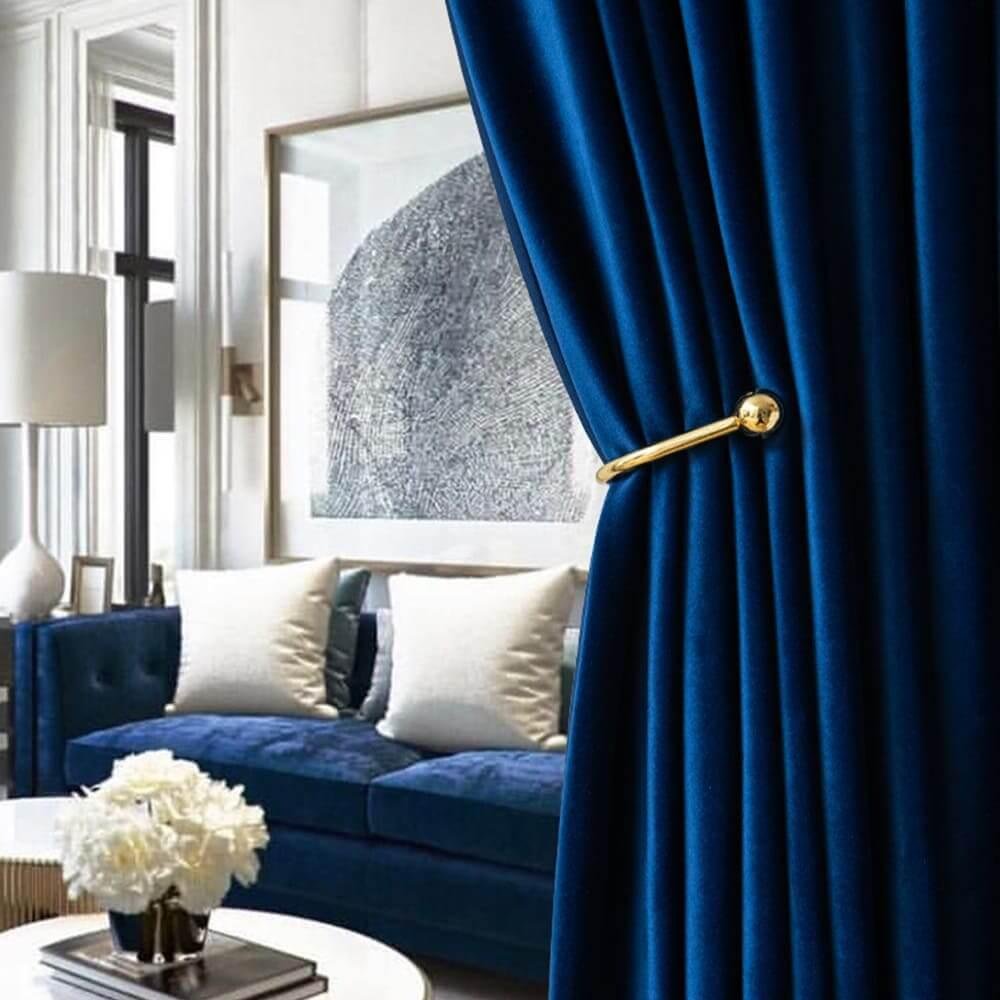
Velvet is made up of pile — dust cut fibres standing vertically from the base weave, which gives a surface that is not only soft to touch but also visually rich in a way that flat-woven fabrics cannot simply replicate. The pile is the reason velvet has its characteristic lustre: the manner in which it seems to change colour when you move around a room, catching and reflecting light differently depending on the angle.
Nowadays velvet curtains are mostly made from polyester, a blend of polyester and cotton, or cotton. Of these, polyester velvet is the cheapest and the easiest to live with – it is easier to wash, it keeps its colour well, and it resists crushing better. Cotton velvet is more tender, breathable, and more attractive at close range but it needs a gentler touch. Silk velvet – the deluxe version from time immemorial – can be found but it is very rare and very costly; in fact most people who believe they want silk velvet after seeing and touching a high quality cotton or poly-cotton velvet, decide that the latter will also make them very happy.
Weight is really the biggest practical benefit of using velvet for curtains. In situations where lighter materials such as cotton lawn or polyester voile require lining and stuffing to hang well, velvet will simply hang beautifully by itself. It’s the inherent density of the fabric that gives rise to those deep, regular folds which the interior decorators try to imitate through the use of lighter fabrics.
The Real Advantages of Velvet Curtains
Outstanding light control and sound absorption
The thick velvet pile gives it a unique quality among fabrics that can block light very effectively even without a separate blackout lining. A quality velvet curtain on its own can considerably darken a room without needing to be treated. When backed with a blackout lining, velvet can create an almost complete absence of light. The thickness that prevents light from getting through also muffles sound — placing velvet curtains in a bedroom or home office brings about a substantial reduction in external noise, unlike thinner fabrics.
Exceptional thermal performance
That is the reason why velvet is highly favored in cold countries. The dense pile of velvet captures the air which slows down the transfer of heat. Wintertime velvet drapes will significantly cut down the amount of heat escaping through windows – windows are responsible for a large percentage of heating consumption in homes. In summer time if velvet curtains are kept closed, they will prevent solar heat from entering and keep the room cooler than it would be otherwise.
Visual impact that no other fabric matches
Honestly speaking, velvet curtains can really transform a room like nothing else can — not even cotton or polyester curtains can compare. Hanging a pair of long, floor-length velvet curtains of a dark color really makes a room feel totally different – it brings in warmth, richness, and a feeling of well-thought-out design that is quite difficult to obtain with any other single decorative piece.
The colour intensity of velvet is simply unequalled. Emerald green, sapphire blue, and burgundy velvet look like gemstones. The same colours in cotton or polyester will look dull by comparison. If you want a vivid colour option in a room and want it to really work, then velvet is the fabric to go for.
They make any room feel more considered and expensive
This isn’t about faking a character that is something else! The point is, velvet is immediately associated with class, work, and meticulousness. Even cheap velvet fabric, if selected and installed with care, give off the impression that a person really went through the room with a fine tooth comb. Such an impression changes the emotional impact of the room on all of those who come in.
The Genuine Disadvantages of Velvet Curtains
They require more maintenance than almost any other fabric
Here is the frank talk that velvet lovers occasionally tend to put aside. In comparison with other materials, velvet reveals dust, pet hair and lint more clearly. A velvet fabric can be down in areas where the curtain is regularly folded, where the velvet is rubbed against itself, or where children and pets are coming into contact with it. Washing velvet – even the washable polyester velvet – needs cold water, a delicate cycle and careful drying. The pile will be permanently crushed if it is ironed directly.
None of the above is impossible, however, it does imply that velvet curtains require constant upkeep. A weekly vacuuming using an upholstery tool, steaming from time to time, and washing very carefully every once in a while are the steps involved in owning velvet curtains. If you can’t devote yourself to such a level of care, then a different fabric will be more suitable for you.
They can overwhelm smaller rooms
Heavy dark-coloured velvet curtains in a tiny room could be more stifling than luxurious. The very fabric which appears stunning in the big living room with towering ceilings can make the small bedroom seem as if it is shutting you in. Light velvet hues – dusty rose, sage green, light grey – or a velvet blend of a thinner quality in smaller spaces – could get you the look without the heaviness of the colour.
They need strong, quality hardware
Velvet curtains are by far the heaviest choice when compared to the polyester or cotton alternatives. Most basic curtain rods which the lightweight ones sold cheaply in a discount store cannot support a pair of full velvet curtains, especially if the window is wide. So, the rod bends and sags in the middle leading to bunching of the curtains instead of hanging properly. Purchase a rod with a proper weight rating and wall anchors before you put up velvet curtains.
✦ PRO TIP: When hanging velvet curtains, use ring clips rather than rod-pocket construction. Ring clips allow the heavy fabric to slide easily along the rod, make daily opening and closing much easier, and put less strain on the fabric heading over time.
Direct sunlight fades velvet faster than most fabrics
Velvet is not very resistant to UV rays. In areas with very strong and direct sunlight – such as south-facing rooms in the UK, or rooms in India or Australia where the afternoon sun is very strong – velvet curtains in bright colours could start to fade quite significantly in a few years. If you want to make them last longer, you can either draw sheer curtains when the sun is at its brightest or get UV-protective window films and apply them to the glass.
How to Style Velvet Curtains in Different Rooms
Velvet curtains in the living room
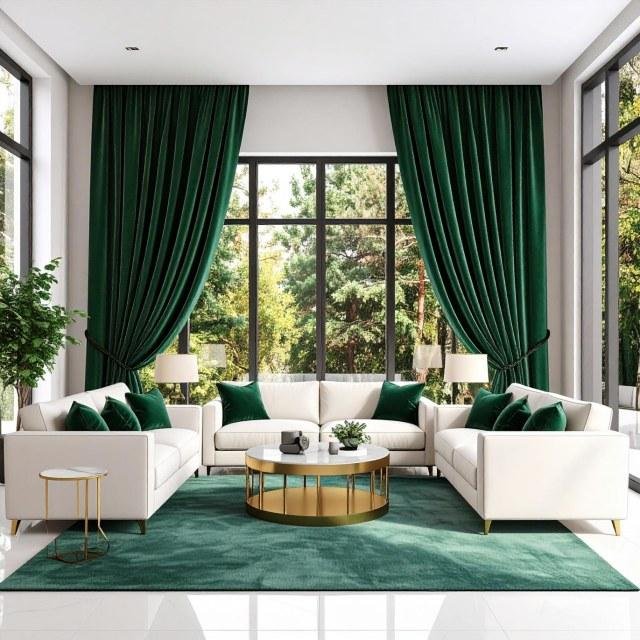
Living rooms are truly the ideal place for velvet curtains. They bring together a touch of theatricality, the ability to control light, and insulation features – all of which perfectly match a living room where one relaxes, entertains, and spends plenty of time. Velvety jewel shades such as bottle green, navy, and burgundy are great choices for walls painted in terracotta, warm white, or mustard yellow and will give the room a warm and inviting look. This is the type of deep, sophisticated color mix that is the hallmark of the most sought-after interiors at present.
In order to create a balanced appearance, allow the velvet curtains to be the main highlight of the room while other elements – sofa fabric, rug, cushions – remain in neutral or complementary colors. One of the most timeless and pleasing room combination is a jewel-toned velvet curtain paired with a cream linen sofa, a jute rug, and basic wooden furniture.
Always go for a floor-length look in the living room — and if the ceiling height permits, think about extending the curtains from the ceiling to the floor. Velvet that is cut short would appear wrong, for a reason that other short curtain fabrics may not even face.
Velvet curtains in the bedroom
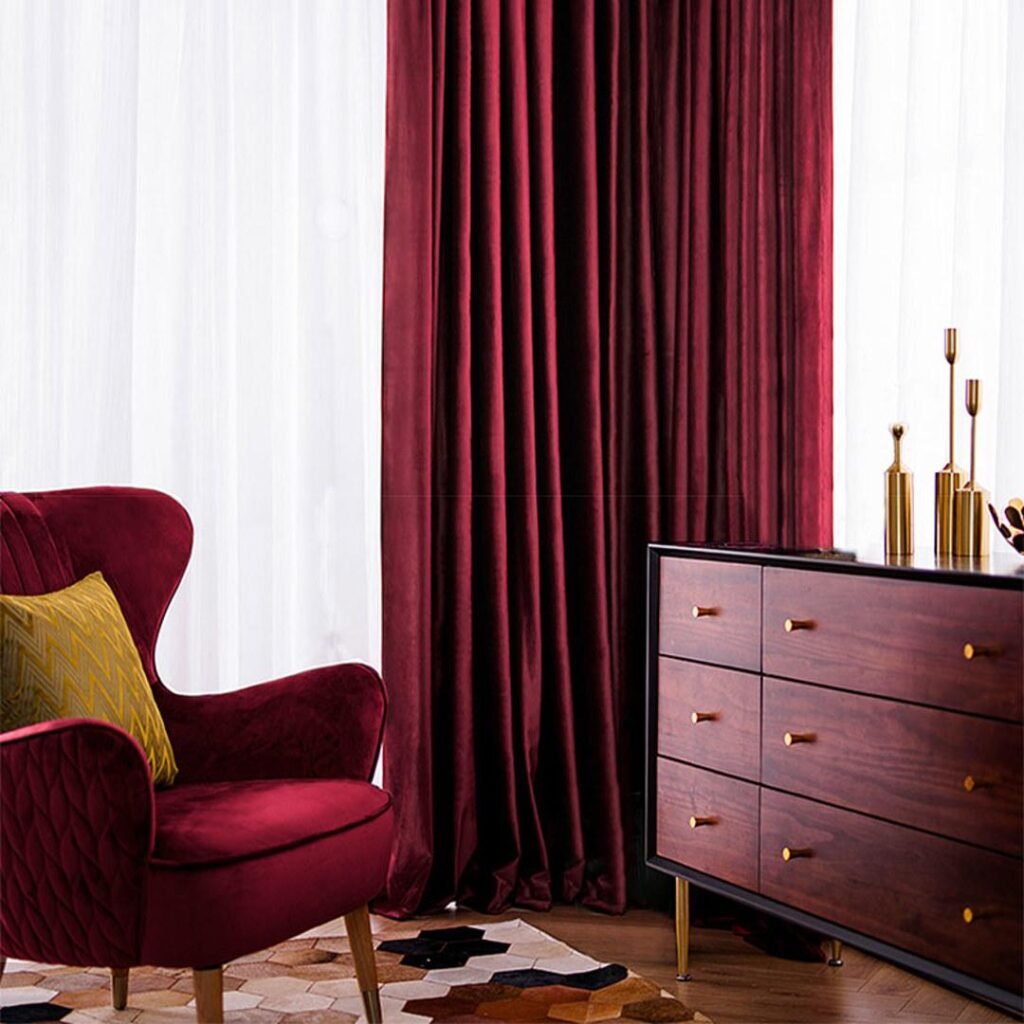
The bedroom is almost certainly the most obvious place to put velvet curtains. Their ability to block out light, absorb sound, and keep a room warm are just the right things for a bedroom to have. In a master bedroom, a little bit of the curtain resting on the floor, about 1 or 2 inches, gives the room a very subtle yet luxurious atmosphere that remarkably alters your mood after a long day.
For bedroom colours, it is preferable to use deep toned muted ones rather than bright saturated ones. Forest green, navy, charcoal, dusty rose, warm terracotta, and slate all help make the serene, cozy mood that is really beneficial for a good bedroom. Extremely bright or very light velvet in a bedroom may give a vibe of unusual energy – kind of opposite to what the room is meant for.
Velvet curtains in the dining room
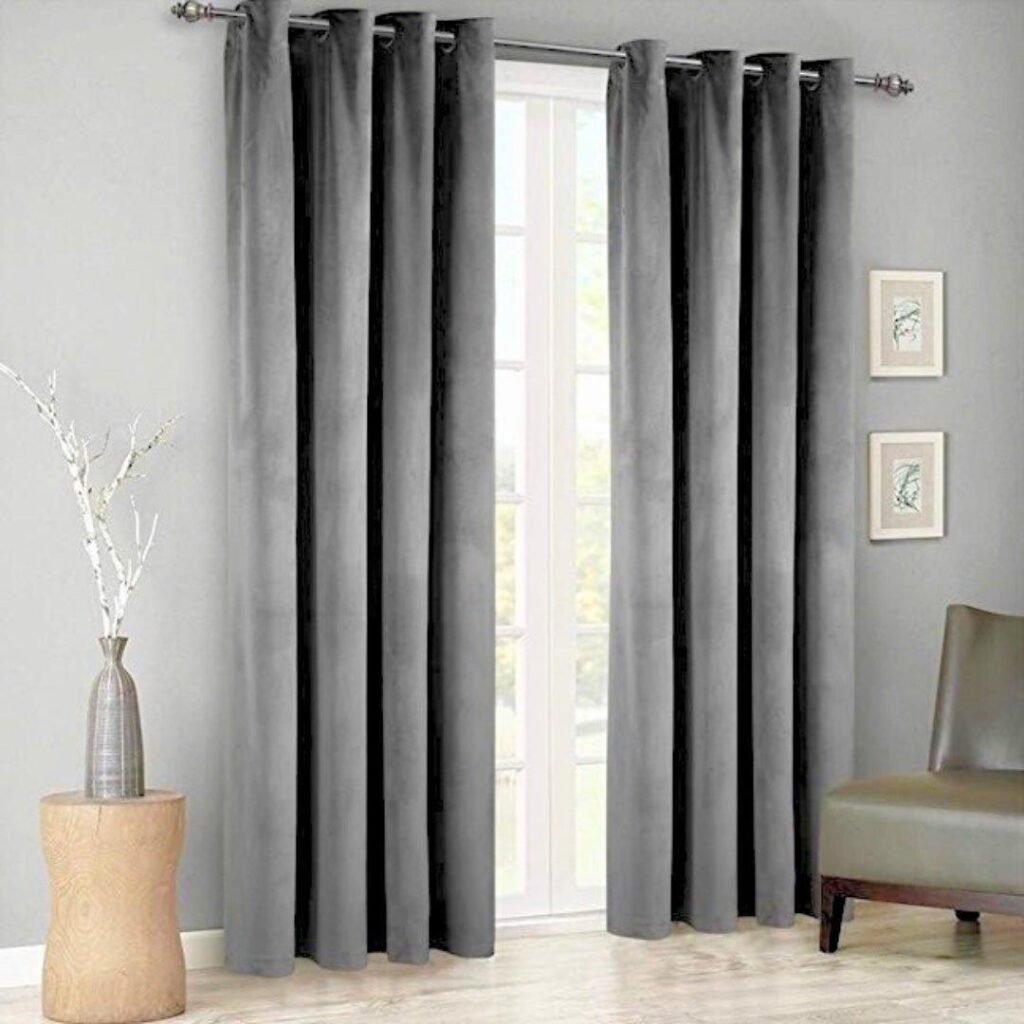
Traditional and semi-casual dining rooms are velvet’s perfect match. Intense warm shades — burgundy, forest green, grey, deep blue — set the exact mood for dining and entertaining. Moreover, dining rooms present a safer context for velvet than family living rooms: less chance of children bumping curtains, loose pets jumping on them, and also a decrease in the physical contact with the fabric on daily basis, etc…
Where velvet curtains do not belong
The simplest answer would be kitchens and bathrooms. Velvet is very absorbent and both these rooms have a lot of moisture. Steam from cooking and food odors will get into the pile and cleaning these fabrics without damage is nearly impossible. The high humidity in bathrooms also helps mildew grow on the backing. These types of rooms are suitable for washable cotton or synthetic materials only, not velvet.
Velvet Curtain Colours — How to Choose the Right One
The choice of colour matters a lot more in the case of velvet than with almost any other fabric because the colour in velvet is so much more intense. These combinations consistently work well:
- Emerald green velvet with warm cream, gold, or tan walls — the timeless pairing that can be found in almost every era of interior design history, and suits modern areas just as well.
- Navy velvet paired with white or pale grey walls, is a very refined and clean combination, that can work in both contemporary and classic homes without looking like a bold design statement.
- Burgundy or wine velvet with warm white, terracotta, or warm grey — will create a rich, cocooned atmosphere that is especially effective during the autumn and winter seasons.
- Put together dusty pink or blush velvet with white, cream, or sage green — subtle and silent, it is a great choice especially for bedrooms and small living spaces.
- Mustard or ochre velvet paired with white or charcoal – a bold, contemporary combination that really works in large rooms with high ceilings where the scale of the statement can be fully appreciated.
- Charcoal or slate velvet with white walls — these are almost like the classic black-and-white combination, elegant and minimal, especially good in home offices and studies.
✦ PRO TIP: Always view your velvet colour choice in the actual room at different times of day before committing. Velvet looks dramatically different in warm evening light versus cool morning daylight. A deep navy in the evening can look almost black; in morning light the blue becomes much more apparent.
How to Care for Velvet Curtains
Velvet care is not complicated, but it is specific. The main rules for cleaning velvet curtains are:
- To avoid dust settling in the pile and gradually flattening it, vacuum weekly with the soft upholstery nozzle of your vacuum cleaner.
- Use a velvet brush or a soft-bristle garment brush when attempting to raise flattened pile – without exception, the brushing should be done in the direction of the nap.
- Steam and velvet are the perfect partners – simply keep a clothes steamer or a steam iron about 2 to 3 inches from velvet surface and the wrinkles and crushed parts will be removing. Just don’t let the steam nozzle touch the velvet.
- It is best to avoid ironing velvet directly because the heat and pressure will permanently flatten the pile. If you are determined to press velvet, flip it with the pile downwards onto a piece of velvet and press lightly from the back.
- Machine wash polyester velvet with cold water on a delicate cycle using a mesh laundry bag. Take out immediately and hang or spread out for air drying. Avoid tumble drying it on a high heat setting.
- For spot cleaning: use a slightly damp cloth to dab very lightly. Don’t rub at all — rubbing will flatten the pile permanently and usually worsen the stains.
- Cotton velvet: the right and safest choice for full curtain cleaning is professional dry cleaning.
What to Look for When Buying Velvet Curtains
There are a lot of powerful options with a very wide price range, therefore these are the differentiators that separate good velvet curtains from bad ones:
- Pile density — a denser pile will mean a richer look and superior light manipulation. One way to evaluate this is by handling the material; excellent velvet is substantial and bouncy whereas bad velvet is thin and a bit rough.
- Fabric composition — 100% polyester velvet is the longest lasting and easiest to clean. Poly-cotton blends are softer to touch. Cotton velvet looks wonderful but is very fine and easily damaged. Read the label.
- Weight — heavy velvet drapes more attractively and is better at light blocking. If weight per metre is specified, this could be a good guide; anything over 300g per square metre will drape beautifully.
- Lining quality — if the curtain has a separate lining (for thermal or blackout performance), check that it is sewn in properly, not glued. Glued linings can separate after washing.
- Heading quality — the header tape or grommets at the top of the curtain are the ones that carry the entire weight and the daily stress of opening and closing. Make sure the grommets are made of solid metal, not plastic, and the header tape is tightly woven.
- Colour consistency — check the fabric thoroughly for any changes in colour along the width that would mean the dyeing is not even. A good velvet should be totally uniform in colour.
Velvet vs Other Luxury Curtain Fabrics
How does velvet stack up against the other options at the premium end of the market?
- Velvet versus linen — linen curtains is lighter, more casual, perfect for bright sunny rooms, and a lot easier to maintain. Velvet offers more effective light control, better insulation, plus, it visually adds drama. Both materials are gorgeous; the decision will be determined by the vibe you desire and the functional requirements of the space.
- Velvet versus heavy cotton — when cotton lining is used, it drapes very nicely and can actually be washed without any difficulty, something velvet cannot do. Cotton also lacks the deep saturated colours and the shine that velvet has. However, as a practical material that still looks good, cotton is an excellent choice.
- Velvet versus faux suede — suede is somewhat similar to velvet in terms of texture but it is often thinner, lighter and practically the one that can be taken care of more easily. Velvet, on the other hand, has a greater colour depth and the drape is also better. If you want the look of velvet but don’t want to spend a lot of time taking care of it, faux suede is a good option for the rooms.
Final Thoughts
Velvet curtains are more than just a decoration — they involve a financial outlay, extensive maintenance and show a great deal about your taste for a room. However, if done right, it is hard to think of a single decoration that would bring as much change as a pair of velvet curtains. That is why even in temporary setups, interior designers pick velvet whenever they want a room to look complete, warm and beautifully designed.
If you are determined to use velvet in your home, get the best quality velvet for your budget, pick a colour that you really love (not just the safe ones), measure accurately, get good quality fittings, and take good care of them. If velvets are done right, they are one of those home investments that you will still be proud of whenever you look at them years later.
And if you want to explore velvet fabric options for custom-sized curtains — whether you need an unusual length, a specific colour, or fabric by the metre to make your own — we have a full range available in the shop.
Frequently Asked Questions
Q: Are velvet curtains old-fashioned?
A: Not at all — velvet has actually been a really strong design trend for interiors for quite a few years and it is definitely one of the top choices for 2026 as well. What really makes the difference is the styling: magnificent rich polygons colored velvet drapes with a generous floor length paired with simple modern looking furniture and off white walls are a perfect representation of today. Tightly patterned, heavily trimmed, or heavily draped velvet may seem old-fashioned; plain, lovely colour velvet with a simple structure is contemporary.
Q: Do velvet curtains work in a modern, minimalist home?
A: Absolutely, this is indeed one of velvet’s best and most powerful uses. One mere pair of dark velvet drapes in front of a white or a faint grey wall in a nearly bare room make a focus that is not only beautiful but also very simple. It is the contrast of the lushness of the velvet with the simplicity of the rest that really makes the room feel as if it has been designed and not just decorated.
Q: How long do velvet curtains last?
A: High-quality velvet curtains, if maintained well, can normally serve you for 10 to 15 years. The main reasons for early damage include sun fading due to direct sunlight, the lining detaching after severe washing, and the pile getting crushed from wrong ironing or storage. Generally, polyester velvet is stronger and lasts longer than cotton velvet; however, cotton velvet has the better appearance.
Q: Can I use velvet curtains in a warm climate?
A: Velvet’s thermal insulation is a 2-way street: it prevents heat from escaping and entering too. For instance, in a hot climate, heavy velvet curtains will keep a room cooler than bare windows or thin curtains solely by blocking the sun’s rays coming through the glass. In fact, the main issue if very humid climate is moisture: in really humid tropical environment, the thick pile may store moisture and get musty. In dry warm climates, velvet is a great choice.
Q: Are velvet curtains suitable for people with allergies?
A: This requires some thought. Velvet pile does attract dust more easily than smooth fabrics. This can be a problem for people who are sensitive to dust. On the other hand, regular vacuuming and steaming will drastically minimize the amount of dust that is retained. Some allergy sufferers actually choose heavier fabrics like velvet to lighter ones because such materials are less prone to releasing dust particles into the air when the curtains are handled or moved. It really depends on the level of regularity and thoroughness of your cleaning schedule